
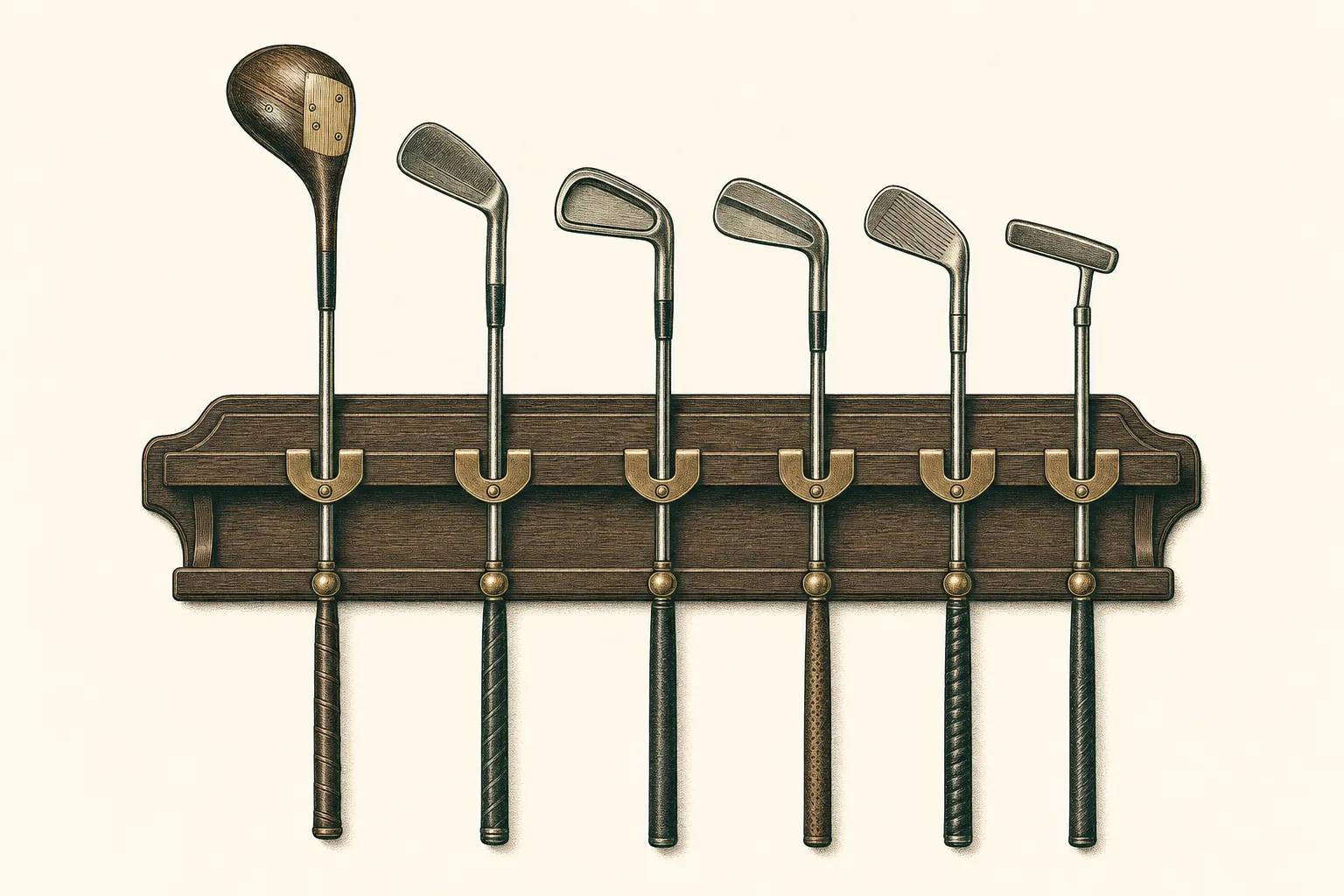
You know the feeling. Someone hands you a club and says "just hit this." The badge is a little worn, the model is a few years — or a few decades — old, and then you flush one and suddenly you get it. This is a guide to those clubs: the icons, the cult classics, the tour weapons, and the gloriously weird, all sourceable as single clubs so you can hit history without buying somebody's whole garage set. Every club below earned its spot with a story.
Good news: most of these are already on the legends rack here at Clubhouse. Ask at the front desk and we’ll pull one for your next bay session — hit history before you ever think about buying it. This doubles as a buying guide, too: every club below is sourceable as a single, so you can chase a legend without buying somebody’s whole garage set.
How the tiers work. Tiers are acquisition strategy, not a quality ranking — some of the best experiences on this list cost less than a dozen ProV1s.
- 🟢 Budget Kings (under $100 used) — the volume tier. Nostalgia bombs and genuine greats that time made cheap.
- 🔵 Modern Legends ($100–200 used) — recent-ish flagships golfers are actively lusting after right now.
- 🟣 Grails (premium used, ~$200+) — coveted high-dollar used finds. Not new-at-retail gear; the thrill is a legend at used money.
About the prices. Prices marked ✓ were verified against live listings (2nd Swing, GlobalGolf, Callaway Pre-Owned, SidelineSwap, eBay) in mid-July 2026 through an adversarial fact-check pass — each claim had to survive three independent verifiers. Unmarked prices are informed market estimates: confirm against sold listings before publishing or buying. All used prices swing with condition and shaft, and retailer asking prices typically run 10–20% above eBay sold prices. One sourcing note from the research: the PGA Value Guide publishes no static per-model prices — its valuations only exist behind an interactive trade-in lookup — so live retailer listings and eBay sold data are the pricing sources of record. ✓
📈 Tier-drift report (July 2026). The market moved since we first drafted this list. Verified moves: TaylorMade SIM2, Ping G425 Max, and Ping G430 Max drivers all moved UP into Grails — every recent flagship driver trades at $200+ across major used retailers. ✓ Meanwhile Titleist's 2026 Vokey SM11 release ($199 new) shoved the SM7/SM8/SM9 down a tier — the SM8 is now a verified Budget-King buy — and Cleveland's RTX-4 and ZipCore have both settled comfortably under $100. ✓ Buy the wedges now; wait patiently on the drivers.
---
🏌️ DRIVERS
🟢 Budget Kings
TaylorMade Burner (2007) / Burner SuperFast 2.0 · est. $40–80 The white-hot seller of the late 2000s and the driver half of America's dads still miss. Ultralight, huge-flying, with that unmistakable hollow thwack. This is the single most requested nostalgia driver in any sim — the club people grab and immediately start telling stories about. Who'll love it: everyone; it's a time machine with a grip.
TaylorMade R7 Quad (2004) · est. $30–60 The driver that invented the tinkering era. Four screw-in weight cartridges let you move ball flight around before "adjustable" was even a category — pros and gearheads went nuts. Twenty years on it still feels like a gadget. Who'll love it: tinkerers and anyone who owned one and never stopped defending it.
TaylorMade R7 TP / R7 425 (2004–05) · est. $30–65 The tour-spec version of the Quad — smaller, spinnier-window, the head serious players actually gamed. A sneaky "better-player bait" club for the rack. Who'll love it: low-handicaps who want to feel what 2005 tour golf felt like.
TaylorMade SLDR (2013) · est. $50–90 The driver that changed how the whole industry talks about launch. Its sliding sole weight and low-forward CG launched the "loft up" revolution — and it remains famously long and famously unforgiving. Hitting it is a fitting lesson disguised as fun. Who'll love it: speed guys chasing that low-spin missile; a humbling for everyone else.
TaylorMade R11 (2011) · est. $50–90 The driver that made white cool overnight. Adjustable sole plate, adjustable hosel, matte white crown against a black face — an aesthetic and adjustability landmark in one. Who'll love it: anyone who golfed through 2011; the "remember when every driver went white?" conversation starts itself.
TaylorMade M2 (2016) · est. $50–90 Possibly the best distance-per-dollar used driver on Earth, and the club a certain Tiger Woods bagged during his early comeback. A decade old and it still hangs with new flagships for most swings. Who'll love it: literally everyone — this might be the best pure value on this entire page.
Titleist 975D / 983K (1999–2003) · est. $30–70 Tiger-era Titleist. The pear-shaped 975D is what the best golf of all time was played with, and the 983K refined it. Small, honest, and gorgeous behind the ball. Who'll love it: better players — hand a modern junior a 260cc head and watch their face.
Callaway Big Bertha (original steel, 1991) · est. $20–50 The howitzer that started the oversized revolution and put "Bertha" into golf's vocabulary forever. A genuine museum piece you can still hit. Who'll love it: everyone — it's the "wait, THIS was oversized?" exhibit.
Callaway Great Big Bertha (titanium, 1995) · est. $25–60 The titanium moonshot. At launch it cost an outrageous $500 in mid-90s money and people paid it gladly. This is where the modern driver era actually begins. Who'll love it: history buffs and anyone whose first "good" driver was a GBB.
Callaway Epic Flash (2019) · est. $70–120 The first AI-designed face in golf — Callaway ran thousands of machine-learning iterations to build Flash Face, paired with Jailbreak bars. A genuine tech-history moment that now costs pocket change. Who'll love it: all comers; it's modern-fast at vintage prices.
Cleveland Launcher (original, 2004) · est. $30–60 The deep-faced sleeper of the mid-2000s and the ancestral grandfather of the Launcher X2 your regulars already rave about. Rack them side by side and let people hit the lineage. Who'll love it: your existing X2 fans, instantly.
Cobra King F9 Speedback (2019) · est. $60–100 CNC-milled face, aero-shaped sole, outrageous speed for the money — the club that made "why does anyone pay full price for drivers?" a mainstream take. Who'll love it: value hunters and swing-speed chasers.
Nike SasQuatch Sumo² (2007) · est. $30–60 The square one. Maximum-MOI geometry, a TING you can hear three bays over, and a face only a physicist could love — and K.J. Choi actually won with it on tour. The single best conversation-starter in golf. Who'll love it: everybody, for exactly one swing, and then five more because it's weirdly straight.
Ping G2 / G10 (2004–07) · est. $30–60 The quiet forgiveness benchmarks of their era while everyone else chased gimmicks. The G10 in particular won everywhere and complained never. Who'll love it: the play-it-straight crowd; Ping people are lifers for a reason.
Ping G400 (2017) · est. $70–110 Ask a gear forum for the best driver of the last decade and G400 answers keep coming. Dense, thudding impact feel, dragonfly crown, and stability that borders on boring — in the best way. Who'll love it: everyone; this is the Budget King most likely to out-hit someone's current gamer.
Persimmon woods (MacGregor / Wilson Staff, pre-1990s) · est. $20–50 Real wood. MyGolfSpy lab-tested persimmon against modern titanium and Golf.com has put them back in pros' hands — the consensus: pured shots hang surprisingly close, mishits get brutally exposed, and everyone walks away grinning. On a launch monitor this is the single most illuminating hitting experience you can offer. Who'll love it: better players especially, but everyone should experience one flushed persimmon in their life.
🔵 Modern Legends
TaylorMade SIM (2020) · est. $110–170 The asymmetric-sole aero era begins. Loved for its shape and speed, and the club that set up SIM2's cult. Who'll love it: modern-gear fans who want 95% of the current flagship experience at 40% of the price.
TaylorMade Stealth (2022) · est. $130–200 The red face. Sixty layers of carbon where titanium used to be — whatever you think of the marketing, "carbonwood" was a genuine materials milestone, and the impact sound is unlike anything else on the rack. Who'll love it: the curious; everyone wants to know what a carbon face feels like.
Titleist TSi3 (2021) · est. $150–200 Aerospace ATI 425 titanium face, tour-preferred shape, adjustable CG track. This was the best players' driver of its generation by acclamation. Who'll love it: better players; it photographs like a tour bay.
Cobra LTDx (2022) · est. $110–170 PWR-COR weighting, zero-CG-twist marketing, real-world speed — the thinking golfer's value flagship with a devoted following. Who'll love it: spec nerds and Rickie loyalists.
Callaway Rogue ST Max (2022) · est. $120–180 The AI-face line matured into pure, dumb forgiveness. One of the easiest-to-live-with drivers of the 2020s. Who'll love it: anyone mid-handicap; it flatters.
🟣 Grails
TaylorMade SIM2 (2021) · ✓ $240–450 used (2nd Swing $239.99–$449.99 across 32 units; Callaway Pre-Owned $252.99; GlobalGolf from ~$245 — zero listings under $200 anywhere) Verified tier-drift: the SIM2 has climbed, not fallen. The forged-ring construction and that milled-back carbon crown made it many players' "best driver TaylorMade ever made," and five years later the used market still agrees. High-end examples carry premium shafts (Ventus Black, Tour AD) that push $450. Who'll love it: everyone — the rare grail that's also easy to hit.
TaylorMade Stealth 2 (2023) · ✓ ~$180–255 secondary / $224–480 retailer-used Second-gen carbonwood with the face fixed and the sound tuned. Note: a widely circulated "$159.99 at Global Golf" price was checked and refuted — the real floor sits near $190 and climbs fast. Who'll love it: modern-gear chasers who want the carbon story without Qi10 money.
TaylorMade Qi10 (2024) · ✓ ~$275–370 used (2nd Swing from $279.99; GlobalGolf $274.99–$369.99) The 10K-MOI era's flagship, now depreciating into reach. Still commands respect — and price. Who'll love it: the "newest thing on the rack" crowd.
Titleist TSR3 (2022) · ✓ ~$250–380 used (2nd Swing $269.99–$512.99; GlobalGolf $214.99–$279.99) The tour-truck staple of the mid-2020s. Speed-ring face tech, gorgeous shape, and a used market that refuses to blink. Who'll love it: better players hunting a legit gamer disguised as a rack club.
Ping G425 Max (2021) · ✓ from ~$245, most $270–440 (2nd Swing $270.99–$439.99) Verified tier-drift UP — we had this pegged as a $130–190 club and the market laughed at us. Golf Monthly still calls it "the epitome of a user-friendly driver," and demand for that forgiveness keeps it in grail money. Who'll love it: everyone; it might be the easiest club on this entire page to hit well.
Ping G430 Max / LST (2023) · ✓ ~$280–400 used (2nd Swing $356.99–$395.99; GlobalGolf $344.99 Very Good) The reigning forgiveness king's recent generation, holding value like a Rolex. A specific "$379.99" point price got refuted in verification — use the range, and expect to pay up. Who'll love it: everyone, which is exactly why it won't get cheaper.
Callaway Paradym / Ai Smoke (2023–24) · est. $250–400 Triple-diamond tour pedigree and AI-designed "smart faces." The most recent Callaways worth grail-hunting as they fall from $600 retail. Who'll love it: Callaway loyalists wanting the newest AI story.
---
🪵 FAIRWAY WOODS
🟢 Budget Kings
TaylorMade RocketBallz (RBZ) 3-wood (2012) · est. $40–80 "It's sooo far." The Speed Pocket slot made the RBZ 3-wood a genuine viral phenomenon — TaylorMade claimed 17 extra yards and, for once, real golfers agreed. Probably the most-requested single fairway wood in used golf. Who'll love it: everyone. This is a must-source; buy two.
TaylorMade V-Steel 3-wood (2003) · est. $30–60 The connoisseur's fairway wood. That scooped V-shaped sole glides off any turf, and tour players kept them in play a decade past their sell-by date. Who'll love it: better players; watch them refuse to give it back.
TaylorMade M2 3-wood (2016) · est. $50–85 Same magic as the M2 driver in fairway form — high launch, stupid distance, zero drama. Who'll love it: anyone who struggles with 3-woods; this one is friendly.
Callaway Steelhead III (2000) · est. $25–55 The warm butter of early-2000s fairway woods. That Steelhead shape earned a fanbase so loyal Callaway resurrected the name in 2016. Who'll love it: feel players and anyone whose dad had one (everyone's dad had one).
Callaway Epic Flash 3-wood (2019) · est. $70–110 The AI face in fairway form — legitimately fast off the deck. Who'll love it: distance-hungry mid-handicaps.
Adams Tight Lies (1996) · est. $20–50 The upside-down trapezoid that saved a company and launched a thousand infomercials. Low profile, shallow face, and it still gets it airborne off tight lies better than clubs made 30 years later. A genuine cult artifact. Who'll love it: everyone who's ever topped a 3-wood, which is everyone.
🆕 Orlimar TriMetal (1998) · est. $20–45 — new addition The other great infomercial fairway wood — copper-tungsten-maraging steel, sold by the million on late-night TV, and secretly good. Golfers of a certain age will gasp. Who'll love it: the nostalgia crowd; instant "my uncle swore by this" reactions.
🆕 Sonartec SS-03 (2003) · est. $40–90 — new addition The tour-van secret. Sonartec fairways showed up uninvited in tour bags all through the early 2000s because they simply worked; the brand died, the cult never did. GolfWRX forums still light up about them. Who'll love it: gearheads — this is deep-cut credibility for your rack.
🔵 Modern Legends
Ping G425 fairway (2021) · est. $120–170 Rock-solid, endlessly recommended, holds value the way Pings do. Who'll love it: everyone; the safe pick that never disappoints.
Titleist TSi2 fairway (2021) · est. $130–190 Tour-caliber launch with a premium feel. Who'll love it: better players building the Titleist corner of the rack.
TaylorMade Stealth 3-wood (2022) · est. $130–190 Modern bomber with the carbon-era look. Who'll love it: distance chasers.
---
🌗 HYBRIDS
🟢 Budget Kings
TaylorMade Rescue Mid / Dual (2003–05) · est. $25–55 The club that named the category — to this day people call every hybrid "a rescue" because of this exact club. Historic and still completely playable. Who'll love it: everyone; it's the Kleenex of golf clubs.
Adams Idea a2 / a3 (2007–09) · est. $25–50 Adams put hybrids in everyone's bag — the Idea line mainstreamed the category for regular golfers and built a cult that outlived the brand. Who'll love it: the long-iron-haters, i.e., most of humanity.
Callaway Big Bertha Heavenwood (2004) · est. $30–60 The 7-wood with a fanbase like a boy band. The name alone sells the swing, and the flight is pure comfort food. Who'll love it: everyone — and 7-woods are having a tour renaissance, so it's newly relevant.
TaylorMade SIM Max Rescue (2020) · est. $60–100 Modern, easy, and everywhere for a reason. Who'll love it: anyone who wants the newest-feeling club in the budget tier.
Ping G410 hybrid (2019) · est. $70–100 The modern benchmark, quietly slipping under $100. Who'll love it: everyone; the do-everything rack hybrid.
🆕 Cobra Baffler (original, 1975) · est. $25–60 — new addition The proto-hybrid. Those twin sole rails were rescuing golfers from bad lies decades before "hybrid" was a word. A history lesson that still digs the ball out. Who'll love it: gear historians and anyone who appreciates an origin story.
🔵 Modern Legends
Ping G425 / G430 hybrid (2021–23) · est. $110–180 The current gold standard, holding value accordingly. Who'll love it: everybody's-second-favorite-club material.
Titleist TSi2 / GT hybrid (2021–24) · est. $120–200 Tour-trusted and buttery. Who'll love it: better players who "don't even like hybrids" — until this one.
---
⛳ IRONS (source the 7-iron)
The 7-iron is golf's universal measuring stick — the first club anyone pulls to see how they're swinging. Every entry here is sourceable as a single.
🟢 Budget Kings
Ping Eye2 (1982) · ✓ $28–50 per single (2nd Swing: 316 in stock, most $31.99–$46.99) The crown jewel of the budget tier and the best story in golf equipment. Launched in fall 1982, the Eye2 is the best-selling club in golf history — it drove Ping's iron market share from 18% in 1985 to 28% by 1988, and its square grooves triggered a legal war that changed golf's rules. Forty-plus years later there are literally hundreds in stock at any given moment for less than a dinner out. ✓ Who'll love it: every single person who walks in. This is the rack's anchor; the most iconic-per-dollar object in golf.
Tommy Armour 845 Silver Scot (1988) · est. $15–40 One of the best-selling iron lines ever and the cavity-back a whole generation learned on. The badge alone triggers memories. Who'll love it: the 40+ crowd, instantly and emotionally.
Callaway X-14 / X-18 (2000–2004) · est. $15–40 Callaway's mega-sellers of the early 2000s — the 360-degree undercut channel put these in millions of bags. Who'll love it: everyone who golfed in the Bush administration.
TaylorMade RAC LT / OS (2003–05) · est. $15–40 The early-2000s staple. "RAC" stood for Relative Amount of Character, which is exactly the energy this rack needs. Who'll love it: millennial golfers reliving their high-school team days.
TaylorMade Burner 2.0 irons (2010) · est. $15–40 The distance-iron darling of its day — big, hot, and shameless. Who'll love it: beginners and bombers; watch a 12-handicap hit their "career 7-iron" with it.
Wilson Staff blades (Dyna-Power era, 1960s–70s) · est. $20–60 More majors have been won with Wilson Staff irons than any other brand, and these butter knives are what did it. Hitting one flush is a religious experience; hitting one thin is a lesson. Who'll love it: purists and better players; the ultimate "they don't make 'em like this" club.
Titleist DCI 962 (1997) · est. $20–50 The thinking player's iron of the late '90s — the DCI black/gold era Titleist built its iron reputation on. Who'll love it: better players of a certain vintage; deep-cut credibility.
Ben Hogan Apex (1990s editions) · est. $25–60 The most romantic name in irons, from the most obsessive perfectionist golf ever produced. The forged feel holds up; the mystique doubles it. Who'll love it: feel players and Hogan disciples — they'll tell you about the Five Lessons unprompted.
Titleist 681 / 690.MB (1990s–2000s) · est. $25–60 Tour blades with Tiger-adjacent lineage (the 681 design family is what he played before Nike). Small, sharp, spectacular. Who'll love it: single-digits who want to feel what tour irons demanded.
Titleist AP2 712/714 (2011–14) · est. $30–60 The forged players' cavity that a young Jordan Spieth rode to world #1. The best "real players' iron" value in used golf. Who'll love it: better players; many will remember lusting after these.
Ping i210 (2018) · est. $35–70 Famously soft for a cast iron and beloved by every fitter who's ever bent one. Who'll love it: the better-player crowd who want modern playability with feel.
Mizuno MP-33 / MP-32 / MP-14 (1990s–2004) · est. $30–70 "Nothing feels like a Mizuno" was built on these. Grain-flow forged in Hiroshima, worshipped on forums for twenty years. The MP-33 may be the most beloved blade of the modern era. Who'll love it: feel obsessives — hand it over and count to three before the sigh.
Mizuno MP-20 / JPX 919 Tour (2018–19) · est. $40–80 The modern chapter of the same religion, with copper underlay in the MP-20 for extra myth. Who'll love it: better players bridging classic feel and modern shaping.
Srixon ZX7 / ZX5 (2021) · est. $50–90 The sneaky-great tour iron — Srixon's forged feel per dollar is the best-kept non-secret in golf. Who'll love it: informed gearheads; nodding-respect club.
🆕 Nike VR Pro Blades (2011) · est. $30–70 per single — new addition Nike quit golf clubs in 2016 and turned everything swooshed into a collector's item. The VR-era blades — the McIlroy/Tiger design lineage — are cult icons with a dead-brand premium still forming. Buy before that premium finishes forming. Who'll love it: Tiger/Rory-era fans and collectors.
🔵 Modern Legends
TaylorMade P790 (2017–present) · ✓ ~$110–190 per single 7-iron (SidelineSwap singles mostly $110–190; new-gen singles listed ~$127) The defining iron of the last decade, verified as the Modern Legends anchor. Hollow body, SpeedFoam-injected, a forged face that flies like a distance iron and looks like a players' club — the formula every manufacturer has spent eight years chasing. Who'll love it: everyone from 20-handicaps to scratch; the most universally raved-about iron of the modern era.
Titleist T100 (2019–present) · est. $90–160 per single The modern tour-forged standard — the most-played iron model on tour for stretches of its life. Who'll love it: better players; instant tour-bay credibility.
Callaway Apex Pro (2021) · est. $90–150 per single The players'-distance darling with forged feel and a tour following. Who'll love it: single-digit players who still want a little help.
Mizuno Pro 223 / JPX 923 Tour (2022) · est. $100–170 per single The current keepers of the Mizuno feel flame. Who'll love it: the same feel cult, newer vintage.
Ping i230 / Blueprint (2022–23) · est. $100–180 per single The beloved players' cavity and Ping's pure blade — the Blueprint being the rare Ping that better players describe as pretty. Who'll love it: Ping loyalists who ball-strike.
TaylorMade P7MC / P7MB (2020–23) · est. $110–180 per single Modern tour blades, gorgeous and uncompromising. Who'll love it: the best ball-strikers in your building.
🟣 Grails
TaylorMade P7TW (2019) · ✓ ~$135+ per club even in Below-Average condition (2nd Swing: worn 3–PW set $1,086.99) The marquee grail. Tiger Woods spent nine design iterations with TaylorMade building his actual blueprint: forged 1025 carbon steel, tungsten weighting, about an hour of CNC milling per head, and the first Milled Grind sole ever applied to an iron. ✓ You are hitting Tiger's personal spec — and singles command a premium over set math, so expect $150–250 for a clean 7-iron. Who'll love it: everyone will want to; elite ball-strikers will actually enjoy it. The ultimate "you have to try this" club.
Miura MB / CB series (boutique, ongoing) · est. $250–450 per single Hand-forged in Himeji by the Miura family — the katana-maker mystique of golf, whispered about in every "purest feel ever" thread. Who'll love it: feel romantics with the ball-striking to cash the check.
Mizuno Pro 241/243/245 (2024) · est. $150–260 per single The current pinnacle of the feel dynasty, still shedding retail price. Who'll love it: modern Mizuno cultists.
Titleist 620 MB (2019) · est. $130–250 per single Modern tour blade, timeless shape. Who'll love it: traditionalists.
PXG 0311 (original, 2015) · est. $150–300 per single Bob Parsons' money-no-object moonshot — hollow-body, TPE-injected, more screws than a hardware store. Whatever you think of the marketing, the original 0311 genuinely moved iron design. Who'll love it: the curious and the contrarian; everyone has an opinion, so let them hit it first.
---
🔧 WEDGES
🟢 Budget Kings
Ping Eye2 pitching wedge / sand wedge (1982) · ✓ ~$40 (2nd Swing, same $28–50 band as the irons) The grooves that went to court. The Eye2's square grooves spun so hard from the rough that they sparked the great groove war — and when the rules changed, Eye2s were famously grandfathered, so pros kept gaming decades-old wedges. Phil Mickelson bagged one in 2010 just to make a point. Who'll love it: everyone; short-game history for two twenties.
Cleveland 588 (1988–present lineage) · est. $20–50 Quite possibly the most beloved wedge shape ever ground — over 15 million sold across its lifetime, and the profile modern Clevelands still chase. Who'll love it: everyone; the platonic ideal of "just a good wedge."
Titleist Vokey Spin Milled (2006–2010s) · est. $30–70 Where the modern Vokey empire's groove obsession went mainstream. Bob Vokey's grinds became golf's default answer to "what wedge should I get?" Who'll love it: better players; the origin story of the SM line below.
Titleist Vokey SM7 / SM8 (2018–20) · ✓ SM8 $50–130 used, most $65–125 (2nd Swing $50.99–$129.99; ~95 SidelineSwap listings) Verified tier-drift DOWN — and it's a gift. The 2026 SM11 release ($199 new) shoved every prior generation down a rung, so genuine modern tour wedges now cost Budget King money. ✓ These are the exact grinds half the tour played five years ago. Who'll love it: everyone; the smartest wedge buy on this page right now.
Cleveland RTX-4 / RTX ZipCore (2018–20) · ✓ RTX-4 $29–93; ZipCore $33–117, most under $110 (2nd Swing live listings) Same story, Cleveland flavor: recent tour-grade spin machines, verified sub-$100. ✓ Who'll love it: everyone; stock several lofts and let people build fantasy wedge setups.
TaylorMade Milled Grind 2 (2020) · est. $40–80 The raw-face era begins — MG2's laser-etched, intentionally-rusting face was built to Tiger's spin standards. Who'll love it: spin chasers and patina appreciators.
🆕 Alien Ultimate Wedge (1990s) · est. $15–40 — new addition The infomercial legend with a flange the size of a spatula. Objectively ridiculous, weirdly effective from sand, and guaranteed to make the whole bay laugh. Who'll love it: everyone, ironically and then sincerely — it really does get out of the bunker.
🔵 Modern Legends
Ping Glide 4.0 (2022) · est. $100–140 Beloved for full-swing consistency and one of the friendliest wedges ever made. Who'll love it: the whole middle of the handicap spectrum.
TaylorMade MG3 / MG4 (2021–23) · est. $100–150 The raw-face lineage matured, with tour wins to show for it. Who'll love it: better players.
Titleist Vokey SM9 / SM10 (2022–24) · SM9 est. $100–140; SM10 tier unverified — check before listing The recent tour standards. Note from the fact-check: a claim placing the SM10 at $154.99 was refuted 0–3, so its exact tier is genuinely in flux as SM11 pressure builds — a live price check is required before you publish a number. Who'll love it: everyone; Vokey is golf's most trusted wedge word.
🟣 Grails
Miura wedges (boutique) · est. $250–350 Hand-ground jewelry for the short game — the fluted-hosel K-Grind is the most recognizable boutique wedge on Earth. Who'll love it: the same romantics as the Miura irons, plus anyone who just wants to hold one.
---
🥅 PUTTERS — all new additions
You asked what was missing: the entire putter category, home to the strongest cult objects in golf.
🟢 Budget Kings
Odyssey White Hot (original insert era, 2000s) · est. $40–80 The most famous face insert ever — that soft tock is one of golf's great sensory memories, and Odyssey has spent 25 years re-releasing it because nobody will let it die. Who'll love it: everyone; muscle memory for millions.
Odyssey 2-Ball (2001) · est. $50–100 The alignment revolution. Two white discs behind the face turned aiming into a cheat code, sold millions, and made mallets mainstream a decade early. Who'll love it: everyone who's ever missed left; the most instantly-understood club on the rack.
Wilson 8802 (1960s design) · est. $30–80 for vintage/reissues The flow-neck blade of legend — Arnold Palmer's weapon, and the template for every "8802-style" putter since. Pure feel, zero forgiveness, maximum romance. Who'll love it: purists; watching someone rediscover a heel-shafted blade is theater.
Ram Zebra (1976) · est. $25–60 The striped mallet that won majors and burned its alignment lines into a generation's memory. Who'll love it: the nostalgia crowd; instant recognition.
🔵 Modern Legends
TaylorMade Spider Tour (2016–17) · est. $100–180 The red (and black) mallet that took over tour Sundays — Jason Day and DJ made the Spider the defining putter silhouette of the 2010s. Who'll love it: modern golfers; it's the mallet they already know from TV.
Ping Anser (1966 design; vintage originals and remakes) · est. $60–200 depending on vintage Sketched by Karsten Solheim on a 78-rpm record sleeve, named by dropping the "w" from "answer," and copied more than any club design in history. Every plumber's-neck blade on Earth is this putter's grandchild. Who'll love it: literally every golfer — most are already putting with its descendant.
🟣 Grails
Scotty Cameron Newport / Newport 2 (1990s–present) · est. $250–450 used; vintage and Tiger-era models far higher The grail of grails. Tiger's Newport 2 GSS won 14 of his 15 majors, and the Scotty collector market (tracked by dedicated price indexes) treats these like watches. Even standard used Newports hold $250+; the aura is the product and the product delivers. Who'll love it: everyone will want a stroke with it. Chain it to the rack.
---
🛸 ODDITIES & CONVERSATION PIECES — new additions
Callaway ERC II (2000) · est. $40–90 The illegal one. Its spring-face COR exceeded USGA limits, Arnold Palmer endorsed it anyway, and golf had a full-blown constitutional crisis. Hitting a genuinely non-conforming driver on a launch monitor — where you can measure the crime — is peak sim-bay content. Who'll love it: everyone; the story sells itself before the swing.
TaylorMade Burner Bubble (1995) · est. $25–60 The copper bubble shaft! A mid-90s icon of go-go gear design that looks like nothing before or since. Who'll love it: '90s kids and design nerds.
---
The Sourcing Playbook
Where the prices live. The PGA Value Guide publishes no browsable per-model prices — everything hides behind its interactive trade-in tool ✓ — so work from 2nd Swing, GlobalGolf, Callaway Pre-Owned, and SidelineSwap listings, then sanity-check against eBay sold filters. Retailer asking prices run roughly 10–20% above what things actually sell for on eBay, which is your negotiating margin.
Buy now: SM7/SM8 and RTX-4/ZipCore wedges (verified down-tier ✓), Ping Eye2 singles (316 in stock at one retailer alone ✓), M2 driver, RBZ 3-wood, and any Nike gear before dead-brand premiums finish forming. Wait / hunt: SIM2, G425 Max, G430, Qi10, TSR3 — all verified $200+ with no softness in sight ✓. Set eBay alerts and pounce on beat-up examples; rack clubs don't need mint faces. Verify before publishing: every price marked est., plus the SM10's tier — roughly 85 of the ~100 clubs here carried estimates that the fact-check pass didn't individually confirm. The verified fifteen anchor the tiers; treat the rest as editorial targets with a price-check step in your CMS workflow.
All verified prices are point-in-time snapshots of live listings, fetched July 14, 2026. Condition, loft, and shaft swing every number.
Related reading: The Icons That Never Die · Sleeper Classics: Great Clubs the Market Forgot · Used Clubs: How Old Is Too Old?

Sleeper Classics: Great Clubs the Market Forgot
The used-club market has a memory problem. Prices track two things — marketing budgets and recency — and neither has much to do with how a club actually performs. A driver that led forgiveness testing in its day gets lapped by nine model cycles and lands in the $100 bin next to genuine junk. A forged iron a Champions Tour pro carried in his own bag sells for less than a single new wedge because the brand never bought enough American ad pages. That inefficiency is your opening.