“Callaway's first AI-designed 'Flash' face for higher ball speed. A strong standard head and a smart used buy.”
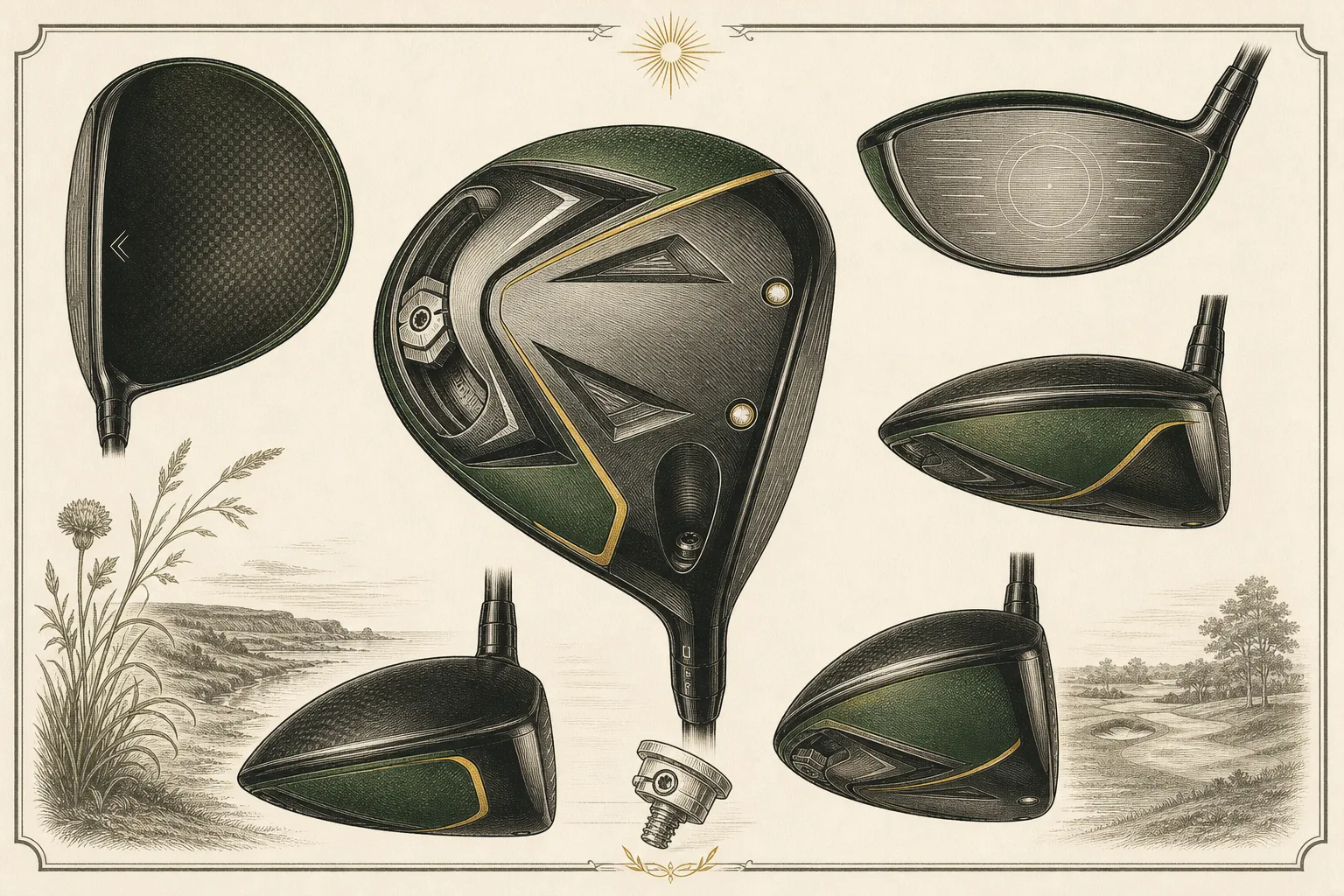
The first driver with a face designed by artificial intelligence. For 2019 Callaway pointed a supercomputer at one question — make the face faster — and let machine learning iterate. It ran ~15,000 virtual face designs (versus the 8-10 a human team would try), converging on 'Flash Face,' a counter-intuitive geometry with some of its THINNEST sections in the middle rather than the usual thick-center/thin-edge pattern. The computation reportedly took a supercomputer running 24/7 for about four weeks (roughly 34 years on a laptop). Flash Face sat on top of Jailbreak bars and a triaxial-carbon crown, and Callaway claimed tour-player ball-speed gains averaging ~1.7 mph. It was a genuine industry first and a marketing landmark, launched at $529.
Notable as a documented industry first — the first known use of AI/machine learning to design a golf clubface — covered by mainstream and specialist media (Golf Digest, MyGolfSpy, Today's Golfer). That milestone gives it lasting significance, but as a recent, high-volume, depreciating driver it is remembered as a technological landmark rather than a scarce or hunted collectible.
A wide fit for mid handicaps and up wanting a fast, forgiving, adjustable 460cc driver; the standard model launches higher with more spin than the Sub Zero, which suits players who need help getting the ball up. Low-spin, higher-speed players should look at the Sub Zero. Like the GBB Epic, it remains a legitimately playable used gamer in 2026, not just a display piece.
Launched January 2019 against TaylorMade's M5/M6 (also touting speed-tuned faces) and Ping's G410, succeeding the Rogue (2018) and preceding the Mavrik. It extended the Epic/Jailbreak line and, crucially, kicked off the AI-designed-face era that Callaway rode through Mavrik, Rogue ST, Paradym and beyond — every later Callaway 'AI face' descends from this one. Modern equivalent: any current AI-face Callaway driver.
Forgiving in standard trim, with the AI face aimed mainly at ball speed rather than MOI. The 460cc head, carbon crown and Jailbreak give solid stability, and Flash Face was tuned to hold speed across a wider face area, which helps off-center strikes. An 8 keeps it in modern game-improvement territory; the low-spin Sub Zero variant trades a little forgiveness for spin control, so the standard Epic Flash is the more forgiving sibling and still trails dedicated 'Max' MOI heads.
Calibrated across the whole catalog — a tour blade scores low here on purpose; it means control, not ease.
A current-generation-adjacent used driver: clean private-party Epic Flash drivers typically sell for roughly $100-160 in 2026 depending on shaft, adjustable hosel and head condition, with premium shafts pushing higher. It depreciates normally; reconditioned-retail listings sit above private-party and reflect grading/warranty rather than any collector premium.
The Legends Rack
The first AI-designed face in golf — Callaway ran thousands of machine-learning iterations to build Flash Face, paired with Jailbreak bars. A genuine tech-history moment that now costs pocket change. Who'll love it: all comers; it's modern-fast at vintage prices.
Who it suitsAll
Reading is one thing — hitting is another. Book a bay and see the numbers for yourself before you buy anywhere.
“Callaway's first AI-designed 'Flash' face for higher ball speed. A strong standard head and a smart used buy.”
The first driver with a face designed by artificial intelligence. For 2019 Callaway pointed a supercomputer at one question — make the face faster — and let machine learning iterate. It ran ~15,000 virtual face designs (versus the 8-10 a human team would try), converging on 'Flash Face,' a counter-intuitive geometry with some of its THINNEST sections in the middle rather than the usual thick-center/thin-edge pattern. The computation reportedly took a supercomputer running 24/7 for about four weeks (roughly 34 years on a laptop). Flash Face sat on top of Jailbreak bars and a triaxial-carbon crown, and Callaway claimed tour-player ball-speed gains averaging ~1.7 mph. It was a genuine industry first and a marketing landmark, launched at $529.
Notable as a documented industry first — the first known use of AI/machine learning to design a golf clubface — covered by mainstream and specialist media (Golf Digest, MyGolfSpy, Today's Golfer). That milestone gives it lasting significance, but as a recent, high-volume, depreciating driver it is remembered as a technological landmark rather than a scarce or hunted collectible.
A wide fit for mid handicaps and up wanting a fast, forgiving, adjustable 460cc driver; the standard model launches higher with more spin than the Sub Zero, which suits players who need help getting the ball up. Low-spin, higher-speed players should look at the Sub Zero. Like the GBB Epic, it remains a legitimately playable used gamer in 2026, not just a display piece.
Launched January 2019 against TaylorMade's M5/M6 (also touting speed-tuned faces) and Ping's G410, succeeding the Rogue (2018) and preceding the Mavrik. It extended the Epic/Jailbreak line and, crucially, kicked off the AI-designed-face era that Callaway rode through Mavrik, Rogue ST, Paradym and beyond — every later Callaway 'AI face' descends from this one. Modern equivalent: any current AI-face Callaway driver.
Forgiving in standard trim, with the AI face aimed mainly at ball speed rather than MOI. The 460cc head, carbon crown and Jailbreak give solid stability, and Flash Face was tuned to hold speed across a wider face area, which helps off-center strikes. An 8 keeps it in modern game-improvement territory; the low-spin Sub Zero variant trades a little forgiveness for spin control, so the standard Epic Flash is the more forgiving sibling and still trails dedicated 'Max' MOI heads.
Calibrated across the whole catalog — a tour blade scores low here on purpose; it means control, not ease.
A current-generation-adjacent used driver: clean private-party Epic Flash drivers typically sell for roughly $100-160 in 2026 depending on shaft, adjustable hosel and head condition, with premium shafts pushing higher. It depreciates normally; reconditioned-retail listings sit above private-party and reflect grading/warranty rather than any collector premium.
The Legends Rack
The first AI-designed face in golf — Callaway ran thousands of machine-learning iterations to build Flash Face, paired with Jailbreak bars. A genuine tech-history moment that now costs pocket change. Who'll love it: all comers; it's modern-fast at vintage prices.
Who it suitsAll
Reading is one thing — hitting is another. Book a bay and see the numbers for yourself before you buy anywhere.