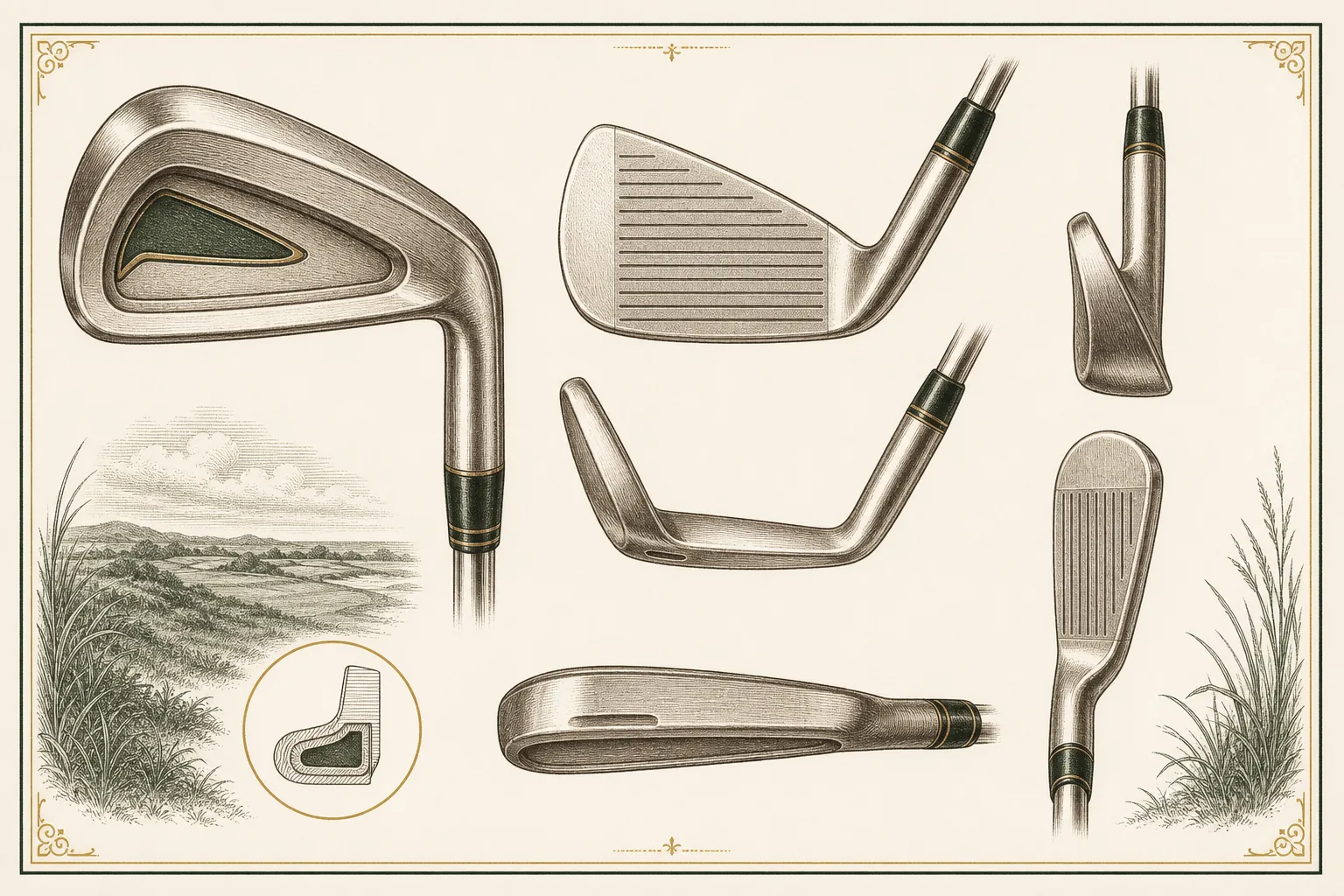
“A classic muscleback blade from Wilson's golden era, forged with the thin soles and small heads of its day. A collector's and purist's iron; very demanding to hit consistently.”
Dyna-Power began life in 1956 when Wilson's earlier 'Dyna-Weighting' concept was reworked around a patented bore-through hosel that ran the shaft down through the head to the sole, freeing up discretionary weight that designers could redistribute for feel and stability. By 1962 Wilson paired that hosel with its 'Fluid Feel' weight removal, and the circa-1969-70 'bullet-back' Dyna-Powered irons represent that lineage at its peak refinement — a forged blade that, per Wilson's own innovation team, was 'fundamentally a game-improvement technology, albeit for a forged blade': mass positioned behind the hitting area with a low, centered CG decades before that became standard iron-design language. The multi-material 1200 series later in the 1970s pushed the same Dyna-Power concept further with mixed materials in the head.
It is actively collected and referenced decades on: GolfWRX 'Classic Clubs' threads specifically identify and date 1970s Dyna-Powered sets, period listings (golfstix, Facebook Golf Club History archive) treat the bullet-back Dyna-Powered as a landmark model, and Wilson explicitly revived its bore-through hosel concept — branded 'Fluid Feel Hosel' — for the modern 2020 Staff Model Blade specifically because of this iron's engineering legacy, not as generic retro branding.
A vintage-collector or low-handicap nostalgia buy today, appealing to players who want the specific forged feel Wilson still markets as its heritage. Not a practical choice for anyone wanting modern forgiveness, distance, or gapping; a mid-to-high handicapper should buy essentially anything made in the last 20 years instead.
Competed through the 1960s-70s against Wilson's own X-31 and Fluid Feel Tour Blade lines as well as period forged blades from MacGregor and Spalding; it was directly succeeded within Wilson's own catalog by the 1985-era Fluid Feel Tour Blades and, decades later, explicitly referenced by the 2020 Staff Model Blade's hosel design.
Forgiving only relative to the pure blades that preceded it: the bore-through hosel and Fluid Feel weight removal push discretionary mass toward a lower, more centered CG than a conventional forged blade of its day, softening the penalty for a mishit. It remains a compact-headed forged blade by modern standards, though — thin strikes and toe hits still cost real distance and feel, and there is no perimeter weighting in the modern cavity-back sense.
Calibrated across the whole catalog — a tour blade scores low here on purpose; it means control, not ease.
Modest but real collector demand: complete vintage sets typically sell for roughly $100-$250 on eBay and specialist vintage-club sites depending on shaft type, wear and completeness of matched serial-numbered sets — meaningfully more than a purely commodity 1970s iron, but far below true blue-chip collectibles.
Reading is one thing — hitting is another. Book a bay and see the numbers for yourself before you buy anywhere.
“A classic muscleback blade from Wilson's golden era, forged with the thin soles and small heads of its day. A collector's and purist's iron; very demanding to hit consistently.”
Dyna-Power began life in 1956 when Wilson's earlier 'Dyna-Weighting' concept was reworked around a patented bore-through hosel that ran the shaft down through the head to the sole, freeing up discretionary weight that designers could redistribute for feel and stability. By 1962 Wilson paired that hosel with its 'Fluid Feel' weight removal, and the circa-1969-70 'bullet-back' Dyna-Powered irons represent that lineage at its peak refinement — a forged blade that, per Wilson's own innovation team, was 'fundamentally a game-improvement technology, albeit for a forged blade': mass positioned behind the hitting area with a low, centered CG decades before that became standard iron-design language. The multi-material 1200 series later in the 1970s pushed the same Dyna-Power concept further with mixed materials in the head.
It is actively collected and referenced decades on: GolfWRX 'Classic Clubs' threads specifically identify and date 1970s Dyna-Powered sets, period listings (golfstix, Facebook Golf Club History archive) treat the bullet-back Dyna-Powered as a landmark model, and Wilson explicitly revived its bore-through hosel concept — branded 'Fluid Feel Hosel' — for the modern 2020 Staff Model Blade specifically because of this iron's engineering legacy, not as generic retro branding.
A vintage-collector or low-handicap nostalgia buy today, appealing to players who want the specific forged feel Wilson still markets as its heritage. Not a practical choice for anyone wanting modern forgiveness, distance, or gapping; a mid-to-high handicapper should buy essentially anything made in the last 20 years instead.
Competed through the 1960s-70s against Wilson's own X-31 and Fluid Feel Tour Blade lines as well as period forged blades from MacGregor and Spalding; it was directly succeeded within Wilson's own catalog by the 1985-era Fluid Feel Tour Blades and, decades later, explicitly referenced by the 2020 Staff Model Blade's hosel design.
Forgiving only relative to the pure blades that preceded it: the bore-through hosel and Fluid Feel weight removal push discretionary mass toward a lower, more centered CG than a conventional forged blade of its day, softening the penalty for a mishit. It remains a compact-headed forged blade by modern standards, though — thin strikes and toe hits still cost real distance and feel, and there is no perimeter weighting in the modern cavity-back sense.
Calibrated across the whole catalog — a tour blade scores low here on purpose; it means control, not ease.
Modest but real collector demand: complete vintage sets typically sell for roughly $100-$250 on eBay and specialist vintage-club sites depending on shaft type, wear and completeness of matched serial-numbered sets — meaningfully more than a purely commodity 1970s iron, but far below true blue-chip collectibles.
Reading is one thing — hitting is another. Book a bay and see the numbers for yourself before you buy anywhere.