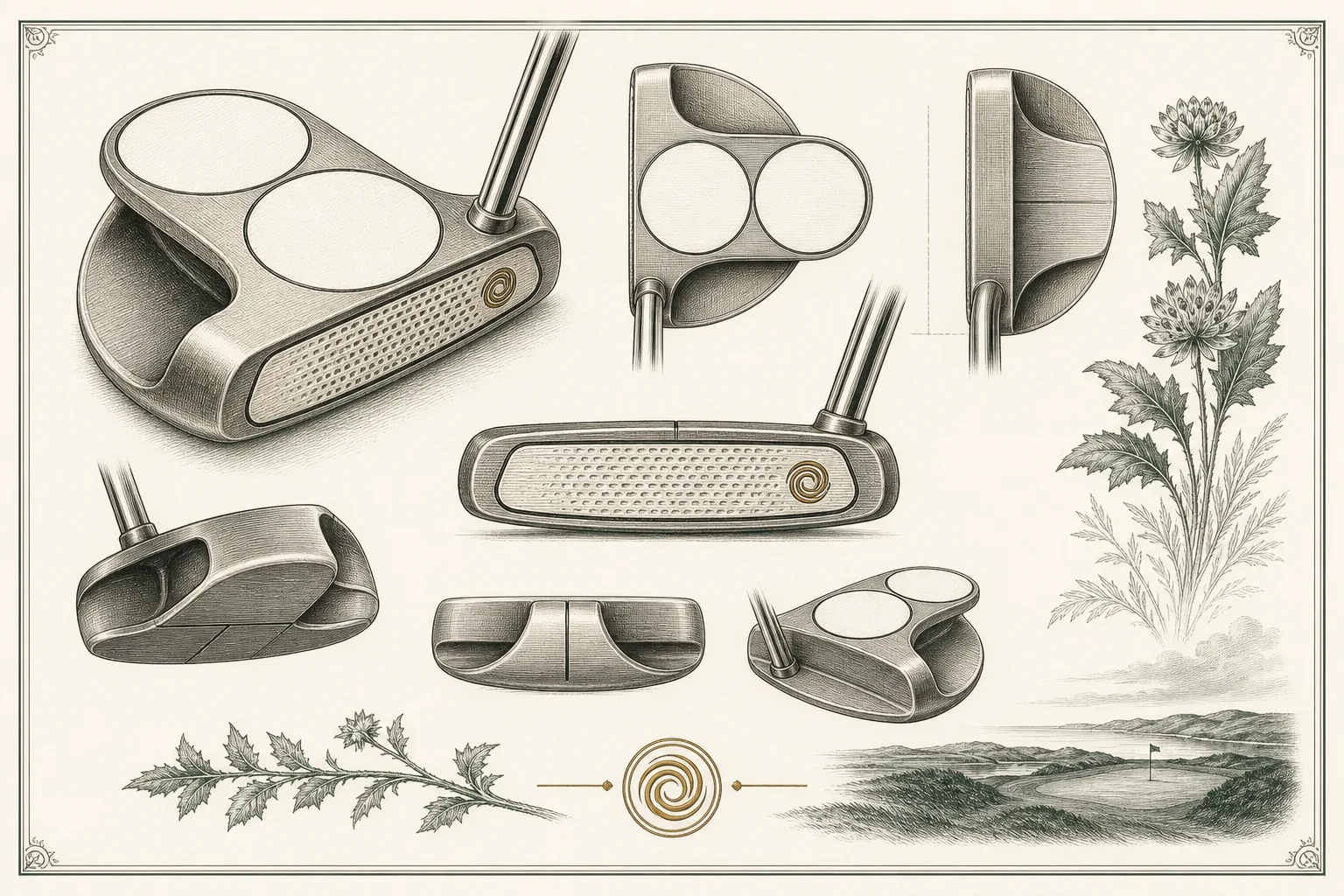
“The original 2001 2-Ball, one of the best-selling putters ever made thanks to its two-circle alignment and soft White Hot insert. Face-balanced for a straight stroke, so it lines up almost by itself. If you struggle to aim, this is the one that started it all.”
The White Hot 2-Ball (2001) is the best-selling putter design in golf history and the club that turned an alignment idea into a phenomenon. Its premise is disarmingly simple: two white golf-ball-sized discs on the mallet head, in line with the ball, so the eye extends the ball back along the target line and squares the face almost automatically. Marry that to Odyssey's beloved two-part urethane White Hot insert — the same material as Callaway's Rule 35 ball cover — and a rounded high-MOI mallet body, and you get a putter that both aims itself and rolls the ball with a soft, skid-free feel. It sold in staggering numbers to amateurs and flooded professional tours, and it endures: Michael Block was still gaming a lead-taped 2001 2-Ball in 2024. Few designs have been copied more.
Icon-level and well documented across independent media: widely reported as the biggest-selling putter model in golf history, accounting at its peak for roughly one in four putters sold, with the 2-Ball alignment concept spawning countless imitators. Its cultural staying power is concrete — PGA Tour coverage of Michael Block gaming an original 2001 2-Ball in 2024, and GolfWRX/2nd Swing 'modern classics' retrospectives. This meets the icon bar on sales, influence and durable cultural footprint, not enthusiast forums alone.
Ideal for players who struggle to aim — which is most amateurs — and who want a stable, near-face-balanced mallet for a straight-back-straight-through stroke. The soft insert favors smoother, faster greens and feel-oriented putters. Who should think twice: players with a strongly arced stroke who want toe hang (the 2-Ball is largely face-balanced), and traditionalists who dislike a large, busy head at address or prefer a blade's compact look.
Launched 2001 off the momentum of the 2000 White Hot line, it detonated the alignment-aid era and forced rivals to answer with their own sightline mallets; it spawned a long 2-Ball dynasty (2-Ball Blade, SRT, XG, Versa, White Hot OG 2-Ball). It arrived as Scotty Cameron milled blades and TaylorMade Rossa competed on feel, and it beat them on aim. A modern equivalent is the White Hot OG 2-Ball or a Ten/triple-track alignment mallet — the whole aim-assist mallet category descends from it.
High putter forgiveness on both axes. The rounded mallet body distributes mass to the perimeter for a high MOI that resists twisting on mishits, and the White Hot insert steadies distance control on off-center strikes — but its signature contribution is aim forgiveness: the two-ball visual makes squaring the face and starting the ball on line dramatically easier for most players, cutting the most common source of missed putts. An 8 reflects strong mechanical stability plus that alignment edge; ultra-wide modern mallets edge it only slightly on raw MOI.
Calibrated across the whole catalog — a tour blade scores low here on purpose; it means control, not ease.
Plentiful and cheap for such a famous club: realistic private-party value in 2026 is roughly $40-$90 for a clean original 2-Ball, with pristine inserts and popular lengths at the top; yellowed or worn inserts and refinished heads pull it down. Reconditioned-retail listings can show more but reflect grading and warranty. It sells cheap because millions were made, not because it is unloved — an outstanding cost-per-alignment-help buy and a genuine collector's touchstone.
The Legends Rack
The alignment revolution. Two white discs behind the face turned aiming into a cheat code, sold millions, and made mallets mainstream a decade early. Who'll love it: everyone who's ever missed left; the most instantly-understood club on the rack.
Who it suitsAll
Reading is one thing — hitting is another. Book a bay and see the numbers for yourself before you buy anywhere.
“The original 2001 2-Ball, one of the best-selling putters ever made thanks to its two-circle alignment and soft White Hot insert. Face-balanced for a straight stroke, so it lines up almost by itself. If you struggle to aim, this is the one that started it all.”
The White Hot 2-Ball (2001) is the best-selling putter design in golf history and the club that turned an alignment idea into a phenomenon. Its premise is disarmingly simple: two white golf-ball-sized discs on the mallet head, in line with the ball, so the eye extends the ball back along the target line and squares the face almost automatically. Marry that to Odyssey's beloved two-part urethane White Hot insert — the same material as Callaway's Rule 35 ball cover — and a rounded high-MOI mallet body, and you get a putter that both aims itself and rolls the ball with a soft, skid-free feel. It sold in staggering numbers to amateurs and flooded professional tours, and it endures: Michael Block was still gaming a lead-taped 2001 2-Ball in 2024. Few designs have been copied more.
Icon-level and well documented across independent media: widely reported as the biggest-selling putter model in golf history, accounting at its peak for roughly one in four putters sold, with the 2-Ball alignment concept spawning countless imitators. Its cultural staying power is concrete — PGA Tour coverage of Michael Block gaming an original 2001 2-Ball in 2024, and GolfWRX/2nd Swing 'modern classics' retrospectives. This meets the icon bar on sales, influence and durable cultural footprint, not enthusiast forums alone.
Ideal for players who struggle to aim — which is most amateurs — and who want a stable, near-face-balanced mallet for a straight-back-straight-through stroke. The soft insert favors smoother, faster greens and feel-oriented putters. Who should think twice: players with a strongly arced stroke who want toe hang (the 2-Ball is largely face-balanced), and traditionalists who dislike a large, busy head at address or prefer a blade's compact look.
Launched 2001 off the momentum of the 2000 White Hot line, it detonated the alignment-aid era and forced rivals to answer with their own sightline mallets; it spawned a long 2-Ball dynasty (2-Ball Blade, SRT, XG, Versa, White Hot OG 2-Ball). It arrived as Scotty Cameron milled blades and TaylorMade Rossa competed on feel, and it beat them on aim. A modern equivalent is the White Hot OG 2-Ball or a Ten/triple-track alignment mallet — the whole aim-assist mallet category descends from it.
High putter forgiveness on both axes. The rounded mallet body distributes mass to the perimeter for a high MOI that resists twisting on mishits, and the White Hot insert steadies distance control on off-center strikes — but its signature contribution is aim forgiveness: the two-ball visual makes squaring the face and starting the ball on line dramatically easier for most players, cutting the most common source of missed putts. An 8 reflects strong mechanical stability plus that alignment edge; ultra-wide modern mallets edge it only slightly on raw MOI.
Calibrated across the whole catalog — a tour blade scores low here on purpose; it means control, not ease.
Plentiful and cheap for such a famous club: realistic private-party value in 2026 is roughly $40-$90 for a clean original 2-Ball, with pristine inserts and popular lengths at the top; yellowed or worn inserts and refinished heads pull it down. Reconditioned-retail listings can show more but reflect grading and warranty. It sells cheap because millions were made, not because it is unloved — an outstanding cost-per-alignment-help buy and a genuine collector's touchstone.
The Legends Rack
The alignment revolution. Two white discs behind the face turned aiming into a cheat code, sold millions, and made mallets mainstream a decade early. Who'll love it: everyone who's ever missed left; the most instantly-understood club on the rack.
Who it suitsAll
Reading is one thing — hitting is another. Book a bay and see the numbers for yourself before you buy anywhere.