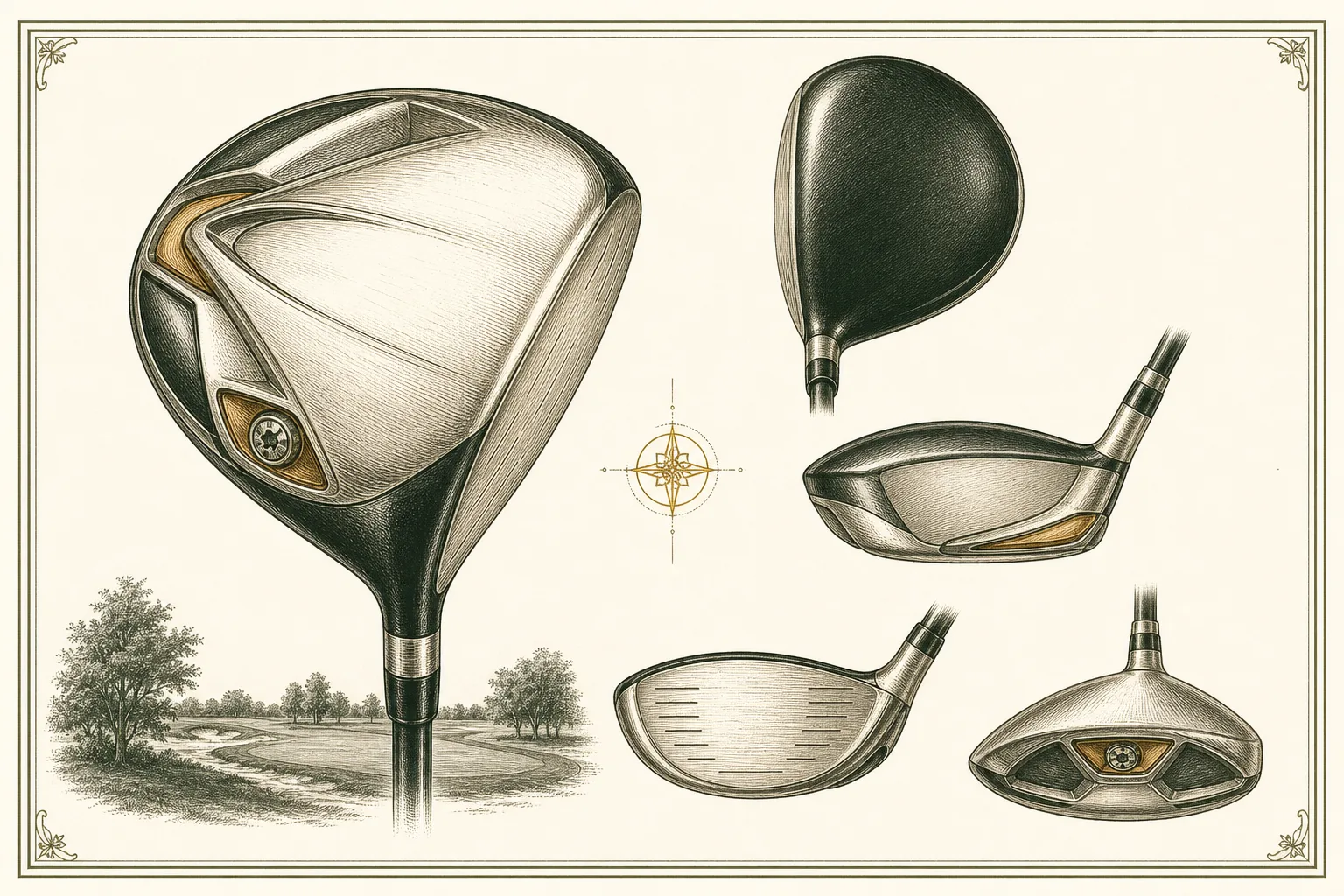
Original standard r7 movable-weight driver.
“The club that launched movable-weight fitting industry-wide - six launch conditions from four TLC weights. Confirmed 400cc head and M.A.S.² 7-65 stock shaft via TaylorMade's own spec sheet. A genuine landmark, but tiny and unforgiving by modern standards.”
The r7 Quad is the driver that put movable weight technology on the map. TaylorMade's own spec sheet documents four TLC ports and cartridges totaling 24 grams in a 400-410cc titanium head, letting a player or fitter redistribute mass among the ports to build one of six distinct launch/spin/curvature combinations without buying a second club or taping lead to the sole. Vijay Singh gamed a 10.5-degree r7 Quad through his record 2004 season — nine wins, a then-record $10.9 million in earnings, and PGA Tour/PGA of America Player of the Year — cementing its reputation before a full season had passed. Contemporary reviews called it a preview of where drivers were headed; two decades later, TaylorMade revived the concept with a nostalgia-driven r7 Quad Mini release.
GolfWRX forum members still refer to it by name as 'the classic TaylorMade r7 Quad TP' when comparing it to modern drivers, and MyGolfSpy built an entire retro product launch — the r7 Quad Mini — around trading on the original's nostalgia and reputation, evidence that TaylorMade itself judged the demand for the name to be real and durable rather than a passing trend. It is also credited, independent of any single tour result, with launching the movable-weight category that every major driver maker adopted within a few years.
Better players (roughly 90-105+ mph swing speed) who want genuine fitting-grade control over launch, spin and shot shape from a compact, tour-proportioned head. High-handicappers or anyone who mis-hits the driver often should look at the larger-headed r7 460/SuperQuad instead — the r7 Quad's small face and shallow margin for error will punish, not forgive, an inconsistent strike.
Launched in 2004 as TaylorMade's flagship, it predates the 460cc-max-legal era and TaylorMade's own larger-headed r7 460/SuperQuad follow-ups (2005-2007) that applied the same movable-weight idea to a bigger, more forgiving head. Every subsequent 'adjustable weight' driver from Callaway (FT-5), Nike (SasQuatch Sumo2) and Titleist trace their commercial logic back to the r7 Quad proving the concept sold. A modern equivalent in spirit — full-swing weight/CG adjustability sold as the headline feature — is something like a Cobra Darkspeed or Titleist GT4 with sliding-weight tracks.
By 2020s standards this is a small, unforgiving players' head — TaylorMade's spec sheet puts it at roughly 400-410cc, well under the modern 460cc legal maximum, with a compact, deep-faced profile built for better ball-strikers rather than mis-hit insurance. The four TLC weights let a fitter dial in launch and shape, but that is precision tuning for a skilled swing, not the wide margin-for-error a max-forgiveness head provides; period reviewers also noted the weights could rattle with age, a small but real durability quirk of the mechanism.
Calibrated across the whole catalog — a tour blade scores low here on purpose; it means control, not ease.
Realistic 2026 private-party value runs roughly $40-90 for a clean example with stock M.A.S.² 7-65 shaft on eBay/SidelineSwap; the nostalgia and historical significance keep it from bottoming out the way an equally old, less remembered driver would, but it is not a high-dollar collectible — value is driven by playable condition and the occasional buyer chasing the name.
The Legends Rack
The driver that invented the tinkering era. Four screw-in weight cartridges let you move ball flight around before "adjustable" was even a category — pros and gearheads went nuts. Twenty years on it still feels like a gadget. Who'll love it: tinkerers and anyone who owned one and never stopped defending it.
Who it suitsAll
Reading is one thing — hitting is another. Book a bay and see the numbers for yourself before you buy anywhere.
Original standard r7 movable-weight driver.
“The club that launched movable-weight fitting industry-wide - six launch conditions from four TLC weights. Confirmed 400cc head and M.A.S.² 7-65 stock shaft via TaylorMade's own spec sheet. A genuine landmark, but tiny and unforgiving by modern standards.”
The r7 Quad is the driver that put movable weight technology on the map. TaylorMade's own spec sheet documents four TLC ports and cartridges totaling 24 grams in a 400-410cc titanium head, letting a player or fitter redistribute mass among the ports to build one of six distinct launch/spin/curvature combinations without buying a second club or taping lead to the sole. Vijay Singh gamed a 10.5-degree r7 Quad through his record 2004 season — nine wins, a then-record $10.9 million in earnings, and PGA Tour/PGA of America Player of the Year — cementing its reputation before a full season had passed. Contemporary reviews called it a preview of where drivers were headed; two decades later, TaylorMade revived the concept with a nostalgia-driven r7 Quad Mini release.
GolfWRX forum members still refer to it by name as 'the classic TaylorMade r7 Quad TP' when comparing it to modern drivers, and MyGolfSpy built an entire retro product launch — the r7 Quad Mini — around trading on the original's nostalgia and reputation, evidence that TaylorMade itself judged the demand for the name to be real and durable rather than a passing trend. It is also credited, independent of any single tour result, with launching the movable-weight category that every major driver maker adopted within a few years.
Better players (roughly 90-105+ mph swing speed) who want genuine fitting-grade control over launch, spin and shot shape from a compact, tour-proportioned head. High-handicappers or anyone who mis-hits the driver often should look at the larger-headed r7 460/SuperQuad instead — the r7 Quad's small face and shallow margin for error will punish, not forgive, an inconsistent strike.
Launched in 2004 as TaylorMade's flagship, it predates the 460cc-max-legal era and TaylorMade's own larger-headed r7 460/SuperQuad follow-ups (2005-2007) that applied the same movable-weight idea to a bigger, more forgiving head. Every subsequent 'adjustable weight' driver from Callaway (FT-5), Nike (SasQuatch Sumo2) and Titleist trace their commercial logic back to the r7 Quad proving the concept sold. A modern equivalent in spirit — full-swing weight/CG adjustability sold as the headline feature — is something like a Cobra Darkspeed or Titleist GT4 with sliding-weight tracks.
By 2020s standards this is a small, unforgiving players' head — TaylorMade's spec sheet puts it at roughly 400-410cc, well under the modern 460cc legal maximum, with a compact, deep-faced profile built for better ball-strikers rather than mis-hit insurance. The four TLC weights let a fitter dial in launch and shape, but that is precision tuning for a skilled swing, not the wide margin-for-error a max-forgiveness head provides; period reviewers also noted the weights could rattle with age, a small but real durability quirk of the mechanism.
Calibrated across the whole catalog — a tour blade scores low here on purpose; it means control, not ease.
Realistic 2026 private-party value runs roughly $40-90 for a clean example with stock M.A.S.² 7-65 shaft on eBay/SidelineSwap; the nostalgia and historical significance keep it from bottoming out the way an equally old, less remembered driver would, but it is not a high-dollar collectible — value is driven by playable condition and the occasional buyer chasing the name.
The Legends Rack
The driver that invented the tinkering era. Four screw-in weight cartridges let you move ball flight around before "adjustable" was even a category — pros and gearheads went nuts. Twenty years on it still feels like a gadget. Who'll love it: tinkerers and anyone who owned one and never stopped defending it.
Who it suitsAll
Reading is one thing — hitting is another. Book a bay and see the numbers for yourself before you buy anywhere.