Hit 16 times in The Clubhouse
“The original SIM: aerodynamic head with a forward sliding weight for lower spin off faster swings. It was TaylorMade's flagship for exactly one year before SIM2 took over in 2021 - used copies are now firmly bargain territory. Slower swingers should still look at SIM Max instead.”
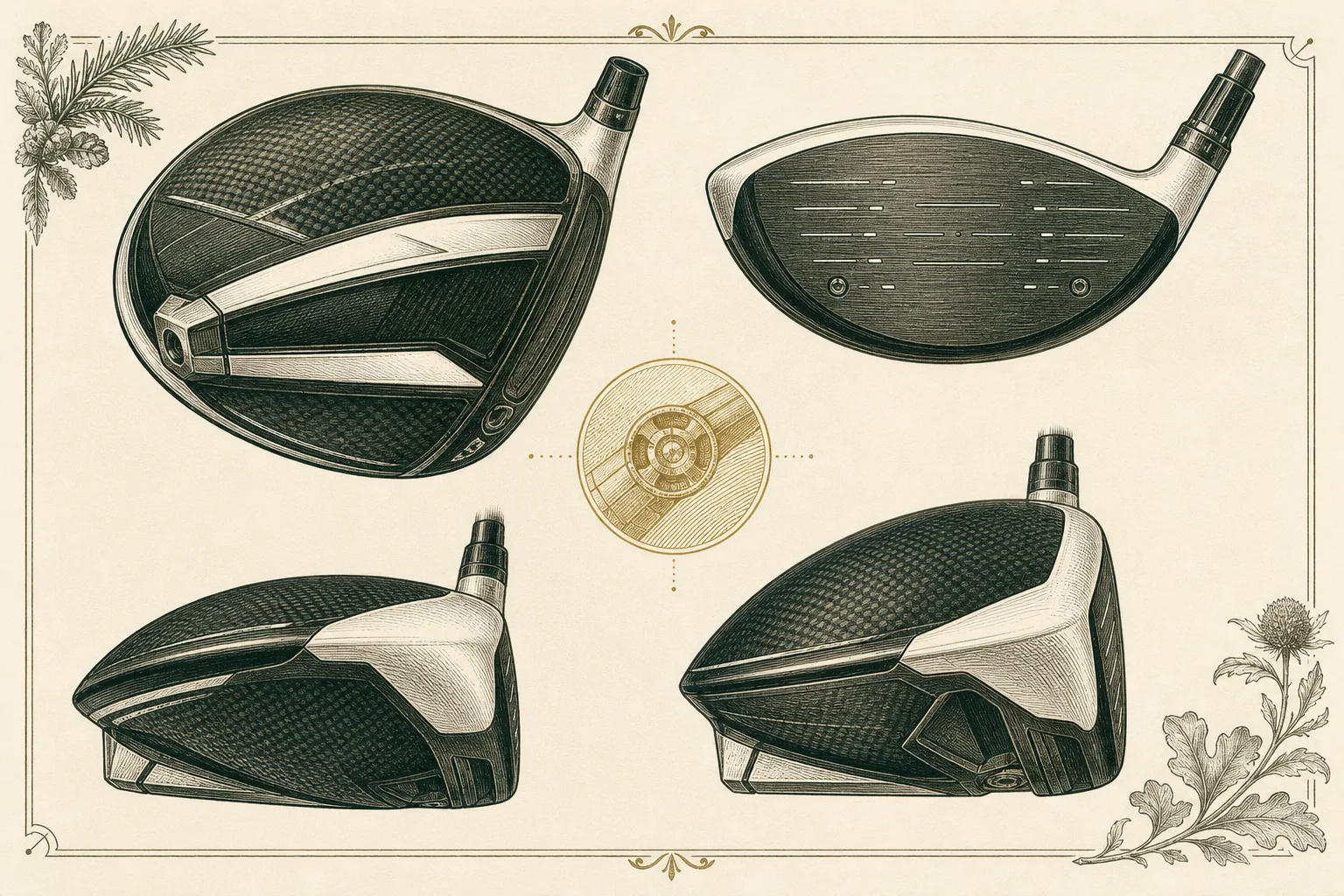
SIM ('Shape In Motion') was TaylorMade's 2020 driver platform reset after the M-series, built around an asymmetric, heel-to-toe rotated Inertia Generator on the sole -- a visibly tilted weight pod designed to reduce drag through the swing arc rather than just add mass. It kept a single sliding weight track (unlike the dual-track M5) for players who wanted to bias draw or fade without a full custom-fit process, paired with second-generation Twist Face for off-center forgiveness. It launched as TaylorMade's tour-preferred model in the family -- Rory McIlroy put it in play -- positioned as the low-spin, shot-shaping option ahead of the more forgiving SIM Max and SIM Max D siblings.
Not a cult classic -- it was a normal one-year flagship in TaylorMade's annual driver cycle, replaced by SIM2 in 2021 -- but it holds real historical weight as the platform that formally ended the M-series naming and introduced the rotated Inertia Generator shape TaylorMade carried into SIM2 and referenced for years after. Tour adoption (Rory McIlroy and other TaylorMade staffers) is documented, not folklore.
Best for lower-handicap, faster-swing-speed players who want to actively bias shot shape with the sliding weight and prefer a smaller, more workable face. A higher-handicap player chasing forgiveness and simplicity is better fit by the SIM Max, and a player fighting a slice is better fit by the SIM Max D.
Launched as TaylorMade's flagship for 2020 against Callaway's Mavrik and Ping's G410/G710 drivers, and inside TaylorMade's own lineup sat above SIM Max and SIM Max D on the workability-vs-forgiveness spectrum. Replaced after one year by SIM2 (2021), continuing TaylorMade's established annual refresh pace; a modern equivalent is TaylorMade's current flagship, which offers meaningfully more forgiveness from the same basic multi-material, movable-weight approach.
The rotated Inertia Generator and second-gen Twist Face genuinely help off-center forgiveness versus TaylorMade's late M-series drivers, and MyGolfSpy testing found it more forgiving than the M5 with solid ball speed retention on mis-hits. But within the SIM family itself it's the least forgiving of the three: a smaller face and single sliding weight (versus the Max's larger face and extra fixed back weight) trade some MOI for shot-shaping control and lower spin, which is exactly why TaylorMade built the higher-MOI Max and Max D for players who wanted more forgiveness.
Calibrated across the whole catalog — a tour blade scores low here on purpose; it means control, not ease.
A 2020 flagship driver six years on the used market typically sells for roughly $110-$170 in 2026 depending on shaft and headcover/tool completeness; reconditioned-retail listings run higher (often $150-$220) for graded, warrantied stock. It has depreciated the way all annual-cycle TaylorMade drivers do -- functional value only, no collector premium.
The Legends Rack
The asymmetric-sole aero era begins. Loved for its shape and speed, and the club that set up SIM2's cult. Who'll love it: modern-gear fans who want 95% of the current flagship experience at 40% of the price.
Who it suitsAll
Reading is one thing — hitting is another. Book a bay and see the numbers for yourself before you buy anywhere.
Hit 16 times in The Clubhouse
“The original SIM: aerodynamic head with a forward sliding weight for lower spin off faster swings. It was TaylorMade's flagship for exactly one year before SIM2 took over in 2021 - used copies are now firmly bargain territory. Slower swingers should still look at SIM Max instead.”
SIM ('Shape In Motion') was TaylorMade's 2020 driver platform reset after the M-series, built around an asymmetric, heel-to-toe rotated Inertia Generator on the sole -- a visibly tilted weight pod designed to reduce drag through the swing arc rather than just add mass. It kept a single sliding weight track (unlike the dual-track M5) for players who wanted to bias draw or fade without a full custom-fit process, paired with second-generation Twist Face for off-center forgiveness. It launched as TaylorMade's tour-preferred model in the family -- Rory McIlroy put it in play -- positioned as the low-spin, shot-shaping option ahead of the more forgiving SIM Max and SIM Max D siblings.
Not a cult classic -- it was a normal one-year flagship in TaylorMade's annual driver cycle, replaced by SIM2 in 2021 -- but it holds real historical weight as the platform that formally ended the M-series naming and introduced the rotated Inertia Generator shape TaylorMade carried into SIM2 and referenced for years after. Tour adoption (Rory McIlroy and other TaylorMade staffers) is documented, not folklore.
Best for lower-handicap, faster-swing-speed players who want to actively bias shot shape with the sliding weight and prefer a smaller, more workable face. A higher-handicap player chasing forgiveness and simplicity is better fit by the SIM Max, and a player fighting a slice is better fit by the SIM Max D.
Launched as TaylorMade's flagship for 2020 against Callaway's Mavrik and Ping's G410/G710 drivers, and inside TaylorMade's own lineup sat above SIM Max and SIM Max D on the workability-vs-forgiveness spectrum. Replaced after one year by SIM2 (2021), continuing TaylorMade's established annual refresh pace; a modern equivalent is TaylorMade's current flagship, which offers meaningfully more forgiveness from the same basic multi-material, movable-weight approach.
The rotated Inertia Generator and second-gen Twist Face genuinely help off-center forgiveness versus TaylorMade's late M-series drivers, and MyGolfSpy testing found it more forgiving than the M5 with solid ball speed retention on mis-hits. But within the SIM family itself it's the least forgiving of the three: a smaller face and single sliding weight (versus the Max's larger face and extra fixed back weight) trade some MOI for shot-shaping control and lower spin, which is exactly why TaylorMade built the higher-MOI Max and Max D for players who wanted more forgiveness.
Calibrated across the whole catalog — a tour blade scores low here on purpose; it means control, not ease.
A 2020 flagship driver six years on the used market typically sells for roughly $110-$170 in 2026 depending on shaft and headcover/tool completeness; reconditioned-retail listings run higher (often $150-$220) for graded, warrantied stock. It has depreciated the way all annual-cycle TaylorMade drivers do -- functional value only, no collector premium.
The Legends Rack
The asymmetric-sole aero era begins. Loved for its shape and speed, and the club that set up SIM2's cult. Who'll love it: modern-gear fans who want 95% of the current flagship experience at 40% of the price.
Who it suitsAll
Reading is one thing — hitting is another. Book a bay and see the numbers for yourself before you buy anywhere.