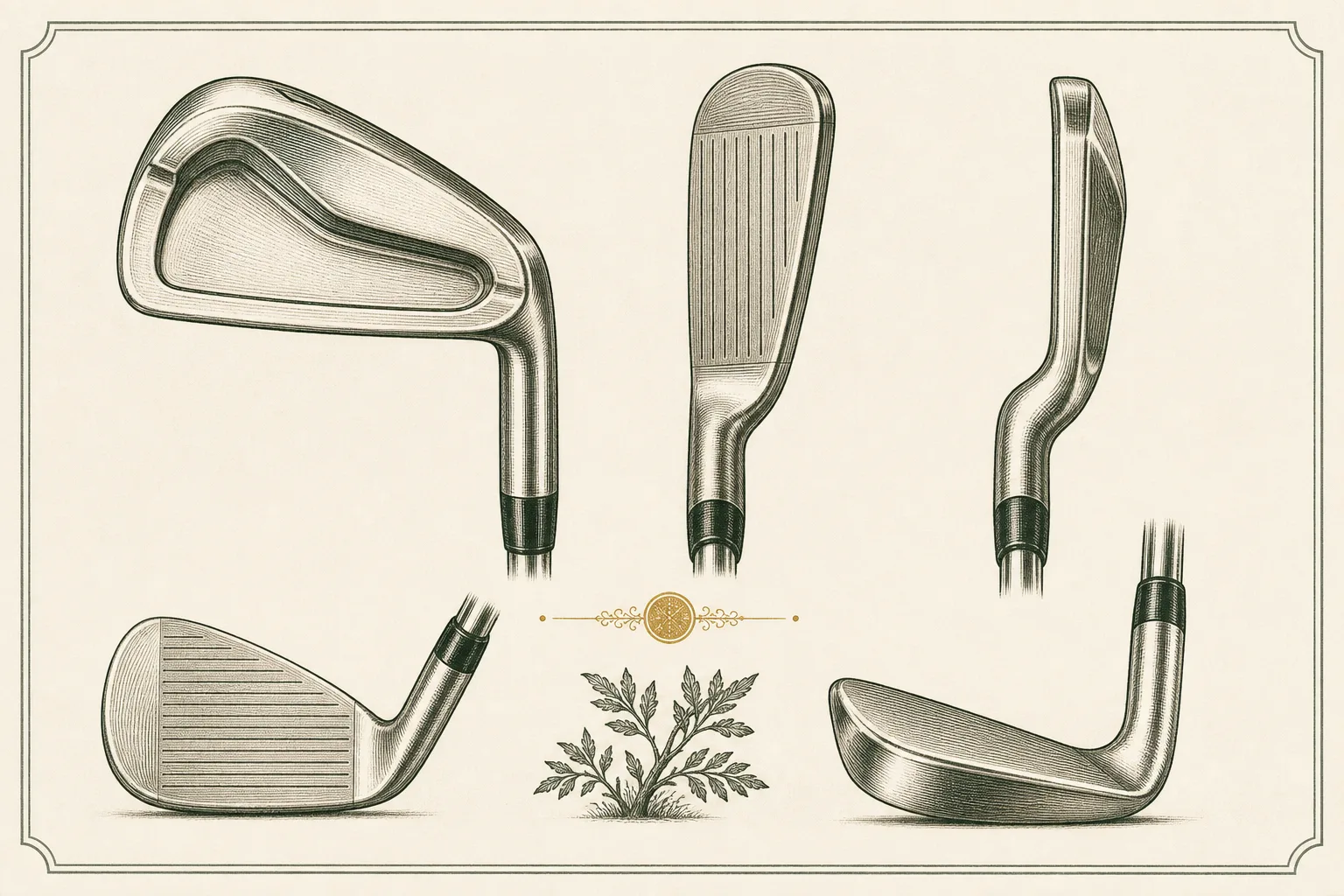
“A classic muscleback blade with CG pulled slightly lower than its stablemates to make the ball easier to get airborne without sacrificing workability. Still rung-4 - the low CG doesn't change who should be playing it.”
The MP-33 (2002) was Mizuno's first CAD-designed muscle-back blade, developed from feedback pooled across the PGA, European and Japan tours to make the definitive modern Mizuno blade. Grain Flow Forged from a single billet of 1025 mild carbon steel in Hiroshima, it visually echoed the earlier MS-3 blade but added a computer-optimized sweet spot, a rolled leading edge, cambered mid-sole and beveled trailing edge for cleaner turf interaction. Its defining trick for a pure blade was a slightly lower center of gravity than rival muscle-backs, getting the ball airborne a touch easier without sacrificing the dense, 'buttery' feel Mizuno built its name on. It had one of the longest runs in Mizuno iron history, in the line more than four years and available on custom order long after.
Two decades on it is still named among the greatest Mizuno blades ever made in GolfWRX's 'greatest Mizuno blade irons of all time' roundup, and reviewers keep writing 'X years too late' retrospectives (Golfing Engineer, MyGolfSpy forum) about tracking down clean sets. It carries a strong user rating and is tied to a future World No. 1 (Luke Donald played it early in his career), which keeps feel-chasers hunting it down rather than letting sets sit.
Scratch-to-low single-digit ball-strikers (roughly 0-6) with 85+ mph iron speed who want maximum workability and premium blade feel and who reliably find the center of the face. Anyone chasing forgiveness, distance or higher launch should avoid it entirely — a players-cavity or game-improvement iron will be far kinder.
At launch it slotted at the top of the MP range and competed with Titleist's 681/690.MB blades, the Callaway/Hogan forged blades and TaylorMade's forged players' irons of the early 2000s. It was succeeded conceptually by the MP-37 and later MP-67 blades, and its 'lower-CG blade' brief lives on in today's Mizuno Pro 221.
This is a true muscle-back blade and it plays like one: thin sole, minimal offset, compact head and a small sweet spot that punishes thin and toe strikes with lost distance and harsh feedback. Its one concession to playability is a CG set slightly lower than competing blades of its era, which helps launch but does not add meaningful off-center forgiveness. A 3 places it just above the most penal blades — forgiving only in the narrow sense of 'easier to launch than most blades,' not forgiving in any absolute sense.
Calibrated across the whole catalog — a tour blade scores low here on purpose; it means control, not ease.
Clean forged blades from this era hold value better than cast game-improvement sets because of steady feel-chaser demand. Realistic 2026 private-party value for a clean 3-PW or 4-PW set runs roughly $150-350 depending on shaft, flex and groove/face wear; rust on the raw-ish carbon steel and worn grooves pull it toward the bottom of that range, while clean examples with premium shafts sit at the top. Reconditioned-retail listings (2nd Swing, Golfbidder) will show more because those are graded/warrantied store prices, not what a set trades for privately.
The Legends Rack
"Nothing feels like a Mizuno" was built on these. Grain-flow forged in Hiroshima, worshipped on forums for twenty years. The MP-33 may be the most beloved blade of the modern era. Who'll love it: feel obsessives — hand it over and count to three before the sigh.
Who it suitsBetter players
Reading is one thing — hitting is another. Book a bay and see the numbers for yourself before you buy anywhere.
“A classic muscleback blade with CG pulled slightly lower than its stablemates to make the ball easier to get airborne without sacrificing workability. Still rung-4 - the low CG doesn't change who should be playing it.”
The MP-33 (2002) was Mizuno's first CAD-designed muscle-back blade, developed from feedback pooled across the PGA, European and Japan tours to make the definitive modern Mizuno blade. Grain Flow Forged from a single billet of 1025 mild carbon steel in Hiroshima, it visually echoed the earlier MS-3 blade but added a computer-optimized sweet spot, a rolled leading edge, cambered mid-sole and beveled trailing edge for cleaner turf interaction. Its defining trick for a pure blade was a slightly lower center of gravity than rival muscle-backs, getting the ball airborne a touch easier without sacrificing the dense, 'buttery' feel Mizuno built its name on. It had one of the longest runs in Mizuno iron history, in the line more than four years and available on custom order long after.
Two decades on it is still named among the greatest Mizuno blades ever made in GolfWRX's 'greatest Mizuno blade irons of all time' roundup, and reviewers keep writing 'X years too late' retrospectives (Golfing Engineer, MyGolfSpy forum) about tracking down clean sets. It carries a strong user rating and is tied to a future World No. 1 (Luke Donald played it early in his career), which keeps feel-chasers hunting it down rather than letting sets sit.
Scratch-to-low single-digit ball-strikers (roughly 0-6) with 85+ mph iron speed who want maximum workability and premium blade feel and who reliably find the center of the face. Anyone chasing forgiveness, distance or higher launch should avoid it entirely — a players-cavity or game-improvement iron will be far kinder.
At launch it slotted at the top of the MP range and competed with Titleist's 681/690.MB blades, the Callaway/Hogan forged blades and TaylorMade's forged players' irons of the early 2000s. It was succeeded conceptually by the MP-37 and later MP-67 blades, and its 'lower-CG blade' brief lives on in today's Mizuno Pro 221.
This is a true muscle-back blade and it plays like one: thin sole, minimal offset, compact head and a small sweet spot that punishes thin and toe strikes with lost distance and harsh feedback. Its one concession to playability is a CG set slightly lower than competing blades of its era, which helps launch but does not add meaningful off-center forgiveness. A 3 places it just above the most penal blades — forgiving only in the narrow sense of 'easier to launch than most blades,' not forgiving in any absolute sense.
Calibrated across the whole catalog — a tour blade scores low here on purpose; it means control, not ease.
Clean forged blades from this era hold value better than cast game-improvement sets because of steady feel-chaser demand. Realistic 2026 private-party value for a clean 3-PW or 4-PW set runs roughly $150-350 depending on shaft, flex and groove/face wear; rust on the raw-ish carbon steel and worn grooves pull it toward the bottom of that range, while clean examples with premium shafts sit at the top. Reconditioned-retail listings (2nd Swing, Golfbidder) will show more because those are graded/warrantied store prices, not what a set trades for privately.
The Legends Rack
"Nothing feels like a Mizuno" was built on these. Grain-flow forged in Hiroshima, worshipped on forums for twenty years. The MP-33 may be the most beloved blade of the modern era. Who'll love it: feel obsessives — hand it over and count to three before the sigh.
Who it suitsBetter players
Reading is one thing — hitting is another. Book a bay and see the numbers for yourself before you buy anywhere.