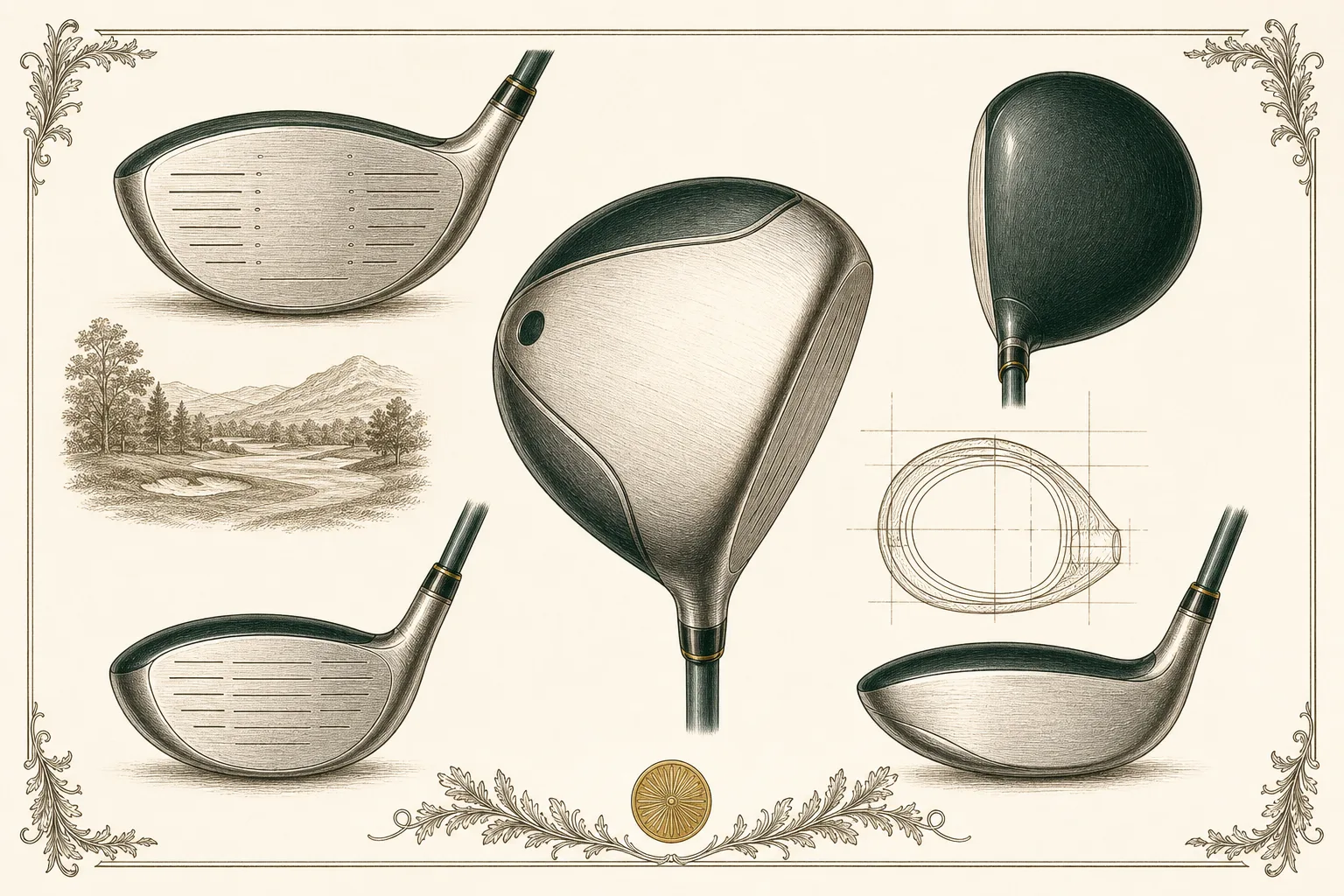
“The infamous one -- non-conforming COR, a USGA truce offer, and an Arnold Palmer rebuke that only boosted sales. Iconic to own; remind anyone it's illegal in USGA competition and outclassed by any legal modern head.”
The ERC II is the driver that turned a rules dispute into a public brawl. Announced October 18, 2000 and hitting US shelves in 2001, it was a forged-titanium head Callaway knowingly sold as non-conforming for exceeding the USGA's coefficient-of-restitution ('spring-like effect') limit — the first time a major premium OEM offered US golfers a legal-everywhere-except-USGA-competition driver on purpose, rather than quietly discontinuing it. Shops reportedly could not keep it in stock despite a price north of $500. It also detonated a genuine controversy: Arnold Palmer, then chairman of the USGA's Members Program and a paid Callaway consultant, was publicly accused of hypocrisy for endorsing a club he himself said should not be used in USGA competition, and said the criticism from friends and readers 'really hurt.' The R&A, unlike the USGA, ruled it conforming, so it was legal for competitive play across most of the world outside the US.
This is an icon of a specific kind — not because it's beloved to hit, but because it is one of the two or three most consequential equipment-rules flashpoints in modern golf, covered independently by ESPN, Golf Digest, the Tampa Bay Times, and Callaway's own corporate press releases, and still cited today as the moment a major manufacturer chose to sell non-conforming clubs to recreational golfers on principle. The Arnold Palmer controversy alone gives it a documented cultural footprint well beyond its on-course merits.
In 2001, marketed to any recreational golfer chasing extra yards who did not care about posting a USGA handicap score or playing sanctioned competition — Callaway explicitly sold it for casual, non-competitive play. Today it fits only a very specific buyer: someone who wants a piece of golf's COR-war history to own or display. Anyone wanting a legal, effective driver — for competition or otherwise — should buy literally any current conforming model instead; a 25-year-old non-conforming head is outclassed on every performance metric.
Followed the original ERC (1999-2000), which had already forced the USGA/R&A split over COR limits; the ERC II escalated it by being sold intentionally as non-conforming in the US rather than pulled. In August 2002 the USGA reaffirmed its .830 COR limit for anyone wanting to post a handicap score, closing off the loophole the ERC II had been testing. Callaway settled into fully conforming drivers afterward, and the whole episode is the direct precedent for the square-groove Ping Eye 2 dispute a decade later.
Its headline advantage was speed, not forgiveness: the non-conforming spring-like face returns extra ball speed on center and near-center strikes regardless of swing quality, which functionally pads mis-hit distance the way any hot face does. But nothing in the sourced record suggests unusual perimeter weighting or MOI engineering beyond Callaway's normal 2001 forged-titanium construction, so it lands as a moderately forgiving driver whose real party trick was COR, not head design.
Calibrated across the whole catalog — a tour blade scores low here on purpose; it means control, not ease.
A genuine piece of equipment-rules history keeps this above generic old-driver pricing: clean examples with headcover typically bring $60-$150 in 2026 private-party sales, driven by collectors of golf-rules memorabilia rather than players, since it remains functionally non-conforming and cannot be used in any sanctioned competition or handicap round.
The Legends Rack
The illegal one. Its spring-face COR exceeded USGA limits, Arnold Palmer endorsed it anyway, and golf had a full-blown constitutional crisis. Hitting a genuinely non-conforming driver on a launch monitor — where you can measure the crime — is peak sim-bay content. Who'll love it: everyone; the story sells itself before the swing.
Who it suitsAll
Reading is one thing — hitting is another. Book a bay and see the numbers for yourself before you buy anywhere.
“The infamous one -- non-conforming COR, a USGA truce offer, and an Arnold Palmer rebuke that only boosted sales. Iconic to own; remind anyone it's illegal in USGA competition and outclassed by any legal modern head.”
The ERC II is the driver that turned a rules dispute into a public brawl. Announced October 18, 2000 and hitting US shelves in 2001, it was a forged-titanium head Callaway knowingly sold as non-conforming for exceeding the USGA's coefficient-of-restitution ('spring-like effect') limit — the first time a major premium OEM offered US golfers a legal-everywhere-except-USGA-competition driver on purpose, rather than quietly discontinuing it. Shops reportedly could not keep it in stock despite a price north of $500. It also detonated a genuine controversy: Arnold Palmer, then chairman of the USGA's Members Program and a paid Callaway consultant, was publicly accused of hypocrisy for endorsing a club he himself said should not be used in USGA competition, and said the criticism from friends and readers 'really hurt.' The R&A, unlike the USGA, ruled it conforming, so it was legal for competitive play across most of the world outside the US.
This is an icon of a specific kind — not because it's beloved to hit, but because it is one of the two or three most consequential equipment-rules flashpoints in modern golf, covered independently by ESPN, Golf Digest, the Tampa Bay Times, and Callaway's own corporate press releases, and still cited today as the moment a major manufacturer chose to sell non-conforming clubs to recreational golfers on principle. The Arnold Palmer controversy alone gives it a documented cultural footprint well beyond its on-course merits.
In 2001, marketed to any recreational golfer chasing extra yards who did not care about posting a USGA handicap score or playing sanctioned competition — Callaway explicitly sold it for casual, non-competitive play. Today it fits only a very specific buyer: someone who wants a piece of golf's COR-war history to own or display. Anyone wanting a legal, effective driver — for competition or otherwise — should buy literally any current conforming model instead; a 25-year-old non-conforming head is outclassed on every performance metric.
Followed the original ERC (1999-2000), which had already forced the USGA/R&A split over COR limits; the ERC II escalated it by being sold intentionally as non-conforming in the US rather than pulled. In August 2002 the USGA reaffirmed its .830 COR limit for anyone wanting to post a handicap score, closing off the loophole the ERC II had been testing. Callaway settled into fully conforming drivers afterward, and the whole episode is the direct precedent for the square-groove Ping Eye 2 dispute a decade later.
Its headline advantage was speed, not forgiveness: the non-conforming spring-like face returns extra ball speed on center and near-center strikes regardless of swing quality, which functionally pads mis-hit distance the way any hot face does. But nothing in the sourced record suggests unusual perimeter weighting or MOI engineering beyond Callaway's normal 2001 forged-titanium construction, so it lands as a moderately forgiving driver whose real party trick was COR, not head design.
Calibrated across the whole catalog — a tour blade scores low here on purpose; it means control, not ease.
A genuine piece of equipment-rules history keeps this above generic old-driver pricing: clean examples with headcover typically bring $60-$150 in 2026 private-party sales, driven by collectors of golf-rules memorabilia rather than players, since it remains functionally non-conforming and cannot be used in any sanctioned competition or handicap round.
The Legends Rack
The illegal one. Its spring-face COR exceeded USGA limits, Arnold Palmer endorsed it anyway, and golf had a full-blown constitutional crisis. Hitting a genuinely non-conforming driver on a launch monitor — where you can measure the crime — is peak sim-bay content. Who'll love it: everyone; the story sells itself before the swing.
Who it suitsAll
Reading is one thing — hitting is another. Book a bay and see the numbers for yourself before you buy anywhere.