“One step below the forged TP line: a compact semi-cavity for mid-to-low handicaps who want blade looks with a little forgiveness. A legit budget players iron.”
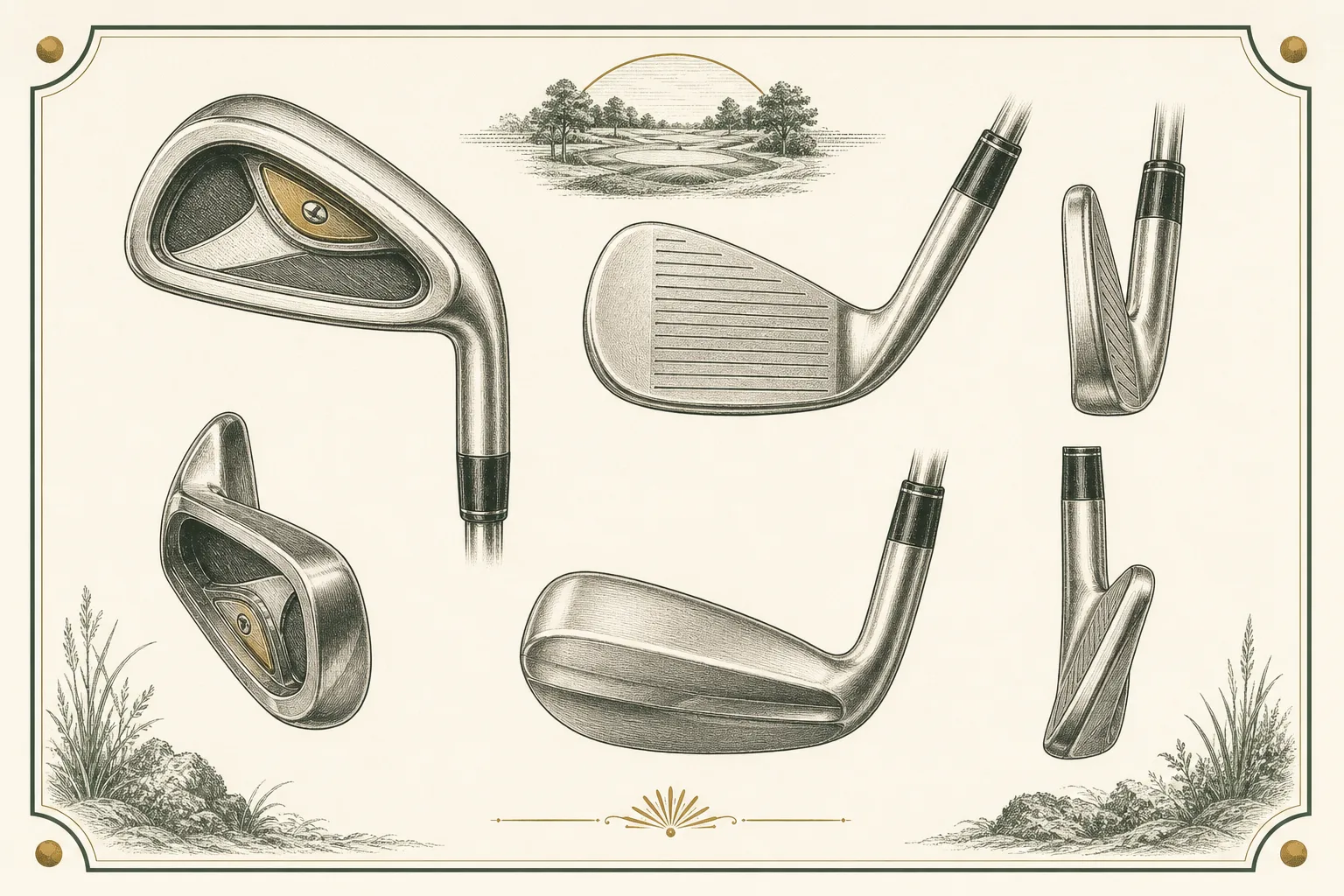
TaylorMade billed the 2002 RAC LT ('Low Trajectory') as its finest player's cavity-back to date, and it earned real tour credibility: 2004 U.S. Open champion Retief Goosen, Darren Clarke and Hale Irwin were among the pros who put it in play. The semi-cavity design used medium offset and a low CG to keep flight penetrating in wind, while its signature feature -- a 'Tuned Performance Cartridge' of feel chambers along the sole -- redistributed roughly 16 grams of mass to the perimeter and damped vibration, chasing a forged-blade feel without sacrificing the cavity's stability. A thin, tour-cambered sole let it glide through tight lies, aimed squarely at better players. Reviewers who tested it called it, without much hedging, some of the most forgiving irons they'd played for the category.
Real, specific tour credibility -- gamed by a reigning U.S. Open champion and two other established pros -- combined with unusually enthusiastic contemporary reviews ('the most forgiving irons I've ever played,' from a tester specifically comparing it to peers), yet it carries almost no modern collector recognition or forum mythology two decades on. It quietly did everything asked of it and then was forgotten in favor of flashier TaylorMade branding cycles that followed.
Above-average players with driver swing speeds of roughly 90-115 mph (TaylorMade's own spec) who want low-to-mid trajectory, workability and a forged-adjacent feel with a forgiveness cushion. One documented adjustment: its medium offset is more than some players expect from a 'better player' iron, and testers reported initially pulling long-iron shots until they compensated for it. Not the right choice for a high handicapper wanting maximum forgiveness and height -- the RAC HT in the same catalog year covers that need instead.
Released in 2002, ahead of the era of enormous game-improvement irons, as TaylorMade's flagship for the better-player segment, competing with Ping's i3, Titleist's 690 series and Mizuno's MP-30/32. It was succeeded by the RAC LT2 in 2004, which iterated the same Tuned Performance Cartridge platform with updated tuning rather than replacing the concept.
Forgiving for a players' cavity-back, not in absolute terms: the Tuned Performance Cartridge moves about 16 grams to the perimeter and the low CG helps mishits retain distance and line better than a blade, and the thin cambered sole helps from tight lies. But this is still a semi-cavity aimed at better players with a compact head and medium (not maximum) offset -- nowhere near the forgiveness of its own stablemate, the RAC HT, built for the opposite end of the skill spectrum.
Calibrated across the whole catalog — a tour blade scores low here on purpose; it means control, not ease.
Complete steel sets sell for roughly $90-180 privately in 2026; despite the tour pedigree and strong period reviews, 20-plus-year-old cavity-backs don't command a premium in the current used market, and pricing tracks other RAC-era players' irons rather than exceeding them. Clean examples with upgraded shafts (Dynamic Gold, Rifle) sit at the top of the range.
The Legends Rack
The early-2000s staple. "RAC" stood for Relative Amount of Character, which is exactly the energy this rack needs. Who'll love it: millennial golfers reliving their high-school team days.
Who it suitsAll
Reading is one thing — hitting is another. Book a bay and see the numbers for yourself before you buy anywhere.
“One step below the forged TP line: a compact semi-cavity for mid-to-low handicaps who want blade looks with a little forgiveness. A legit budget players iron.”
TaylorMade billed the 2002 RAC LT ('Low Trajectory') as its finest player's cavity-back to date, and it earned real tour credibility: 2004 U.S. Open champion Retief Goosen, Darren Clarke and Hale Irwin were among the pros who put it in play. The semi-cavity design used medium offset and a low CG to keep flight penetrating in wind, while its signature feature -- a 'Tuned Performance Cartridge' of feel chambers along the sole -- redistributed roughly 16 grams of mass to the perimeter and damped vibration, chasing a forged-blade feel without sacrificing the cavity's stability. A thin, tour-cambered sole let it glide through tight lies, aimed squarely at better players. Reviewers who tested it called it, without much hedging, some of the most forgiving irons they'd played for the category.
Real, specific tour credibility -- gamed by a reigning U.S. Open champion and two other established pros -- combined with unusually enthusiastic contemporary reviews ('the most forgiving irons I've ever played,' from a tester specifically comparing it to peers), yet it carries almost no modern collector recognition or forum mythology two decades on. It quietly did everything asked of it and then was forgotten in favor of flashier TaylorMade branding cycles that followed.
Above-average players with driver swing speeds of roughly 90-115 mph (TaylorMade's own spec) who want low-to-mid trajectory, workability and a forged-adjacent feel with a forgiveness cushion. One documented adjustment: its medium offset is more than some players expect from a 'better player' iron, and testers reported initially pulling long-iron shots until they compensated for it. Not the right choice for a high handicapper wanting maximum forgiveness and height -- the RAC HT in the same catalog year covers that need instead.
Released in 2002, ahead of the era of enormous game-improvement irons, as TaylorMade's flagship for the better-player segment, competing with Ping's i3, Titleist's 690 series and Mizuno's MP-30/32. It was succeeded by the RAC LT2 in 2004, which iterated the same Tuned Performance Cartridge platform with updated tuning rather than replacing the concept.
Forgiving for a players' cavity-back, not in absolute terms: the Tuned Performance Cartridge moves about 16 grams to the perimeter and the low CG helps mishits retain distance and line better than a blade, and the thin cambered sole helps from tight lies. But this is still a semi-cavity aimed at better players with a compact head and medium (not maximum) offset -- nowhere near the forgiveness of its own stablemate, the RAC HT, built for the opposite end of the skill spectrum.
Calibrated across the whole catalog — a tour blade scores low here on purpose; it means control, not ease.
Complete steel sets sell for roughly $90-180 privately in 2026; despite the tour pedigree and strong period reviews, 20-plus-year-old cavity-backs don't command a premium in the current used market, and pricing tracks other RAC-era players' irons rather than exceeding them. Clean examples with upgraded shafts (Dynamic Gold, Rifle) sit at the top of the range.
The Legends Rack
The early-2000s staple. "RAC" stood for Relative Amount of Character, which is exactly the energy this rack needs. Who'll love it: millennial golfers reliving their high-school team days.
Who it suitsAll
Reading is one thing — hitting is another. Book a bay and see the numbers for yourself before you buy anywhere.