
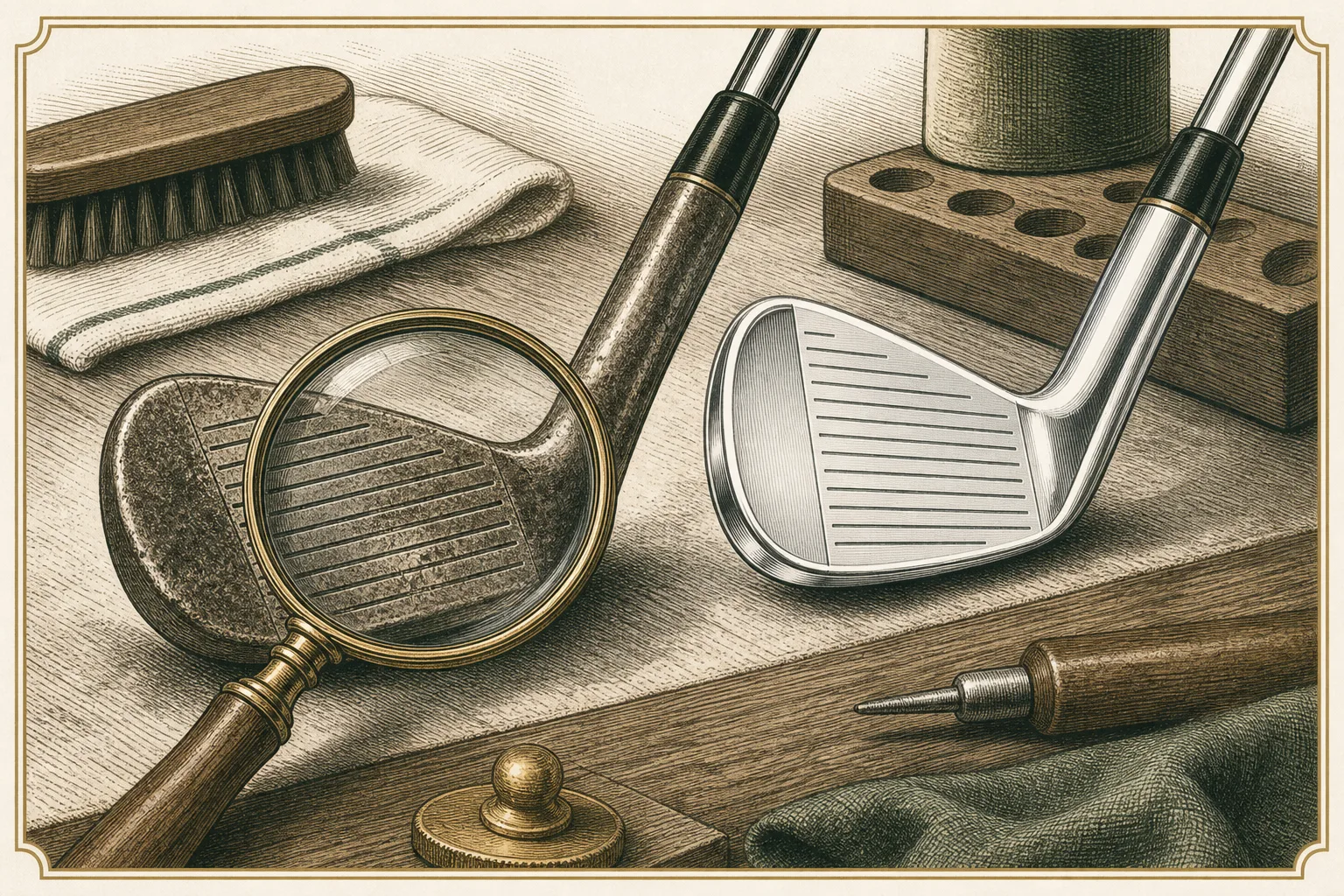
Here's the honest answer nobody selling new clubs wants to give you: age matters far less than category, condition, and fit. A 20-year-old putter can be every bit as good as one released last spring. A 20-year-old driver is genuinely leaving distance on the table. And a 20-year-old wedge might be fine — or it might be a smooth-faced spin killer, depending entirely on how many bunker shots its previous owner hit.
So instead of one expiration date, think of your bag as a set of categories that age at completely different speeds. Once you see it that way, the used market stops being a minefield and starts being the single best value in golf.
Drivers age fastest — but slower than the ads say
Driver technology is the one place where the marketing has some truth behind it. Modern heads are more forgiving on mis-hits, faces are engineered to keep ball speed up on strikes toward the heel and toe, and adjustability lets a fitter dial in loft and lie. When MyGolfSpy tested a ten-year-old flagship driver against a then-current one, the new club won on ball speed, carry, and total distance — worth roughly a stroke per round for the average player.
But look closer at that number: ten years of "revolutionary breakthroughs" bought about ten yards and one stroke. Golf Digest's robot testing tells the same story from the other direction — on center strikes, a driver from three or four years ago gives up almost nothing to a brand-new one. The real gains show up on mis-hits, where newer heads can save five or six yards on a high-toe strike.
The practical takeaway: a driver from the last 8–10 years is still a real golf club, and a lightly used one from two or three model cycles back is one of the smartest buys in the game. A driver from 2005? It'll still work, but you're giving away forgiveness that modern used clubs offer for a hundred bucks. That's the one category where "20 years old" costs you something measurable.
Irons age slowly, and putters barely age at all
Irons are a different animal. An iron head is a lump of steel with loft on it; there's no spring-face arms race happening down there at anything like driver pace. Manufacturers have mostly "improved" iron distance by strengthening lofts — today's 7-iron often carries yesterday's 6-iron's loft — which is why your buddy's new set goes "a club longer." The genuine gains in the last two decades are in forgiveness and launch for game-improvement heads, and they're real but incremental. A well-fit cavity-back set from 10–15 years ago will not hold back a beginner or a mid-handicapper in any way that shows up on a scorecard. Condition and fit (lie angle, shaft, grips) matter enormously more than the year on the box. If iron design language is new to you, Iron Design, Explained covers blades versus cavities properly.
Putters are the extreme case: the best design in golf is 60 years old. Karsten Solheim sketched the PING Anser on a record sleeve in 1966, and its heel-toe weighting and plumber's-neck hosel are still the template for most blade putters sold today. A putter has no grooves to wear out and takes no violent impacts. If the face is undamaged and the length suits you, a 25-year-old putter gives up essentially nothing.
The 10–15 year sweet spot
Here's where the value math gets fun. Golf equipment depreciates like a luxury car: brutally in the first three years, then it flattens out. By the time a club is 10–15 years old, you're paying scrap-metal prices for equipment that was tour-quality when it launched — and, outside of drivers, still performs within a whisker of new.
That window is the sweet spot because it's old enough to be cheap but new enough to have modern fundamentals: 460cc titanium drivers, cavity-back irons with decent forgiveness, wedge grinds that make sense, graphite woods shafts that aren't noodles. A full used set from that era can cost less than one new driver. For a new golfer figuring out whether they even like this game, that's the play — and Buying Your First Set walks through exactly how to do it.
The icons that never die
Some clubs have simply refused to become obsolete, and they're proof that "old" and "outdated" aren't the same word.
PING Eye 2 irons (1982). The set that made perimeter weighting mainstream. Golfers still game them, reviewers still test them against modern clubs, and the forgiveness still holds up. They're the used-market equivalent of a Toyota with 200,000 miles left in it.
PING Anser putters (1966). The most copied putter shape in history. Every "Anser-style" blade in a new-release lineup is paying tribute to the original.
Odyssey White Hot inserts (2000). The original White Hot urethane insert was so beloved that decades later a majority of Odyssey users on tour still asked for it, and the company eventually re-released it as the "White Hot OG" line. When tour pros with free access to everything keep choosing 25-year-old face technology, that tells you something about how putters age.
If a used club is one of these — or a Titleist blade, a Vokey wedge with fresh grooves, a Scotty Cameron — its age is nearly irrelevant. Buy on condition.
The one thing that genuinely wears out: grooves
Everything above assumed the club is in good shape. Grooves are where that assumption dies, because wedges wear by use, not by calendar. MyGolfSpy's lab testing found that a wedge with just 75 rounds on it lost enough spin that shots rolled out dramatically farther than a fresh-grooved wedge — around eight feet less stopping power on approach shots. Sand and dirty range balls chew faces up even faster.
So a 20-year-old wedge that lived in a garage might be perfect, while a three-year-old one that ate 500 bunker shots is done. You can't tell from the model year — you have to look. Run a fingernail across the face: on fresh grooves it catches crisply; on worn ones it glides. While you're inspecting, check the rest too: rust pitting on the face (surface rust on raw wedges is fine, deep pits aren't), dents or rattles in driver and wood heads, "browning" or cracks on old graphite shafts, bent hosels, and grips that are slick or cracked — though grips are a cheap fix, not a dealbreaker. On drivers specifically, listen for a dull, dead sound at impact; a fatigued face is the one hidden failure mode of hard-used modern drivers.
So — is 20+ years old useful?
Direct answer: yes, with two exceptions. A 20-year-old putter, iron set, hybrid, or fairway wood in good condition is a completely legitimate way to play golf, and often a spectacular value. The exceptions are drivers, where two decades of forgiveness gains are real money left on the table, and any wedge whose grooves are worn smooth — which is a condition problem wearing an age costume.
And here's the part where an indoor sim venue is genuinely useful rather than a sales pitch: you don't have to guess. Bring the used set you're eyeing — or grandpa's hand-me-downs — into a bay at Clubhouse and hit them next to something modern on the launch monitor. Ball speed, carry, spin, and dispersion will settle the "too old?" question in about fifteen swings, with actual numbers instead of forum opinions. If the data says the old irons are fine but the driver is bleeding fifteen yards, congratulations: you just saved yourself the cost of a full set and know exactly where to spend instead. If you're not sure what the numbers mean yet, How to Read Data Like a Fitter is the decoder ring.
Old clubs aren't a compromise. Bad-fitting clubs are. Age is just the cheapest variable to check.
From the glossary
Related reading: Buying Your First Set Without Getting Fleeced · Blades, Cavity Backs, and Everything Between · Drivers: Loft, Forgiveness, and the Myths · Reading Your Shot Data Like a Fitter

The Most Forgiving Drivers of the 2010s, Ranked by the Data
From roughly 2014 to 2019, every major manufacturer spent its entire driver budget chasing one number: MOI — how much the head resists twisting when you miss the middle. Carbon crowns, tungsten back weights, faces engineered to fight your specific mishit. Those flagships were the most forgiving drivers ever built to that point, and forgiveness does not expire. Your heel strike in 2026 is the same heel strike it was in 2018, and a head that held ball speed on it then holds ball speed on it now.