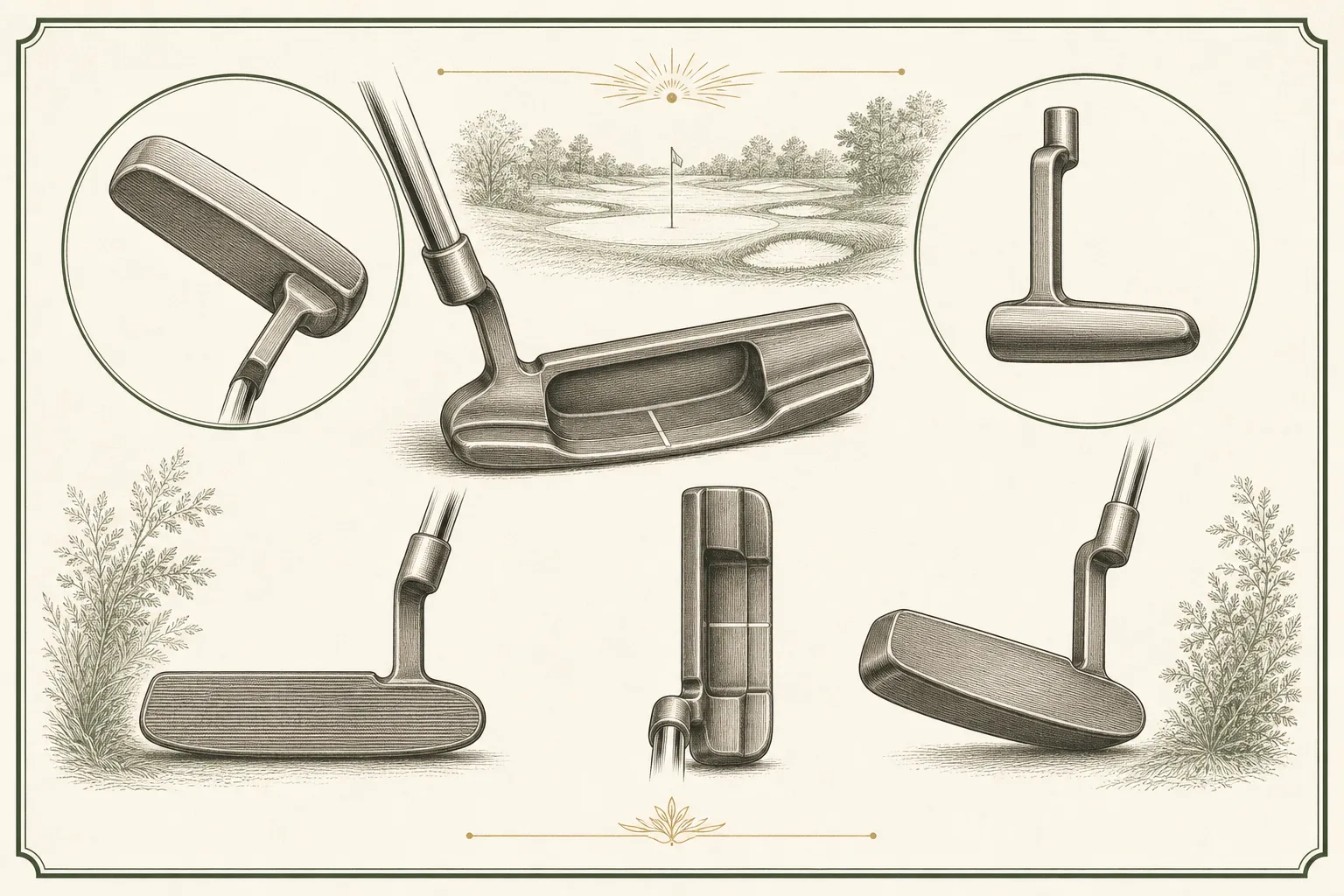
“The Karsten Solheim Anser, the most copied putter shape in golf; plumber-neck blade with toe hang for an arc stroke. The archetype every other blade traces back to.”
The Anser is arguably the most important putter ever made. Karsten Solheim sketched it in January 1966 on the dust jacket of a 78 rpm record; his wife Louise suggested calling it 'the Answer' to putting's flaws, then said to just leave out the 'w.' Solheim filed the patent in May 1966 (granted March 1967). Its innovations — a heel-toe perimeter-weighted blade with a rear cavity and an offset plumber's-neck hosel — moved mass to the corners for stability and became the template for nearly every blade putter since. This 2003 edition (MSRP $199) reflects a modern reissue rather than the 1966 original; Ping has kept the Anser name alive through investment-cast Karsten Series models and milled lines (Redwood in 2006, today's PLD Milled Anser), so the design has run nearly 60 years.
Widely and independently documented as 'one of the most iconic clubs in golf history,' the winningest and most-copied putter model ever made. Golf Digest, MyGolfSpy, Golflink and Ping's own PLD heritage all credit it with inventing heel-toe perimeter weighting for putters; after Solheim's patent expired in 1984 it spawned a flood of copies that continues today. Multiple independent sources and its position at the root of the entire modern blade-putter category put its icon status beyond dispute.
A heel-shafted, toe-hang blade suited to players with an arcing putting stroke who want classic looks, feedback and a compact head over maximum forgiveness — typically better players and traditionalists. It fits a mid-slow to moderate green style and rewards a repeatable release. Players with a straight-back-straight-through stroke or those who want maximum mis-hit stability are better served by a face-balanced mallet.
The 1966 original buried the center-weighted blades of its day and forced the entire industry toward perimeter weighting; once the patent lapsed in 1984, Anser-style putters became the default blade shape for every brand (Scotty Cameron's Newport, Odyssey's #1/#2, and countless others are direct descendants). These reissues (Karsten Series, Redwood, PLD Milled) are premium modern executions of that same 1966 geometry, competing against Scotty Cameron and Bettinardi milled blades rather than against 1960s rivals.
For a putter, forgiveness means twist-resistance on off-center strikes (MOI), and the Anser is the club that invented that idea — but by 2026 standards a compact steel blade is only moderately forgiving. Its heel-toe weighting holds line on mis-hits far better than the center-heavy blades it replaced, yet it gives up meaningful stability to a modern mallet or a high-MOI face-balanced design. A 5 reflects 'the original stability blade, still solid but middle-of-the-pack against today's mallets,' not a knock on the design that started it all.
Calibrated across the whole catalog — a tour blade scores low here on purpose; it means control, not ease.
Wildly variable because 'Ping Anser' spans 60 years of models. Vintage 1960s-80s originals (especially early Scottsdale/85068-address and rare BeCu or manganese-bronze examples) are genuine collector pieces that can run from ~$100 into the many hundreds or more for desirable stampings. Modern milled reissues (Redwood, PLD) trade used around ~$150-$350 depending on model and condition against $250-$400+ retail; ordinary investment-cast Karsten Series Ansers are cheap at ~$40-$100. The name alone tells you little about value — the specific era, finish and stamping drive it.
The Legends Rack
Sketched by Karsten Solheim on a 78-rpm record sleeve, named by dropping the "w" from "answer," and copied more than any club design in history. Every plumber's-neck blade on Earth is this putter's grandchild. Who'll love it: literally every golfer — most are already putting with its descendant.
Who it suitsAll
Reading is one thing — hitting is another. Book a bay and see the numbers for yourself before you buy anywhere.
“The Karsten Solheim Anser, the most copied putter shape in golf; plumber-neck blade with toe hang for an arc stroke. The archetype every other blade traces back to.”
The Anser is arguably the most important putter ever made. Karsten Solheim sketched it in January 1966 on the dust jacket of a 78 rpm record; his wife Louise suggested calling it 'the Answer' to putting's flaws, then said to just leave out the 'w.' Solheim filed the patent in May 1966 (granted March 1967). Its innovations — a heel-toe perimeter-weighted blade with a rear cavity and an offset plumber's-neck hosel — moved mass to the corners for stability and became the template for nearly every blade putter since. This 2003 edition (MSRP $199) reflects a modern reissue rather than the 1966 original; Ping has kept the Anser name alive through investment-cast Karsten Series models and milled lines (Redwood in 2006, today's PLD Milled Anser), so the design has run nearly 60 years.
Widely and independently documented as 'one of the most iconic clubs in golf history,' the winningest and most-copied putter model ever made. Golf Digest, MyGolfSpy, Golflink and Ping's own PLD heritage all credit it with inventing heel-toe perimeter weighting for putters; after Solheim's patent expired in 1984 it spawned a flood of copies that continues today. Multiple independent sources and its position at the root of the entire modern blade-putter category put its icon status beyond dispute.
A heel-shafted, toe-hang blade suited to players with an arcing putting stroke who want classic looks, feedback and a compact head over maximum forgiveness — typically better players and traditionalists. It fits a mid-slow to moderate green style and rewards a repeatable release. Players with a straight-back-straight-through stroke or those who want maximum mis-hit stability are better served by a face-balanced mallet.
The 1966 original buried the center-weighted blades of its day and forced the entire industry toward perimeter weighting; once the patent lapsed in 1984, Anser-style putters became the default blade shape for every brand (Scotty Cameron's Newport, Odyssey's #1/#2, and countless others are direct descendants). These reissues (Karsten Series, Redwood, PLD Milled) are premium modern executions of that same 1966 geometry, competing against Scotty Cameron and Bettinardi milled blades rather than against 1960s rivals.
For a putter, forgiveness means twist-resistance on off-center strikes (MOI), and the Anser is the club that invented that idea — but by 2026 standards a compact steel blade is only moderately forgiving. Its heel-toe weighting holds line on mis-hits far better than the center-heavy blades it replaced, yet it gives up meaningful stability to a modern mallet or a high-MOI face-balanced design. A 5 reflects 'the original stability blade, still solid but middle-of-the-pack against today's mallets,' not a knock on the design that started it all.
Calibrated across the whole catalog — a tour blade scores low here on purpose; it means control, not ease.
Wildly variable because 'Ping Anser' spans 60 years of models. Vintage 1960s-80s originals (especially early Scottsdale/85068-address and rare BeCu or manganese-bronze examples) are genuine collector pieces that can run from ~$100 into the many hundreds or more for desirable stampings. Modern milled reissues (Redwood, PLD) trade used around ~$150-$350 depending on model and condition against $250-$400+ retail; ordinary investment-cast Karsten Series Ansers are cheap at ~$40-$100. The name alone tells you little about value — the specific era, finish and stamping drive it.
The Legends Rack
Sketched by Karsten Solheim on a 78-rpm record sleeve, named by dropping the "w" from "answer," and copied more than any club design in history. Every plumber's-neck blade on Earth is this putter's grandchild. Who'll love it: literally every golfer — most are already putting with its descendant.
Who it suitsAll
Reading is one thing — hitting is another. Book a bay and see the numbers for yourself before you buy anywhere.