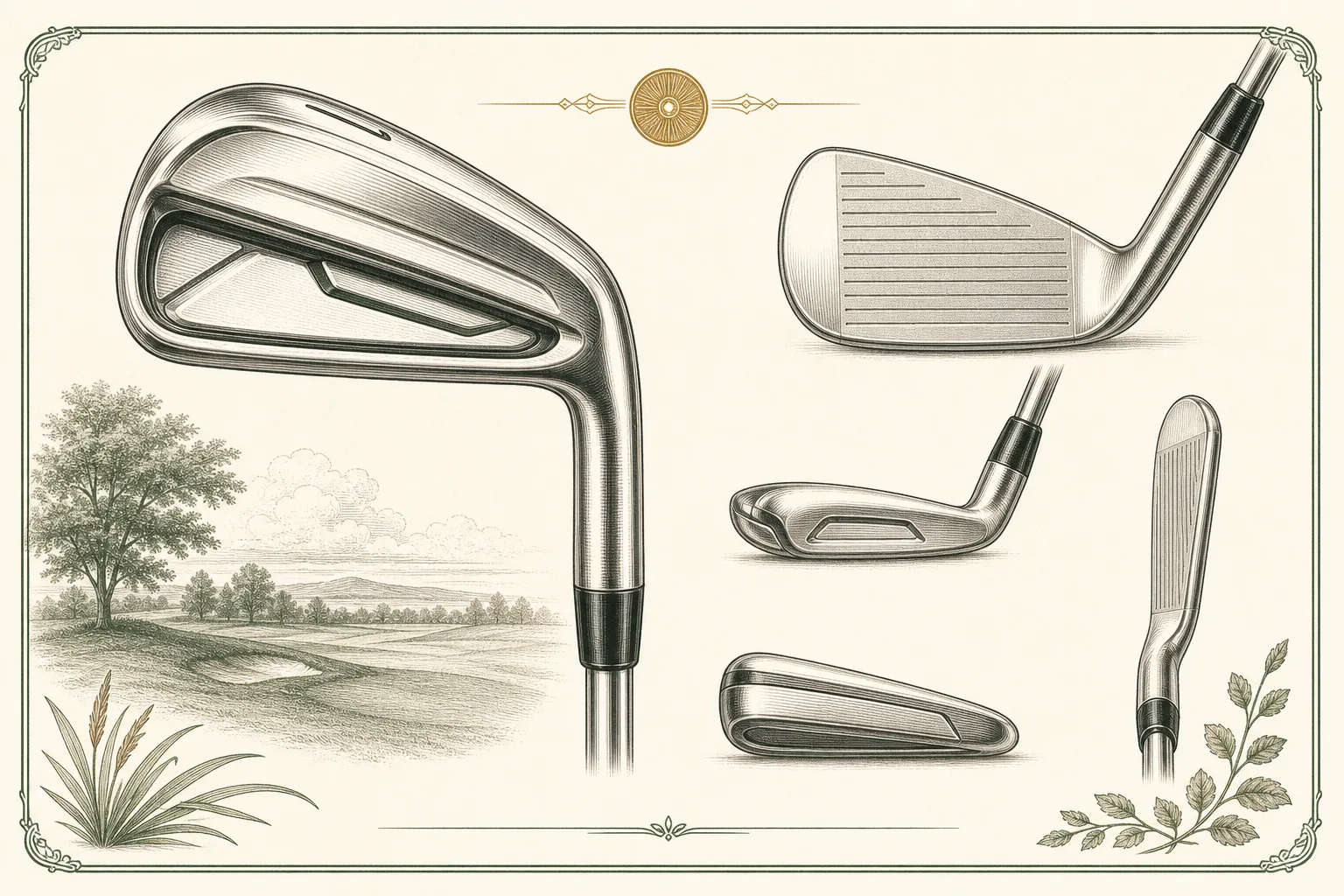
“The T100 launched the T-Series as the modern tour iron replacing the AP2, forged feel and tour shaping with dual tungsten for stability. A rung-2 destination for a proven striker who wants tour-level control.”
The T100 launched in 2019 as the club that quietly ended the AP1/AP2/AP3 naming era Titleist had run since 2004. It was pitched as the modern AP2 successor: a forged, compact tour cavity with a SUP-10 (Japanese spring steel) forged face for ball speed and co-forged tungsten (roughly 66g total, split toe-to-heel) built into the 3-7 iron heads to add stability without inflating the profile. Reviewers at launch pegged it as one of the best players irons of the year, noting it produced slightly more spin than direct rivals while keeping the thin-topline, minimal-offset look tour pros wanted. It became the entry point of the new four-tier T-Series (T100/T200/T300/T400) and, unusually for a debut model, was an almost immediate hit in Titleist's own tour van.
Widely reviewed as a standout players iron at launch and adopted heavily on the PGA Tour as Titleist's direct AP2 replacement, but it is a mainstream OEM flagship on a 2-year refresh cycle rather than a scarce or hunted-down model — no lawsuit, no discontinuation-driven scarcity, just a well-regarded current-era tour iron.
Low-to-mid single-digit handicaps with consistent, center-face contact and enough speed to control a 24-degree 4-iron. Rewards shot-shaping and distance control. A mid-to-high handicapper wanting more carry and mis-hit tolerance should look at the T200 or a game-improvement set instead — the T100 offers little forgiveness margin for an inconsistent strike.
Launched into the same 2019 players-iron field as Mizuno's JPX919 Tour, Callaway's Apex Pro 19, and Ping's i210, and directly replaced the long-running 718 AP2 as Titleist's tour-level cavity. It sits at the head of the T-Series that Titleist has refreshed roughly every two years since (T100 2021, 2023, 2025), each generation retaining the same tour-cavity brief with updated tungsten and CNC-milled face work.
A compact tour cavity, not a game-improvement iron: thin topline, minimal offset, small head. The co-forged tungsten (~66g in the 3-7 irons) pushes CG slightly lower/more toward the perimeter than a pure blade, giving mis-hits a bit more stability than something like a 620 MB, but this is forgiveness within the players-iron class only — it demands a centered, repeatable strike and punishes toe/heel misses more than any GI or players-distance iron.
Calibrated across the whole catalog — a tour blade scores low here on purpose; it means control, not ease.
A complete steel 4-PW set (original MSRP ~$1,399) realistically sells for roughly $450-$650 private-party in 2026 given it is now a two-generations-old model; well-kept sets with premium tour shafts (AMT Tour White, Project X) sit at the top of that range, while worn grooves or off-brand aftermarket shafts push it toward the bottom.
The Legends Rack
The modern tour-forged standard — the most-played iron model on tour for stretches of its life. Who'll love it: better players; instant tour-bay credibility.
Who it suitsBetter players
Reading is one thing — hitting is another. Book a bay and see the numbers for yourself before you buy anywhere.
“The T100 launched the T-Series as the modern tour iron replacing the AP2, forged feel and tour shaping with dual tungsten for stability. A rung-2 destination for a proven striker who wants tour-level control.”
The T100 launched in 2019 as the club that quietly ended the AP1/AP2/AP3 naming era Titleist had run since 2004. It was pitched as the modern AP2 successor: a forged, compact tour cavity with a SUP-10 (Japanese spring steel) forged face for ball speed and co-forged tungsten (roughly 66g total, split toe-to-heel) built into the 3-7 iron heads to add stability without inflating the profile. Reviewers at launch pegged it as one of the best players irons of the year, noting it produced slightly more spin than direct rivals while keeping the thin-topline, minimal-offset look tour pros wanted. It became the entry point of the new four-tier T-Series (T100/T200/T300/T400) and, unusually for a debut model, was an almost immediate hit in Titleist's own tour van.
Widely reviewed as a standout players iron at launch and adopted heavily on the PGA Tour as Titleist's direct AP2 replacement, but it is a mainstream OEM flagship on a 2-year refresh cycle rather than a scarce or hunted-down model — no lawsuit, no discontinuation-driven scarcity, just a well-regarded current-era tour iron.
Low-to-mid single-digit handicaps with consistent, center-face contact and enough speed to control a 24-degree 4-iron. Rewards shot-shaping and distance control. A mid-to-high handicapper wanting more carry and mis-hit tolerance should look at the T200 or a game-improvement set instead — the T100 offers little forgiveness margin for an inconsistent strike.
Launched into the same 2019 players-iron field as Mizuno's JPX919 Tour, Callaway's Apex Pro 19, and Ping's i210, and directly replaced the long-running 718 AP2 as Titleist's tour-level cavity. It sits at the head of the T-Series that Titleist has refreshed roughly every two years since (T100 2021, 2023, 2025), each generation retaining the same tour-cavity brief with updated tungsten and CNC-milled face work.
A compact tour cavity, not a game-improvement iron: thin topline, minimal offset, small head. The co-forged tungsten (~66g in the 3-7 irons) pushes CG slightly lower/more toward the perimeter than a pure blade, giving mis-hits a bit more stability than something like a 620 MB, but this is forgiveness within the players-iron class only — it demands a centered, repeatable strike and punishes toe/heel misses more than any GI or players-distance iron.
Calibrated across the whole catalog — a tour blade scores low here on purpose; it means control, not ease.
A complete steel 4-PW set (original MSRP ~$1,399) realistically sells for roughly $450-$650 private-party in 2026 given it is now a two-generations-old model; well-kept sets with premium tour shafts (AMT Tour White, Project X) sit at the top of that range, while worn grooves or off-brand aftermarket shafts push it toward the bottom.
The Legends Rack
The modern tour-forged standard — the most-played iron model on tour for stretches of its life. Who'll love it: better players; instant tour-bay credibility.
Who it suitsBetter players
Reading is one thing — hitting is another. Book a bay and see the numbers for yourself before you buy anywhere.