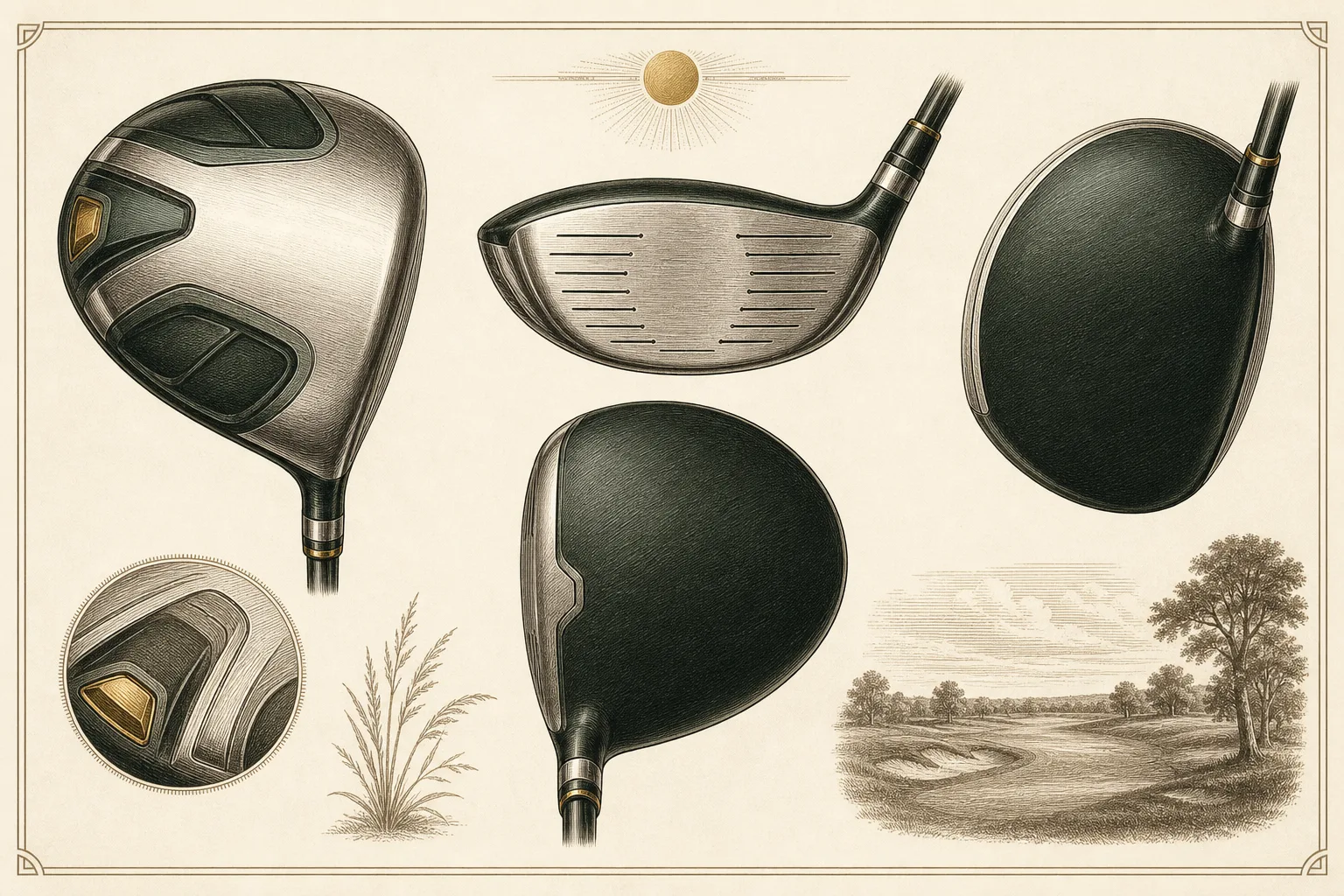
“The SasQuatch Sumo2 (Sumo Squared) was the first square-headed driver ever - a max forgiveness 460cc design that resists twisting on off-center hits. An iconic, ultra-stable big stick.”
The SasQuatch Sumo2 5900 was Nike's answer to the mid-2000s square-driver fad and its flagship forgiveness statement for 2007. Where the round Sumo used all titanium, the Sumo2 pushed the head into a square, flattened footprint with a convex crown and PowerBow weighting shoved into the corners of the clubhead, plus composite construction, to reach a claimed MOI of ~5,900 -- the '5900' in the name -- which Nike touted as maxing out the era's limits on size, COR and MOI simultaneously. The squared shape made it look larger than its 460cc, and one tester likened it to a 'waffle iron.' Nike marketed it as its straightest driver ever, and the 5900 notably tamed the harsh, tinny sound of the first square Sumo into something more subdued.
A well-remembered artifact of the square-driver era -- it scored 4.5/5 across 31 user reviews on golfreview.com and got enthusiastic period press -- and its extreme shape gives it a bit of lasting recognition. But like the whole square-driver fad it is a curiosity, not a collectible: no scarcity, no reverent following, cheap today. The strong period reception and distinctive design earn 'notable' over plain commodity.
Built for mid-to-high handicappers of moderate-to-high swing speed who valued straightness and forgiveness above all and could live with a large, unconventional square head. It is a slice-fighter's and consistency-seeker's driver. Anyone who wants to work the ball, flight it down, or dislikes a big footprint at address should avoid it -- the square shape deliberately sacrifices shot-shaping for stability.
Launched at the peak of the square-driver war against Callaway's FT-i and the wider high-MOI field, and as the squared, higher-MOI counterpart to Nike's own round SasQuatch Sumo. It represents the outer limit of the mid-2000s MOI race before the fad faded and the industry returned to rounded heads and, soon after, adjustability. It predates Nike's FlexLoft adjustable era; loft was fixed per head (8.5/9.5/10.5 plus a 13-degree option per the catalog).
Very high -- this was, by design and by the numbers, one of the most forgiving drivers of its day. A claimed ~5,900 MOI from square-corner PowerBow weighting made it exceptionally resistant to twisting on off-center hits, so heel/toe misses held line and speed unusually well; period reviews aimed it squarely at mid-to-high handicappers wanting consistency off the tee. It lands at 9 rather than 10 only because the square shape traded away workability and some players disliked the look/feel, and modern ~10K-MOI heads exceed it.
Calibrated across the whole catalog — a tour blade scores low here on purpose; it means control, not ease.
Cheap and easy to find in 2026 despite the higher original price: realistic private-party value is roughly $40-90 depending on shaft and condition, with clean examples toward the top. 2nd Swing and Golf Avenue reconditioned listings run higher and are graded, overstating private-sale value. The novelty square shape draws occasional collector curiosity but does not command a real premium; no appreciation.
The Legends Rack
The square one. Maximum-MOI geometry, a TING you can hear three bays over, and a face only a physicist could love — and K.J. Choi actually won with it on tour. The single best conversation-starter in golf. Who'll love it: everybody, for exactly one swing, and then five more because it's weirdly straight.
Who it suitsAll
Reading is one thing — hitting is another. Book a bay and see the numbers for yourself before you buy anywhere.
“The SasQuatch Sumo2 (Sumo Squared) was the first square-headed driver ever - a max forgiveness 460cc design that resists twisting on off-center hits. An iconic, ultra-stable big stick.”
The SasQuatch Sumo2 5900 was Nike's answer to the mid-2000s square-driver fad and its flagship forgiveness statement for 2007. Where the round Sumo used all titanium, the Sumo2 pushed the head into a square, flattened footprint with a convex crown and PowerBow weighting shoved into the corners of the clubhead, plus composite construction, to reach a claimed MOI of ~5,900 -- the '5900' in the name -- which Nike touted as maxing out the era's limits on size, COR and MOI simultaneously. The squared shape made it look larger than its 460cc, and one tester likened it to a 'waffle iron.' Nike marketed it as its straightest driver ever, and the 5900 notably tamed the harsh, tinny sound of the first square Sumo into something more subdued.
A well-remembered artifact of the square-driver era -- it scored 4.5/5 across 31 user reviews on golfreview.com and got enthusiastic period press -- and its extreme shape gives it a bit of lasting recognition. But like the whole square-driver fad it is a curiosity, not a collectible: no scarcity, no reverent following, cheap today. The strong period reception and distinctive design earn 'notable' over plain commodity.
Built for mid-to-high handicappers of moderate-to-high swing speed who valued straightness and forgiveness above all and could live with a large, unconventional square head. It is a slice-fighter's and consistency-seeker's driver. Anyone who wants to work the ball, flight it down, or dislikes a big footprint at address should avoid it -- the square shape deliberately sacrifices shot-shaping for stability.
Launched at the peak of the square-driver war against Callaway's FT-i and the wider high-MOI field, and as the squared, higher-MOI counterpart to Nike's own round SasQuatch Sumo. It represents the outer limit of the mid-2000s MOI race before the fad faded and the industry returned to rounded heads and, soon after, adjustability. It predates Nike's FlexLoft adjustable era; loft was fixed per head (8.5/9.5/10.5 plus a 13-degree option per the catalog).
Very high -- this was, by design and by the numbers, one of the most forgiving drivers of its day. A claimed ~5,900 MOI from square-corner PowerBow weighting made it exceptionally resistant to twisting on off-center hits, so heel/toe misses held line and speed unusually well; period reviews aimed it squarely at mid-to-high handicappers wanting consistency off the tee. It lands at 9 rather than 10 only because the square shape traded away workability and some players disliked the look/feel, and modern ~10K-MOI heads exceed it.
Calibrated across the whole catalog — a tour blade scores low here on purpose; it means control, not ease.
Cheap and easy to find in 2026 despite the higher original price: realistic private-party value is roughly $40-90 depending on shaft and condition, with clean examples toward the top. 2nd Swing and Golf Avenue reconditioned listings run higher and are graded, overstating private-sale value. The novelty square shape draws occasional collector curiosity but does not command a real premium; no appreciation.
The Legends Rack
The square one. Maximum-MOI geometry, a TING you can hear three bays over, and a face only a physicist could love — and K.J. Choi actually won with it on tour. The single best conversation-starter in golf. Who'll love it: everybody, for exactly one swing, and then five more because it's weirdly straight.
Who it suitsAll
Reading is one thing — hitting is another. Book a bay and see the numbers for yourself before you buy anywhere.