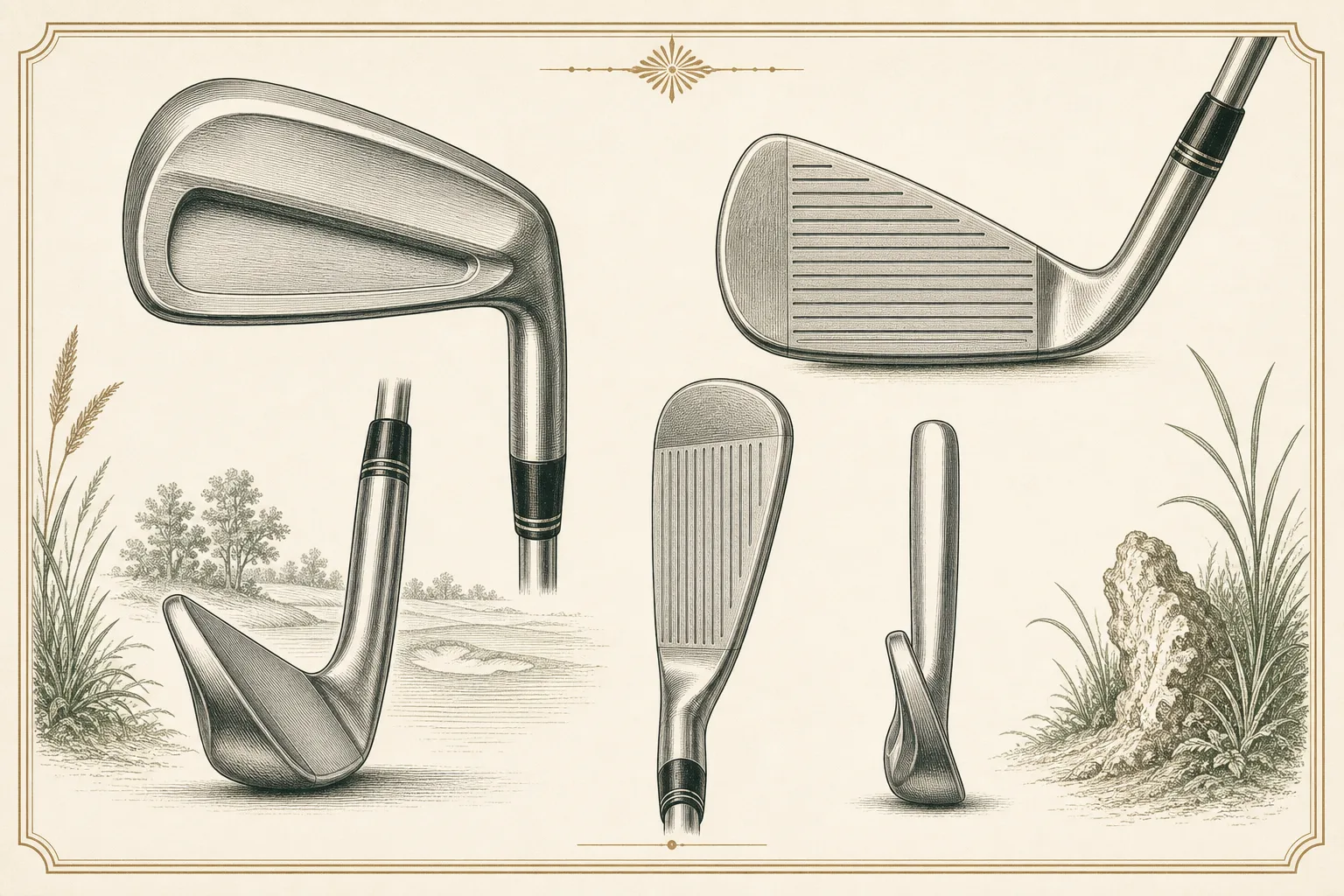
“The classic Apex forged blade - the shape a generation of better players grew up on. Rung-4, and a nostalgia-grade identity club.”
This is the classic Hogan Apex forged blade at its late-1990s peak, the family that culminates in the celebrated 1999 Apex, which enthusiasts still call the tuxedos of the iron world. Forged from soft carbon steel in the original Fort Worth tradition (the 1999 set was Endo-forged in Japan), it is a compact muscleback built for maximum control and the dense, buttery impact feel that made Hogan a byword among purists. It descends directly from the 1970s Apex that is still ranked among the best irons ever made, refined through the '92/'94/'96 versions that nudged weight lower for a touch more playability without abandoning the butter-knife shape. It arrived at the end of the independent Hogan company's run, just as the brand was sold to Spalding following Ben Hogan's death in 1997.
The classic Apex forged blade is one of the genuine cult objects in irons: the 1999 set is singled out by MyGolfSpy (How It's Made feature) and specialist restorers like The Hawk Golf, which sells refurbished 1999 Apex sets from a Vault/Legendary collection, while GolfWRX lists the Apex forgings among the greatest Hogan irons ever. Collectors and feel-chasers still actively hunt clean sets decades later, the textbook cult-classic pattern, backed by multiple independent sources.
For accomplished, low-handicap ball-strikers (roughly 88+ mph, tour-level guidance) who prize soft forged feel, precise trajectory control and shot-shaping and can reliably center the face. It is a nostalgia-grade identity club as much as a playing set. A mid-to-high handicap, or anyone wanting launch help or distance, should not buy it, any modern cavity or players-distance iron will be vastly more forgiving and longer.
The last flowering of the original Fort Worth Ben Hogan Company's blade line before the Spalding sale, competing in its day against Titleist's forged blades, Mizuno's MP muscle-backs and Wilson Staff forgings. Within the Apex family it follows the '92/'94/'96 blades and precedes the game-improvement drift of the early-2000s Spalding-era Apex (Apex 50/FTX). A modern spiritual heir is the revived brand's Fort Worth MB, or a current forged blade like the Mizuno Pro 241.
A pure forged muscleback: thin sole, thin topline, essentially no cavity and a small sweet spot, so mishits bleed distance and telegraph exactly where you missed. That harsh honesty is the point for its buyer. A 2 sits it at the unforgiving floor of the catalog with other blades, far below any cavity-back; you buy it for feel and workability, never for help on off-center strikes.
Calibrated across the whole catalog — a tour blade scores low here on purpose; it means control, not ease.
Beloved but still affordable, it holds value better than an ordinary old blade because collector and feel demand is steady. Specialist refurbishers (The Hawk Golf) price restored 1999 sets as premium vault pieces, which overstates the everyday market. Realistic 2026 private-party value for a clean complete set is roughly $120-275 depending on year, shaft and condition; the sought-after 1999 Endo-forged sets and clean originals sit at the top, worn or rusted sets below. Premium shafts and pristine chrome push it up; groove wear and pitting pull it down.
Reading is one thing — hitting is another. Book a bay and see the numbers for yourself before you buy anywhere.
“The classic Apex forged blade - the shape a generation of better players grew up on. Rung-4, and a nostalgia-grade identity club.”
This is the classic Hogan Apex forged blade at its late-1990s peak, the family that culminates in the celebrated 1999 Apex, which enthusiasts still call the tuxedos of the iron world. Forged from soft carbon steel in the original Fort Worth tradition (the 1999 set was Endo-forged in Japan), it is a compact muscleback built for maximum control and the dense, buttery impact feel that made Hogan a byword among purists. It descends directly from the 1970s Apex that is still ranked among the best irons ever made, refined through the '92/'94/'96 versions that nudged weight lower for a touch more playability without abandoning the butter-knife shape. It arrived at the end of the independent Hogan company's run, just as the brand was sold to Spalding following Ben Hogan's death in 1997.
The classic Apex forged blade is one of the genuine cult objects in irons: the 1999 set is singled out by MyGolfSpy (How It's Made feature) and specialist restorers like The Hawk Golf, which sells refurbished 1999 Apex sets from a Vault/Legendary collection, while GolfWRX lists the Apex forgings among the greatest Hogan irons ever. Collectors and feel-chasers still actively hunt clean sets decades later, the textbook cult-classic pattern, backed by multiple independent sources.
For accomplished, low-handicap ball-strikers (roughly 88+ mph, tour-level guidance) who prize soft forged feel, precise trajectory control and shot-shaping and can reliably center the face. It is a nostalgia-grade identity club as much as a playing set. A mid-to-high handicap, or anyone wanting launch help or distance, should not buy it, any modern cavity or players-distance iron will be vastly more forgiving and longer.
The last flowering of the original Fort Worth Ben Hogan Company's blade line before the Spalding sale, competing in its day against Titleist's forged blades, Mizuno's MP muscle-backs and Wilson Staff forgings. Within the Apex family it follows the '92/'94/'96 blades and precedes the game-improvement drift of the early-2000s Spalding-era Apex (Apex 50/FTX). A modern spiritual heir is the revived brand's Fort Worth MB, or a current forged blade like the Mizuno Pro 241.
A pure forged muscleback: thin sole, thin topline, essentially no cavity and a small sweet spot, so mishits bleed distance and telegraph exactly where you missed. That harsh honesty is the point for its buyer. A 2 sits it at the unforgiving floor of the catalog with other blades, far below any cavity-back; you buy it for feel and workability, never for help on off-center strikes.
Calibrated across the whole catalog — a tour blade scores low here on purpose; it means control, not ease.
Beloved but still affordable, it holds value better than an ordinary old blade because collector and feel demand is steady. Specialist refurbishers (The Hawk Golf) price restored 1999 sets as premium vault pieces, which overstates the everyday market. Realistic 2026 private-party value for a clean complete set is roughly $120-275 depending on year, shaft and condition; the sought-after 1999 Endo-forged sets and clean originals sit at the top, worn or rusted sets below. Premium shafts and pristine chrome push it up; groove wear and pitting pull it down.
Reading is one thing — hitting is another. Book a bay and see the numbers for yourself before you buy anywhere.