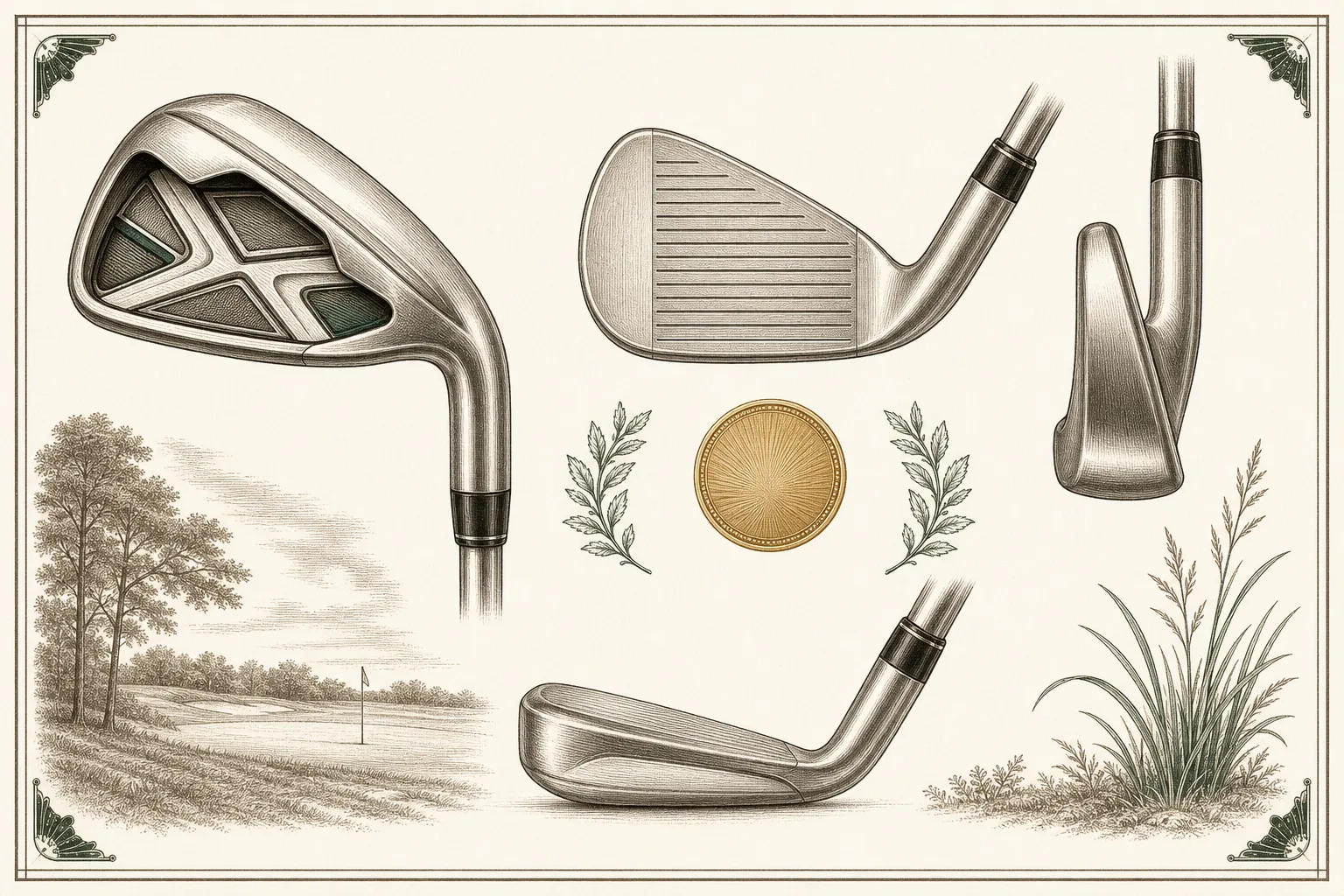
The X-14 launched in 2000 as Callaway's mainstream game-improvement iron aimed at high-handicap players. It introduced the S2H2 (Short, Straight Hollow Hosel) design to shift weight low and toward the perimeter, paired with Variable Face Thickness tapering thin near the topline to keep CG low, and a distinctive dual-rail sole — two raised heel-to-toe rails 0.08in high that cut turf drag and dropped CG a further ~0.12in. It became one of Callaway's better-selling early-2000s GI irons and spawned a companion X-14 Pro Series with tighter offset for better players, before being folded into the X-16/X-18 generation that followed.
No hunt-down cult like a players' iron, but it has an unusually durable enthusiast reputation: golfreview.com shows a 4.1/5 average across 256 user reviews, and a MyGolfSpy forum thread specifically revisited it as 'still good' two decades on — evidence of lasting goodwill, not active collector demand.
High handicappers and beginners wanting an easy-launching, forgiving iron at budget used prices, or a loaner/beater set. Better players wanting workability or modern lofts should look elsewhere — even the companion Pro Series is not a true players' shape.
Launched in 2000 amid Callaway's X-series expansion, competing with Titleist's DCI, Ping's i3/Zing lineage, and TaylorMade's Burner-era GI irons. Superseded by the X-16 and later X-18 (2004) as Callaway's GI flagship. A modern equivalent is a current Callaway Big Bertha-tier super-game-improvement iron.
Dual-rail sole geometry (two 0.08in rails lowering CG ~0.12in) plus VFT and S2H2 perimeter weighting make off-center and thin strikes noticeably more playable than a blade of the era; MOI is high enough to keep mis-hits reasonably online, though the wide sole can catch on tight lies for better players.
Calibrated across the whole catalog — a tour blade scores low here on purpose; it means control, not ease.
Reconditioned listings (2nd Swing) run roughly $230-$440 depending on shaft/configuration and condition; realistic private-party/eBay pricing for a clean set is well under that, commonly $50-$150, since these are 25-year-old commodity irons with no collector premium.
Reading is one thing — hitting is another. Book a bay and see the numbers for yourself before you buy anywhere.
The X-14 launched in 2000 as Callaway's mainstream game-improvement iron aimed at high-handicap players. It introduced the S2H2 (Short, Straight Hollow Hosel) design to shift weight low and toward the perimeter, paired with Variable Face Thickness tapering thin near the topline to keep CG low, and a distinctive dual-rail sole — two raised heel-to-toe rails 0.08in high that cut turf drag and dropped CG a further ~0.12in. It became one of Callaway's better-selling early-2000s GI irons and spawned a companion X-14 Pro Series with tighter offset for better players, before being folded into the X-16/X-18 generation that followed.
No hunt-down cult like a players' iron, but it has an unusually durable enthusiast reputation: golfreview.com shows a 4.1/5 average across 256 user reviews, and a MyGolfSpy forum thread specifically revisited it as 'still good' two decades on — evidence of lasting goodwill, not active collector demand.
High handicappers and beginners wanting an easy-launching, forgiving iron at budget used prices, or a loaner/beater set. Better players wanting workability or modern lofts should look elsewhere — even the companion Pro Series is not a true players' shape.
Launched in 2000 amid Callaway's X-series expansion, competing with Titleist's DCI, Ping's i3/Zing lineage, and TaylorMade's Burner-era GI irons. Superseded by the X-16 and later X-18 (2004) as Callaway's GI flagship. A modern equivalent is a current Callaway Big Bertha-tier super-game-improvement iron.
Dual-rail sole geometry (two 0.08in rails lowering CG ~0.12in) plus VFT and S2H2 perimeter weighting make off-center and thin strikes noticeably more playable than a blade of the era; MOI is high enough to keep mis-hits reasonably online, though the wide sole can catch on tight lies for better players.
Calibrated across the whole catalog — a tour blade scores low here on purpose; it means control, not ease.
Reconditioned listings (2nd Swing) run roughly $230-$440 depending on shaft/configuration and condition; realistic private-party/eBay pricing for a clean set is well under that, commonly $50-$150, since these are 25-year-old commodity irons with no collector premium.
Reading is one thing — hitting is another. Book a bay and see the numbers for yourself before you buy anywhere.