
Wedges are the clubs you'll hit more than any other inside 120 yards, and they're also the clubs most golfers buy with the least thought. People agonize over a driver for months, then grab a 56-degree off the rack because the sticker said "sand wedge." Here's the honest version: the loft stamped on a wedge matters less than two things almost nobody checks — how it gaps against your other clubs, and how its sole is shaped. Get those two right and your short game gets easier without a single lesson. Get them wrong and you'll fight chunks and blades for years and blame your hands.
The four wedges, and why the gap wedge exists
The traditional lineup runs pitching wedge (44–48°), gap wedge (50–52°), sand wedge (54–56°), and lob wedge (58–62°). The names are mostly historical; what actually matters is the number.
Here's the wrinkle: iron lofts have been getting stronger for two decades, because stronger lofts make a 7-iron fly farther and distance sells. A lot of modern game-improvement sets ship with a pitching wedge at 43–45 degrees — which is what a 9-iron was a generation ago. The sand wedge, meanwhile, has stayed parked around 54–56 because that's what works out of a bunker. That opened up a canyon of 10–12 degrees between PW and SW, which is two full clubs of distance with nothing in it. The gap wedge exists purely to fill that hole. If your set's pitching wedge is 44 or 45 degrees and you go straight to a 56, you have a 30-yard dead zone right in prime scoring range. That's not a technique problem. That's a shopping problem.
Gapping: four to six degrees, no exceptions
The rule of thumb from every serious fitter is 4–6 degrees between consecutive wedges, which works out to roughly 10–15 yards of carry per step. Start from the pitching wedge in your iron set — check the actual loft online, don't guess — and build down from there.
A 44-degree PW wants something like 48–52–56 or 48–52–58. A 46-degree PW plays nicely with 50–54–58. If your set PW is a classic 47–48, the old-school 52–56–60 still works beautifully. Notice that in every case the lofts are chosen relative to your set, not copied from a tour player's bag. Whether you carry three wedges or four depends on how many long clubs you're willing to give up at the other end — that's a whole conversation of its own, and it's exactly what the gapping session in a bay is for.
One opinion, offered honestly: most improving golfers don't need a 60-degree lob wedge, and plenty are actively hurt by one. A 60 has a tiny margin for error on contact, and almost every shot people reach for it on can be played with a 56 and a slightly more open face. Earn the 60. Don't start with it.
What bounce actually does
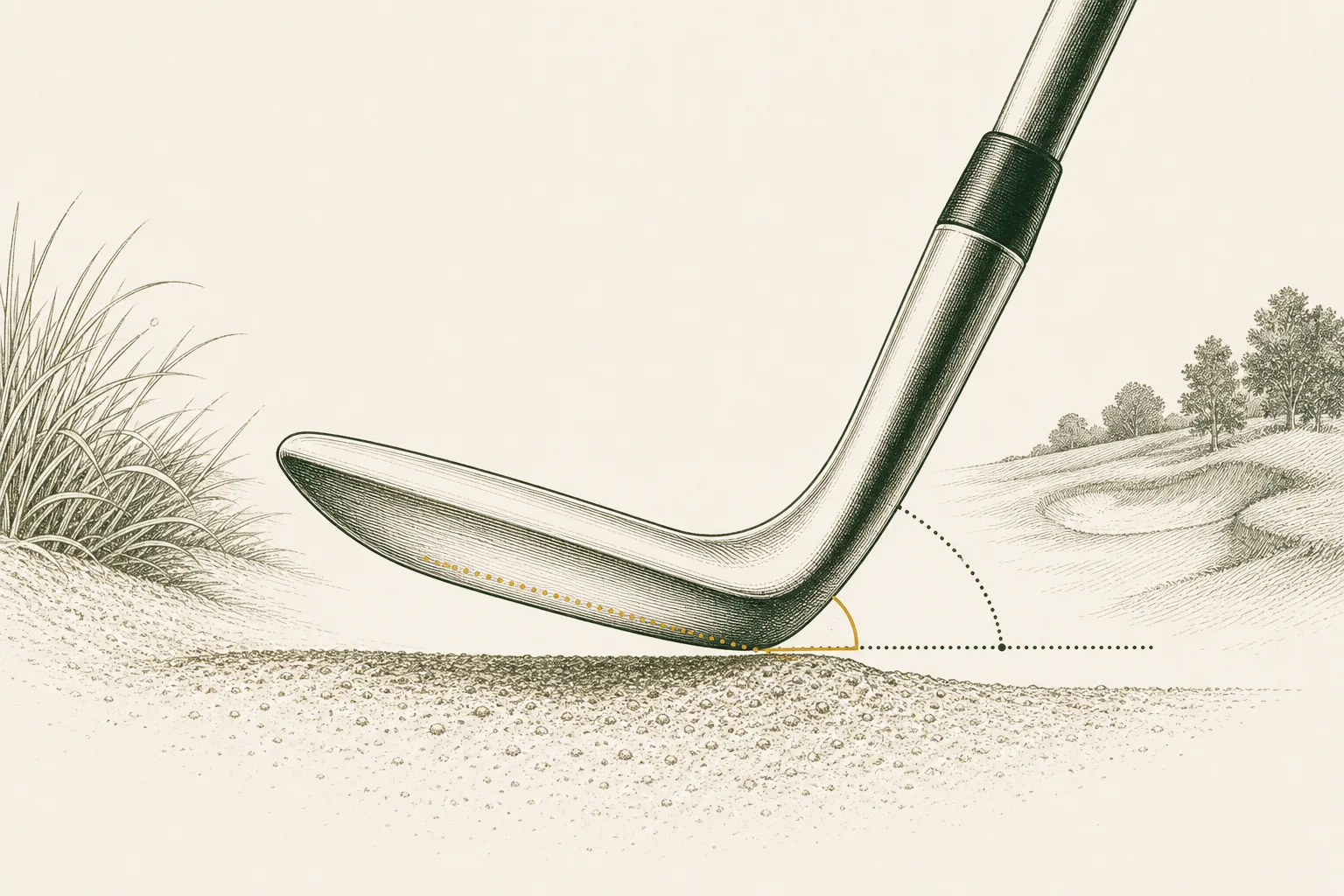
Flip a wedge over and look at the sole. On almost every wedge, the leading edge sits higher than the back of the sole when the shaft is vertical — the sole hangs down below the leading edge. The angle between those two is bounce, measured in degrees, and it's the single most forgiving feature on any golf club.
Here's the physics in one sentence: bounce is what makes the club skid instead of dig. When the sole strikes turf or sand, that downward-angled surface deflects the head up and through, like a boat hull planing on water. Without it, the leading edge knifes into the ground and stops — that's your chunk. With it, the club glides under the ball even when you hit an inch behind it. Bounce is not a flaw to be minimized; it's a bailout built into the club. The sand wedge was literally invented (by Gene Sarazen, in the 1930s) by adding a flange to the back of the sole so the club would splash through sand instead of burying.
Wedges are sold as low bounce (roughly 4–6°), mid (7–10°), and high (10°+). More bounce = more resistance to digging = more forgiveness on soft turf, fluffy sand, and steep swings. Less bounce = the leading edge sits tighter to the ground = cleaner contact off firm, tight lies and hardpan, especially when you open the face.
Matching bounce to your swing and your turf
Two questions decide your bounce. First: what do your divots look like? If you take deep, dollar-bill-plus divots — a "digger" with a steep attack angle — you need mid-to-high bounce to keep the club from trenching. If you barely bruise the grass — a "sweeper" — low-to-mid bounce keeps the club from skipping up into the ball's equator. Second: what turf do you actually play? Soft, lush, sandy conditions want more bounce. Firm, baked, tight conditions want less.
When the two answers conflict, weight the swing over the turf — you carry your attack angle to every course you'll ever play. And if you're going to err, err toward more bounce. The miss with too much bounce is a slightly thin chip that runs out long. The miss with too little bounce is a chunk that goes six feet. One of those ruins a hole.
Grinds, in plain English
Grind just means the shape of the sole — where material has been ground away at the heel, toe, or trailing edge. It sounds like tour-van mysticism, but it answers one practical question: what happens to the bounce when you open the face?
A full, wide sole (Vokey's F or K, Cleveland's "full") keeps all its bounce and wants to be played square — great for full swings and soft bunkers, clumsy for flop shots. A heel-relieved or crescent sole (M, S, C-type grinds) lets the leading edge stay low when you lay the face open, so one wedge can play square pitches and open-faced touch shots. Aggressive tour-style grinds (T, L) strip bounce away for maximum versatility on firm turf — and maximum punishment when your contact isn't precise. If you play mostly square-faced and want forgiveness, take the fuller sole. If you love opening the face around greens, take a versatile mid-bounce grind in your highest-lofted wedge. That covers 90% of golfers; the rest is fitting-cart fine print.
The Florida wrinkle: Bermuda and sugar sand
Around here the turf is Bermuda over sandy soil, and it changes the calculus. Growing-season Bermuda is grabby and sits the ball down; the sandy base underneath is soft; local bunkers run fluffy. All of that argues for more bounce than the national average — a 56 with 12–14 degrees of bounce is a genuinely good default sand wedge for this part of Florida, and it's why so many good local players carry a K-grind or equivalent.
The exception is dormant or tightly-mown Bermuda in winter — those wet, grainy, tight lies are famous for exposing high-bounce wedges, and that's exactly when the shallow, use-the-bounce technique (and sometimes the lower-bounce club) earns its keep. If you play Florida golf year-round, a higher-bounce sand wedge plus a mid-bounce gap or lob wedge covers both seasons.
Prove it in a bay
Gapping is the one wedge decision you can settle with data instead of vibes, and a launch monitor makes it trivial. Bring your wedges into a bay at Clubhouse, hit ten smooth full swings with each, and look at the carry numbers — not total, carry. You're looking for even 10–15 yard steps from PW down to your lowest wedge. If two clubs carry within five yards of each other, one of them is dead weight; if there's a 25-yard hole, you've found next month's purchase. Bounce and grind you'll feel on real turf, but lofts and gaps? Twenty minutes on a launch monitor and you'll know more about your wedge setup than most golfers learn in a decade. If the numbers turn up something weird, that's a fitting conversation — and we do those too.
From the glossary
Related reading: Gapping Your Bag on a Launch Monitor · Blades, Cavity Backs, and Everything Between · The 14 Clubs in Your Bag (and What Each Is For) · Launch and Spin: the Flight Recipe

Sleeper Classics: Great Clubs the Market Forgot
The used-club market has a memory problem. Prices track two things — marketing budgets and recency — and neither has much to do with how a club actually performs. A driver that led forgiveness testing in its day gets lapped by nine model cycles and lands in the $100 bin next to genuine junk. A forged iron a Champions Tour pro carried in his own bag sells for less than a single new wedge because the brand never bought enough American ad pages. That inefficiency is your opening.