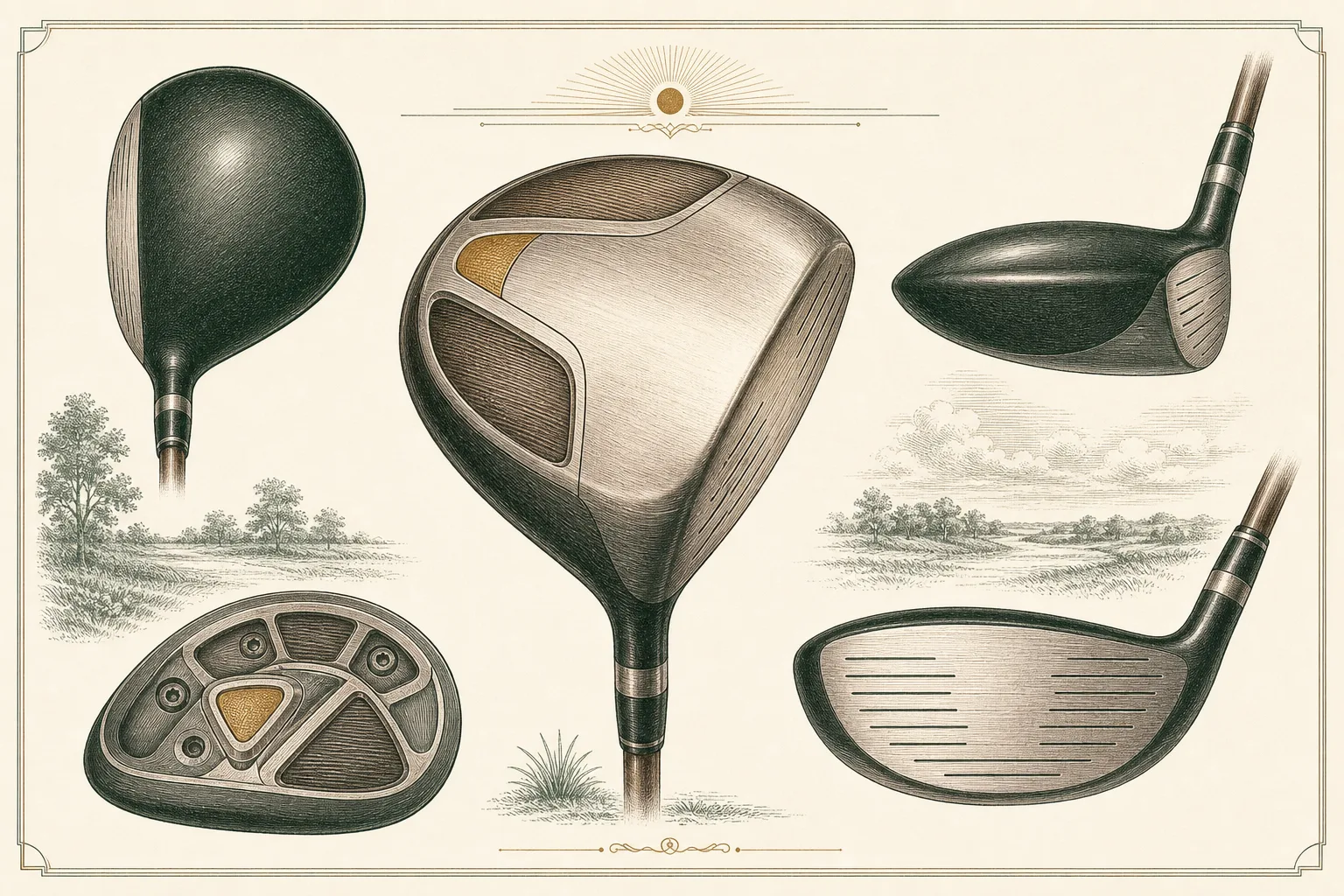
“A late-90s better-player driver with a 260cc head the size of today's fairway woods. It rewards a centered strike and punishes everything else -- a museum piece, not a fitting candidate for anyone we'd put in a bay.”
The 975D, launched in 1998, was Titleist's first widely successful titanium driver and one of the best-selling drivers of its era -- a small (roughly 260-275cc, sources vary), square, deep-faced head with traditional bulge and roll to control side spin, a forward-biased CG for reduced spin, and a through-bore shaft design for stability at impact. It was built for better players who wanted workability and feel over forgiveness, at a moment when the driver market was just beginning its run toward oversized heads. Tiger Woods gamed the 975D through his dominant 2000 season before Titleist introduced the larger 975J in 2001, and Woods moved to Nike equipment in 2002.
Still actively written about and re-tested nearly three decades later -- MyGolfSpy ran a dedicated 2023 head-to-head pitting the 975D against a current TSR driver, and Driving Range Heroes covers it as a 'throwback golf' subject in its own right. Its Tiger Woods association during one of the greatest seasons in golf history (2000, leading into the 2001 'Tiger Slam') keeps it in circulation in retrospective golf media well beyond the typical vintage-driver forgotten-in-a-garage fate.
A tool for low-handicap, better ball-strikers who prize feel and workability and don't need help launching the ball -- exactly the profile it was built for in 1998. Any player who needs forgiveness or modern carry distance will be badly served by it; it belongs to nostalgia and collector bags more than fitting bays today.
Launched as titanium drivers were just overtaking steel, competing against Callaway's Great Big Bertha/Biggest Big Bertha and Ping's early titanium heads, at the front edge of the 'bigger is better' driver head arms race it would soon lose to. Succeeded directly by the larger, thinner-faced 975J in 2001, then Titleist's 983 series in 2003.
Genuinely unforgiving by any modern measure: a compact 260-275cc head (roughly the size of today's fairway woods) with minimal perimeter weighting and a small sweet spot. It rewards a centered strike with a firm, powerful feel and punishes anything else with real distance and dispersion loss -- reviewers note even the 'low-handicap' drivers of the current era carry far more built-in forgiveness than the 975D ever offered.
Calibrated across the whole catalog — a tour blade scores low here on purpose; it means control, not ease.
Cheap and plentiful in 2026: a clean head with an original stock shaft typically sells for roughly $25-60 in private-party listings. There is a small nostalgia/collector premium for documented Tiger-era examples or pristine, unrefinished heads, but it is not a driver anyone pays real money for on functional merit.
The Legends Rack
Tiger-era Titleist. The pear-shaped 975D is what the best golf of all time was played with, and the 983K refined it. Small, honest, and gorgeous behind the ball. Who'll love it: better players — hand a modern junior a 260cc head and watch their face.
Who it suitsBetter players
Reading is one thing — hitting is another. Book a bay and see the numbers for yourself before you buy anywhere.
“A late-90s better-player driver with a 260cc head the size of today's fairway woods. It rewards a centered strike and punishes everything else -- a museum piece, not a fitting candidate for anyone we'd put in a bay.”
The 975D, launched in 1998, was Titleist's first widely successful titanium driver and one of the best-selling drivers of its era -- a small (roughly 260-275cc, sources vary), square, deep-faced head with traditional bulge and roll to control side spin, a forward-biased CG for reduced spin, and a through-bore shaft design for stability at impact. It was built for better players who wanted workability and feel over forgiveness, at a moment when the driver market was just beginning its run toward oversized heads. Tiger Woods gamed the 975D through his dominant 2000 season before Titleist introduced the larger 975J in 2001, and Woods moved to Nike equipment in 2002.
Still actively written about and re-tested nearly three decades later -- MyGolfSpy ran a dedicated 2023 head-to-head pitting the 975D against a current TSR driver, and Driving Range Heroes covers it as a 'throwback golf' subject in its own right. Its Tiger Woods association during one of the greatest seasons in golf history (2000, leading into the 2001 'Tiger Slam') keeps it in circulation in retrospective golf media well beyond the typical vintage-driver forgotten-in-a-garage fate.
A tool for low-handicap, better ball-strikers who prize feel and workability and don't need help launching the ball -- exactly the profile it was built for in 1998. Any player who needs forgiveness or modern carry distance will be badly served by it; it belongs to nostalgia and collector bags more than fitting bays today.
Launched as titanium drivers were just overtaking steel, competing against Callaway's Great Big Bertha/Biggest Big Bertha and Ping's early titanium heads, at the front edge of the 'bigger is better' driver head arms race it would soon lose to. Succeeded directly by the larger, thinner-faced 975J in 2001, then Titleist's 983 series in 2003.
Genuinely unforgiving by any modern measure: a compact 260-275cc head (roughly the size of today's fairway woods) with minimal perimeter weighting and a small sweet spot. It rewards a centered strike with a firm, powerful feel and punishes anything else with real distance and dispersion loss -- reviewers note even the 'low-handicap' drivers of the current era carry far more built-in forgiveness than the 975D ever offered.
Calibrated across the whole catalog — a tour blade scores low here on purpose; it means control, not ease.
Cheap and plentiful in 2026: a clean head with an original stock shaft typically sells for roughly $25-60 in private-party listings. There is a small nostalgia/collector premium for documented Tiger-era examples or pristine, unrefinished heads, but it is not a driver anyone pays real money for on functional merit.
The Legends Rack
Tiger-era Titleist. The pear-shaped 975D is what the best golf of all time was played with, and the 983K refined it. Small, honest, and gorgeous behind the ball. Who'll love it: better players — hand a modern junior a 260cc head and watch their face.
Who it suitsBetter players
Reading is one thing — hitting is another. Book a bay and see the numbers for yourself before you buy anywhere.