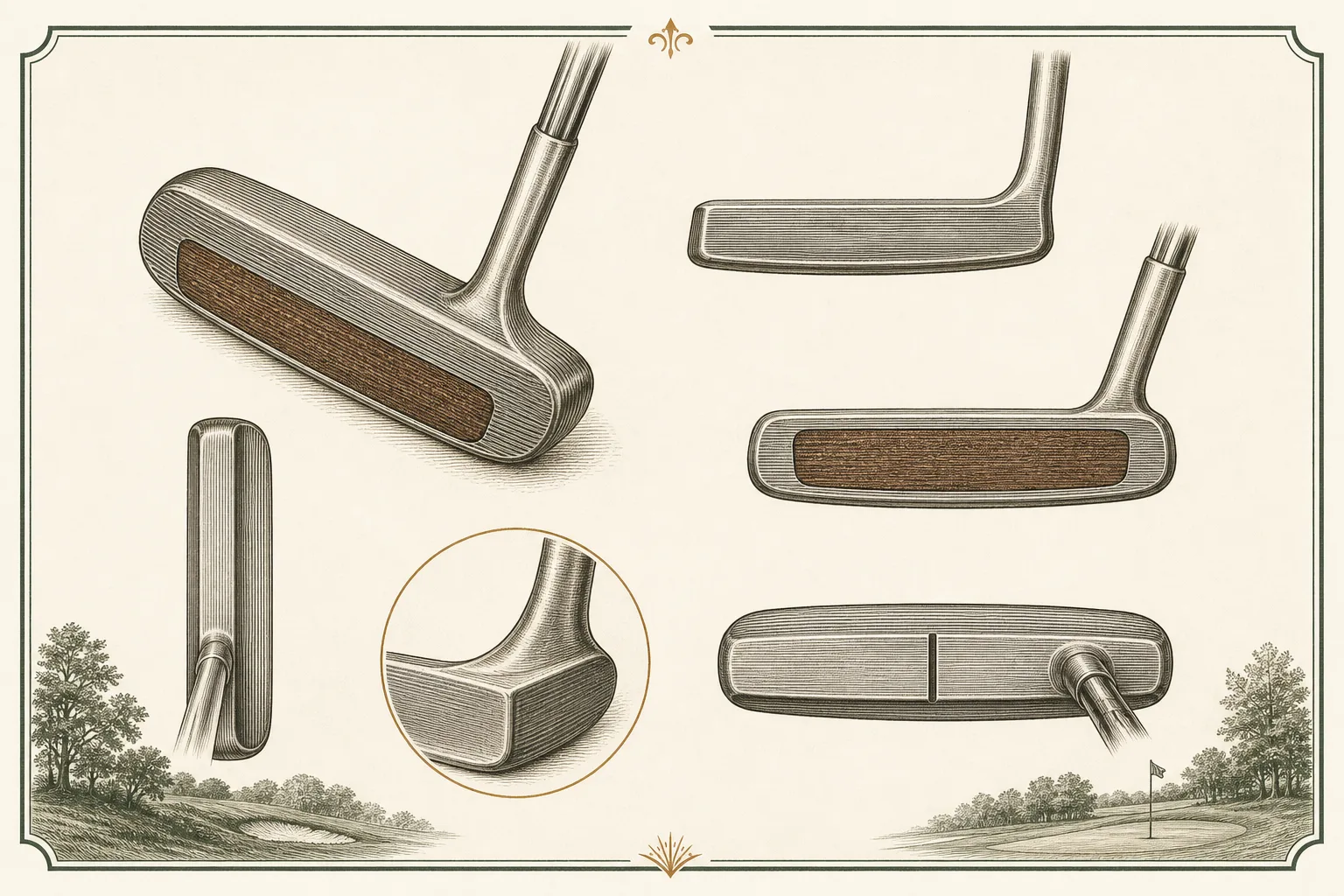
“The Ram Zebra is a famous heel-toe mallet whose black-and-white stripes were a breakthrough alignment aid. A high-MOI classic that still rolls it beautifully.”
Invented by designer Dave Taylor and sold to Ram around 1979-1980 (sources place the design's creation in 1976, ahead of Ram's acquisition), the Zebra was a wide-bodied heel-toe mallet built around a genuinely novel feature: black-and-white striped alignment graphics on the topline, at a time when almost no putter used graphic alignment aids. Ray Floyd used one to win the 1976 Masters while setting the tournament's 72-hole scoring record, and Nick Price won the 1994 Open Championship at Turnberry with one too — two majors bracketing nearly two decades of relevance. Widely credited as the first mass-market alignment putter, it sold in huge numbers through the late 1970s-early 1990s before fading with Ram's decline; its owner has since relaunched Zebra as a standalone putter line.
Two major championship wins (1976 Masters, 1994 Open) tied directly to the putter, corroborated independently across SI.com, the Golf Heritage Society, and Zebra Golf's own company history, plus a modern relaunch decades later under new ownership as a standalone brand — a rare combination of documented tour pedigree and enduring commercial recognition for a putter this old.
Any handicap level benefits from the heel-toe forgiveness and the alignment stripes, which is exactly why it sold so broadly; players preferring a compact blade look or a toe-hang arc stroke should look elsewhere, since the Zebra's face-balanced mallet design suits a straight-back-straight-through stroke best.
Introduced into a putter market still dominated by Ping's Anser-style heel-toe blades; the Zebra carved its own niche by adding a wider mallet body and pioneering visible alignment graphics — a feature so successful that alignment lines are now standard across almost the entire modern putter industry. This model's listed start year of 1973 predates the sourced 1976 design date and 1979-1980 Ram acquisition, an unresolved discrepancy in the historical record.
A wide mallet body with heel-toe weight distribution and (on later versions) adjustable weighting gave it real MOI advantages over the blade putters that dominated before it — genuinely stable on off-center hits for its era. It falls short of modern high-MOI mallets built with dense heel-toe tungsten and face-insert technology, but for a design conceived in the mid-1970s it was ahead of its time and remains a forgiving stroke today.
Calibrated across the whole catalog — a tour blade scores low here on purpose; it means control, not ease.
A cheap, plentiful vintage mallet: original 1970s-80s Zebra putters commonly sell for $25-$75 on eBay and used-club sites, occasionally more for pristine examples with original headcovers or documented tour provenance. Its low price reflects huge original production volume, not any lack of historical significance — buyers should also be careful not to confuse listings with the unrelated modern 'Zebra Milled Series' putters sold new by the relaunched brand.
The Legends Rack
The striped mallet that won majors and burned its alignment lines into a generation's memory. Who'll love it: the nostalgia crowd; instant recognition.
Who it suitsAll
Reading is one thing — hitting is another. Book a bay and see the numbers for yourself before you buy anywhere.
“The Ram Zebra is a famous heel-toe mallet whose black-and-white stripes were a breakthrough alignment aid. A high-MOI classic that still rolls it beautifully.”
Invented by designer Dave Taylor and sold to Ram around 1979-1980 (sources place the design's creation in 1976, ahead of Ram's acquisition), the Zebra was a wide-bodied heel-toe mallet built around a genuinely novel feature: black-and-white striped alignment graphics on the topline, at a time when almost no putter used graphic alignment aids. Ray Floyd used one to win the 1976 Masters while setting the tournament's 72-hole scoring record, and Nick Price won the 1994 Open Championship at Turnberry with one too — two majors bracketing nearly two decades of relevance. Widely credited as the first mass-market alignment putter, it sold in huge numbers through the late 1970s-early 1990s before fading with Ram's decline; its owner has since relaunched Zebra as a standalone putter line.
Two major championship wins (1976 Masters, 1994 Open) tied directly to the putter, corroborated independently across SI.com, the Golf Heritage Society, and Zebra Golf's own company history, plus a modern relaunch decades later under new ownership as a standalone brand — a rare combination of documented tour pedigree and enduring commercial recognition for a putter this old.
Any handicap level benefits from the heel-toe forgiveness and the alignment stripes, which is exactly why it sold so broadly; players preferring a compact blade look or a toe-hang arc stroke should look elsewhere, since the Zebra's face-balanced mallet design suits a straight-back-straight-through stroke best.
Introduced into a putter market still dominated by Ping's Anser-style heel-toe blades; the Zebra carved its own niche by adding a wider mallet body and pioneering visible alignment graphics — a feature so successful that alignment lines are now standard across almost the entire modern putter industry. This model's listed start year of 1973 predates the sourced 1976 design date and 1979-1980 Ram acquisition, an unresolved discrepancy in the historical record.
A wide mallet body with heel-toe weight distribution and (on later versions) adjustable weighting gave it real MOI advantages over the blade putters that dominated before it — genuinely stable on off-center hits for its era. It falls short of modern high-MOI mallets built with dense heel-toe tungsten and face-insert technology, but for a design conceived in the mid-1970s it was ahead of its time and remains a forgiving stroke today.
Calibrated across the whole catalog — a tour blade scores low here on purpose; it means control, not ease.
A cheap, plentiful vintage mallet: original 1970s-80s Zebra putters commonly sell for $25-$75 on eBay and used-club sites, occasionally more for pristine examples with original headcovers or documented tour provenance. Its low price reflects huge original production volume, not any lack of historical significance — buyers should also be careful not to confuse listings with the unrelated modern 'Zebra Milled Series' putters sold new by the relaunched brand.
The Legends Rack
The striped mallet that won majors and burned its alignment lines into a generation's memory. Who'll love it: the nostalgia crowd; instant recognition.
Who it suitsAll
Reading is one thing — hitting is another. Book a bay and see the numbers for yourself before you buy anywhere.