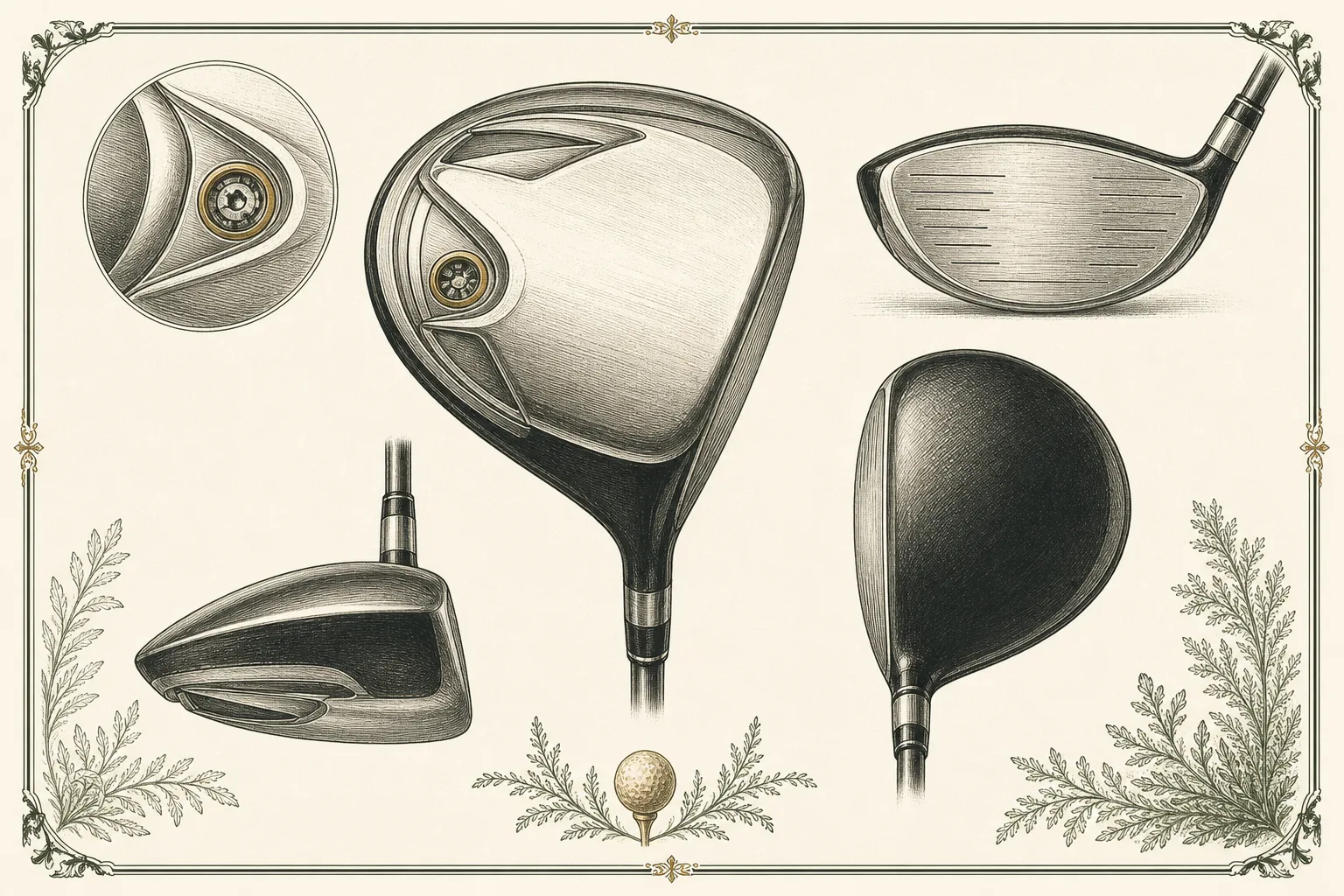
A catalog row covering the named 425 and 425 TP heads; confirm the full sole marking before selection.
“Ultra-thin walls freed 40g into the weights, boosting shot-shape range over the Quad. The TP is a compact, faster-swing head; the 425 is a tinkerer's antique now.”
The r7 425 was TaylorMade's follow-up to the 2004 r7 Quad that had already won the U.S. Open in Retief Goosen's hands, and it existed to solve one problem: the Quad's 400cc head was getting left behind as rivals grew their heads toward the USGA's then-new 460cc volume ceiling. TaylorMade's answer was Ultra-Thin Wall (UTW) casting, shrinking wall thickness to just 0.6mm -- about 40% thinner than typical competitor walls and 25% thinner than the original Quad -- which freed enough mass to grow the head to 425cc while still carrying 28 grams of movable weight split across two widely spaced TaylorMade Launch Control (TLC) ports. Shifting that weight moved the CG laterally up to 5mm and produced a measured 13-yard swing in shot shape in TaylorMade's own robot testing. The 425 TP sat above it as the tour-spec version: a different Fujikura REAX shaft built on Rombax technology, a slightly open face (since better players square it up themselves), and a price roughly $400 higher than the standard 425. It was TaylorMade's flagship for one season before the 460cc r7 460 took over in 2006 as the volume cap finally allowed a full-size head.
It was the No. 1 driver model in its own PGA Tour debut, in the bags of Sergio Garcia, Retief Goosen, Fred Funk, Sean O'Hair, Peter Lonard and Kenny Perry, and Bleacher Report later ran a retrospective calling it 'the driver that changed the world' for popularizing movable-weight adjustability that every major brand copied within a few years. It has real documented significance rather than a collector cult -- nobody hunts down a clean 425 today, and it sells as a cheap, obsolete-tech driver, not a keepsake.
The standard 425 suits a mid-handicap player of that era's swing speeds who wants a mid-size, workable head with some tunability. The TP is for a faster-swinging, better ball-striker who wants to shape shots and doesn't need face-closing help. Neither is a sensible buy today for someone chasing distance -- a modern 460cc driver with adjustable hosel and a lower-spin, higher-MOI design will outperform both by a wide margin.
It launched into the same movable-weight arms race as Callaway's Big Bertha Fusion and Ping's G2, and directly preceded TaylorMade's own r7 460 (2006), which used the same UTW approach to finally fill out to the full 460cc limit. The r7 425's two-port TLC system was itself a scaled-down version of the four-port system used on the original r7 Quad, and it was the last mid-size (sub-460cc) flagship TaylorMade driver before the industry standardized on the volume ceiling.
For a 2005 driver it launched easily and the movable weight let a fitter bias it toward more forgiveness (heel-biased) or more workability (toe-biased), but at 425cc it is meaningfully smaller and lower-MOI than any driver made after the 460cc ceiling arrived a year later. The TP is the less forgiving of the two: an intentionally open face and tour shaft assume a repeatable release, so mis-hits open the face further than the standard 425 would.
Calibrated across the whole catalog — a tour blade scores low here on purpose; it means control, not ease.
Both versions are now bargain-bin clubs: 2nd Swing lists used r7 425s from about $48 (poor condition) up to roughly $88 (average condition), well off any nostalgia premium; TP versions with upgraded shafts trade only slightly higher on eBay. It sells purely as a cheap, playable-if-dated driver for a beginner or as a garage-sale find, not as a collectible.
The Legends Rack
The tour-spec version of the Quad — smaller, spinnier-window, the head serious players actually gamed. A sneaky "better-player bait" club for the rack. Who'll love it: low-handicaps who want to feel what 2005 tour golf felt like.
Who it suitsBetter players
Reading is one thing — hitting is another. Book a bay and see the numbers for yourself before you buy anywhere.
A catalog row covering the named 425 and 425 TP heads; confirm the full sole marking before selection.
“Ultra-thin walls freed 40g into the weights, boosting shot-shape range over the Quad. The TP is a compact, faster-swing head; the 425 is a tinkerer's antique now.”
The r7 425 was TaylorMade's follow-up to the 2004 r7 Quad that had already won the U.S. Open in Retief Goosen's hands, and it existed to solve one problem: the Quad's 400cc head was getting left behind as rivals grew their heads toward the USGA's then-new 460cc volume ceiling. TaylorMade's answer was Ultra-Thin Wall (UTW) casting, shrinking wall thickness to just 0.6mm -- about 40% thinner than typical competitor walls and 25% thinner than the original Quad -- which freed enough mass to grow the head to 425cc while still carrying 28 grams of movable weight split across two widely spaced TaylorMade Launch Control (TLC) ports. Shifting that weight moved the CG laterally up to 5mm and produced a measured 13-yard swing in shot shape in TaylorMade's own robot testing. The 425 TP sat above it as the tour-spec version: a different Fujikura REAX shaft built on Rombax technology, a slightly open face (since better players square it up themselves), and a price roughly $400 higher than the standard 425. It was TaylorMade's flagship for one season before the 460cc r7 460 took over in 2006 as the volume cap finally allowed a full-size head.
It was the No. 1 driver model in its own PGA Tour debut, in the bags of Sergio Garcia, Retief Goosen, Fred Funk, Sean O'Hair, Peter Lonard and Kenny Perry, and Bleacher Report later ran a retrospective calling it 'the driver that changed the world' for popularizing movable-weight adjustability that every major brand copied within a few years. It has real documented significance rather than a collector cult -- nobody hunts down a clean 425 today, and it sells as a cheap, obsolete-tech driver, not a keepsake.
The standard 425 suits a mid-handicap player of that era's swing speeds who wants a mid-size, workable head with some tunability. The TP is for a faster-swinging, better ball-striker who wants to shape shots and doesn't need face-closing help. Neither is a sensible buy today for someone chasing distance -- a modern 460cc driver with adjustable hosel and a lower-spin, higher-MOI design will outperform both by a wide margin.
It launched into the same movable-weight arms race as Callaway's Big Bertha Fusion and Ping's G2, and directly preceded TaylorMade's own r7 460 (2006), which used the same UTW approach to finally fill out to the full 460cc limit. The r7 425's two-port TLC system was itself a scaled-down version of the four-port system used on the original r7 Quad, and it was the last mid-size (sub-460cc) flagship TaylorMade driver before the industry standardized on the volume ceiling.
For a 2005 driver it launched easily and the movable weight let a fitter bias it toward more forgiveness (heel-biased) or more workability (toe-biased), but at 425cc it is meaningfully smaller and lower-MOI than any driver made after the 460cc ceiling arrived a year later. The TP is the less forgiving of the two: an intentionally open face and tour shaft assume a repeatable release, so mis-hits open the face further than the standard 425 would.
Calibrated across the whole catalog — a tour blade scores low here on purpose; it means control, not ease.
Both versions are now bargain-bin clubs: 2nd Swing lists used r7 425s from about $48 (poor condition) up to roughly $88 (average condition), well off any nostalgia premium; TP versions with upgraded shafts trade only slightly higher on eBay. It sells purely as a cheap, playable-if-dated driver for a beginner or as a garage-sale find, not as a collectible.
The Legends Rack
The tour-spec version of the Quad — smaller, spinnier-window, the head serious players actually gamed. A sneaky "better-player bait" club for the rack. Who'll love it: low-handicaps who want to feel what 2005 tour golf felt like.
Who it suitsBetter players
Reading is one thing — hitting is another. Book a bay and see the numbers for yourself before you buy anywhere.