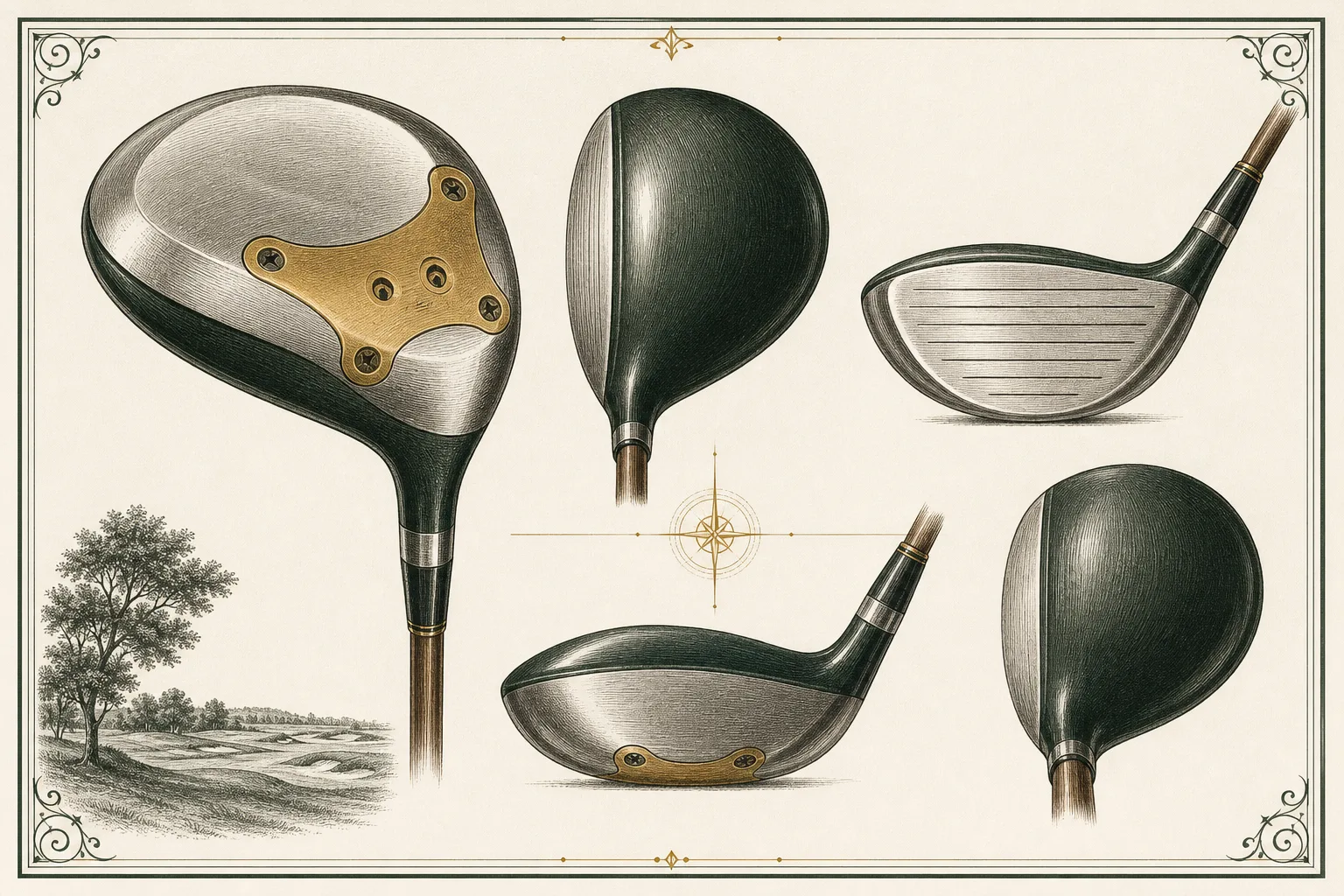
“The Short-Straight-Hollow-Hosel wood that seeded the Big Bertha hosel; strictly a collector/history piece today. Steer any real gamer to a modern max-forgiveness head.”
The S2H2 (Short, Straight, Hollow Hosel) was Callaway's first proprietary driver, launched in 1988 as the company pivoted from a wine-and-clothing conglomerate offshoot into a dedicated club maker. Instead of a traditional hosel, the shaft bored straight through the small (roughly 150cc) stainless steel head down toward the sole, letting Callaway relocate weight from the neck into the perimeter of the clubhead for more stability on off-center hits - the same S2H2 concept had already appeared in Callaway irons that year. The driver's commercial impact was immediate: Callaway's total sales more than doubled between 1988 and 1989, from $4.8 million to $10.4 million, and journeyman pro Don Bies won a tour event gaming the S2H2 driver in 1990. It is the direct engineering ancestor of the bore-through hosel construction Callaway carried into the original Big Bertha three years later.
Genuinely historically important as Callaway's first proprietary driver and the technical seed of Big Bertha, and it is documented as the trigger for the company's sales more than doubling in a single year - but that significance is corporate/historical, not a living player cult. There's no ongoing GolfWRX-style hunt for clean S2H2 drivers the way there is for a Mizuno MP-32; it's a footnote collectors and historians value, not a gamer's club.
Today it's a history/collector piece rather than a playable gamer's driver - anyone wanting a functional driver should look at essentially any modern 460cc head. Its only real 'fit' now is for someone assembling a period-correct Callaway display set or researching the S2H2-to-Big Bertha lineage.
Launched the same year Callaway Golf Company began operating independently, competing against small-headed steel drivers from Taylor Made, Ping, and persimmon holdouts in the late-1980s metalwood transition. It was directly superseded by the original Big Bertha driver in 1991, which scaled the same bore-through, perimeter-weighting philosophy into a much larger, more forgiving head that redefined the category.
Forgiving relative to the small-headed persimmon and early steel drivers it competed against in 1988 - the bore-through hosel moved real mass into the perimeter - but by any absolute or modern standard a roughly 150cc stainless steel head is tiny and unforgiving. There is little of the deep-CG, high-MOI engineering that defines forgiveness in a modern 460cc driver; it demands a centered strike to perform at all.
Calibrated across the whole catalog — a tour blade scores low here on purpose; it means control, not ease.
A PGA of America equipment value guide lists a nominal average value around $300, but that figure reads as a generic reference/insurance number rather than a realistic private-party price. Actual completed eBay sales for a 1988 S2H2 driver in playable condition are far lower, typically in the $30-$80 range, reflecting its age, small head, and status as a curiosity rather than a usable modern driver.
Reading is one thing — hitting is another. Book a bay and see the numbers for yourself before you buy anywhere.
“The Short-Straight-Hollow-Hosel wood that seeded the Big Bertha hosel; strictly a collector/history piece today. Steer any real gamer to a modern max-forgiveness head.”
The S2H2 (Short, Straight, Hollow Hosel) was Callaway's first proprietary driver, launched in 1988 as the company pivoted from a wine-and-clothing conglomerate offshoot into a dedicated club maker. Instead of a traditional hosel, the shaft bored straight through the small (roughly 150cc) stainless steel head down toward the sole, letting Callaway relocate weight from the neck into the perimeter of the clubhead for more stability on off-center hits - the same S2H2 concept had already appeared in Callaway irons that year. The driver's commercial impact was immediate: Callaway's total sales more than doubled between 1988 and 1989, from $4.8 million to $10.4 million, and journeyman pro Don Bies won a tour event gaming the S2H2 driver in 1990. It is the direct engineering ancestor of the bore-through hosel construction Callaway carried into the original Big Bertha three years later.
Genuinely historically important as Callaway's first proprietary driver and the technical seed of Big Bertha, and it is documented as the trigger for the company's sales more than doubling in a single year - but that significance is corporate/historical, not a living player cult. There's no ongoing GolfWRX-style hunt for clean S2H2 drivers the way there is for a Mizuno MP-32; it's a footnote collectors and historians value, not a gamer's club.
Today it's a history/collector piece rather than a playable gamer's driver - anyone wanting a functional driver should look at essentially any modern 460cc head. Its only real 'fit' now is for someone assembling a period-correct Callaway display set or researching the S2H2-to-Big Bertha lineage.
Launched the same year Callaway Golf Company began operating independently, competing against small-headed steel drivers from Taylor Made, Ping, and persimmon holdouts in the late-1980s metalwood transition. It was directly superseded by the original Big Bertha driver in 1991, which scaled the same bore-through, perimeter-weighting philosophy into a much larger, more forgiving head that redefined the category.
Forgiving relative to the small-headed persimmon and early steel drivers it competed against in 1988 - the bore-through hosel moved real mass into the perimeter - but by any absolute or modern standard a roughly 150cc stainless steel head is tiny and unforgiving. There is little of the deep-CG, high-MOI engineering that defines forgiveness in a modern 460cc driver; it demands a centered strike to perform at all.
Calibrated across the whole catalog — a tour blade scores low here on purpose; it means control, not ease.
A PGA of America equipment value guide lists a nominal average value around $300, but that figure reads as a generic reference/insurance number rather than a realistic private-party price. Actual completed eBay sales for a 1988 S2H2 driver in playable condition are far lower, typically in the $30-$80 range, reflecting its age, small head, and status as a curiosity rather than a usable modern driver.
Reading is one thing — hitting is another. Book a bay and see the numbers for yourself before you buy anywhere.