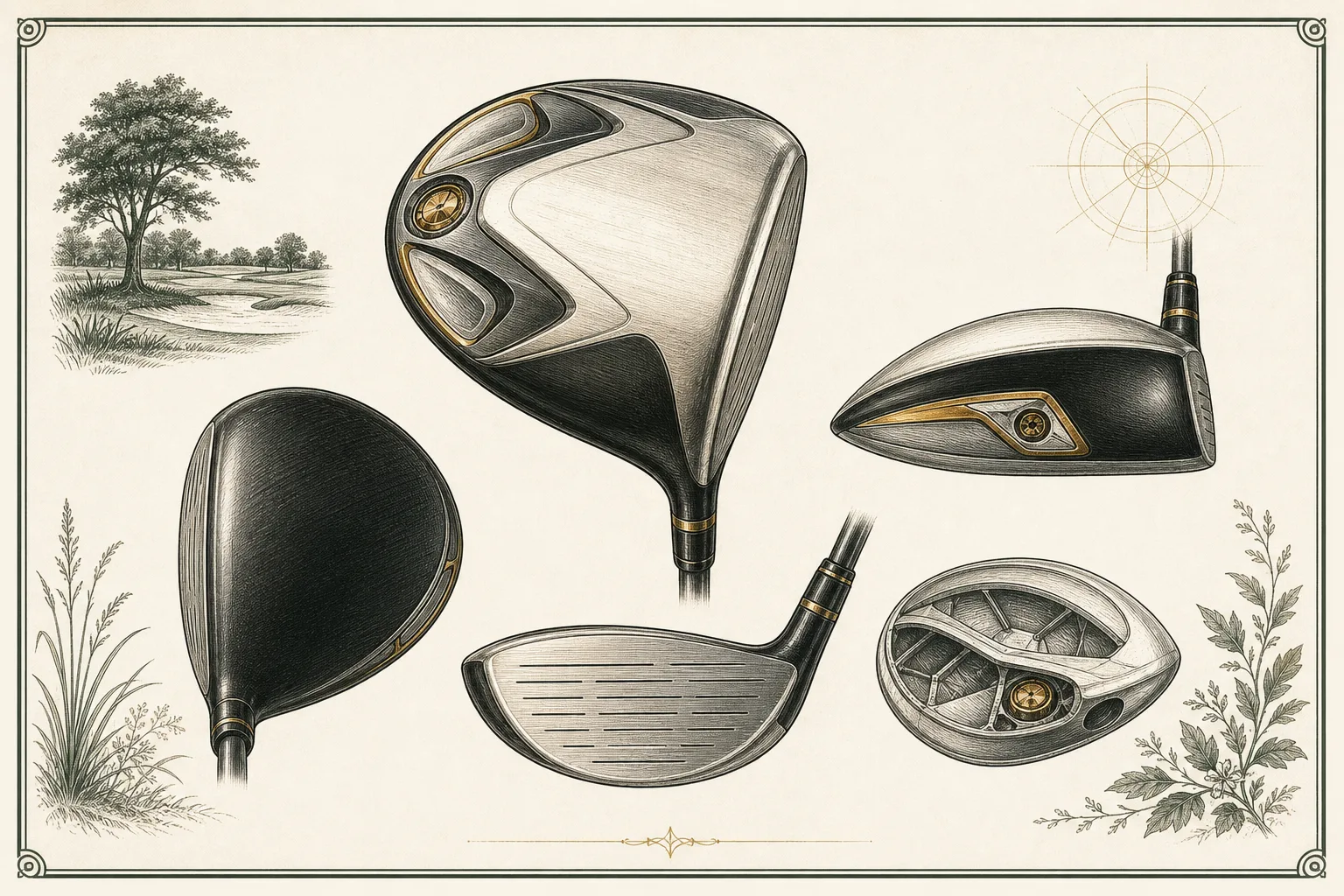
Named Limited/TP players version; choose only for that exact head.
“A limited-run, lower-spin players' r7 that collectors chase. Needs ~95+ mph and a repeatable strike to be worth the rung-3 spin trade-off.”
The r7 Limited was TaylorMade's late-r7-era driver for players who spin the ball too much off the tee, built around a slightly smaller 440cc titanium head (down from the standard 460cc) specifically to lower spin and reduce hook/slice on off-center hits. It kept three TLC movable weights rather than the SuperQuad's four, but TaylorMade claimed the redistribution could still swing ball flight by as much as 35 yards left-to-right — more than it credited to the four-weight r7 Quad. The TP version added an upgraded tour-caliber shaft. TaylorMade's literature billed it 'TaylorMade's Best Movable-Weight Driver Ever,' and Sergio Garcia backed the claim by winning the 2008 Castello Masters gaming a new r7 Limited, closing 20-under at 294.38 yards off the tee.
It has real credentials — a same-season PGA European Tour win for Sergio Garcia and TaylorMade's own superlative marketing tag — but that is tour pedigree and advertising, not evidence of ongoing enthusiast pursuit today. There is no active forum hunt for clean examples and no scarcity narrative; it reads as a well-regarded, late-cycle players' driver rather than a club people specifically chase two decades on.
Better players and low-to-mid handicappers who already generate strong ball speed but spin the driver too much, costing them carry and total distance. High-handicappers or golfers who struggle to get the ball airborne should stick with the standard 460cc r7 or SuperQuad — the smaller head and low-spin design work against exactly the problem they need solved.
Released in 2008 as TaylorMade's final r7-generation driver before the R9 line replaced it later that year — the R9's arrival was already pushing r7 Limited street prices down from $399.99 to $299.99 at retail before the model was fully discontinued. It competed with low-spin players' drivers of the moment like Titleist's 909D2/D3 and Callaway's FT-5. A modern equivalent is a low-spin adjustable driver like a Titleist TSR3 or Callaway Paradym Triple Diamond.
The 440cc head is smaller than the maximum-legal 460cc heads used across the rest of the r7 line specifically to cut spin, which trades away some forgiveness for players who need help getting the ball airborne — TaylorMade's own positioning was for golfers who already spin the ball too much, i.e. better players, not high-handicappers. Reviewers noted it could balloon into the wind for higher-spin swings and does not roll out as much for average players as the low-spin promise suggests.
Calibrated across the whole catalog — a tour blade scores low here on purpose; it means control, not ease.
Realistic 2026 private-party prices run roughly $55-110 for a clean standard r7 Limited head, with TP-shafted examples toward the top of that range or slightly above for a clean, correct pairing — modestly above a base r7 460 of the same era but well short of true collector pricing, reflecting the tour pedigree without a genuine cult premium.
Reading is one thing — hitting is another. Book a bay and see the numbers for yourself before you buy anywhere.
Named Limited/TP players version; choose only for that exact head.
“A limited-run, lower-spin players' r7 that collectors chase. Needs ~95+ mph and a repeatable strike to be worth the rung-3 spin trade-off.”
The r7 Limited was TaylorMade's late-r7-era driver for players who spin the ball too much off the tee, built around a slightly smaller 440cc titanium head (down from the standard 460cc) specifically to lower spin and reduce hook/slice on off-center hits. It kept three TLC movable weights rather than the SuperQuad's four, but TaylorMade claimed the redistribution could still swing ball flight by as much as 35 yards left-to-right — more than it credited to the four-weight r7 Quad. The TP version added an upgraded tour-caliber shaft. TaylorMade's literature billed it 'TaylorMade's Best Movable-Weight Driver Ever,' and Sergio Garcia backed the claim by winning the 2008 Castello Masters gaming a new r7 Limited, closing 20-under at 294.38 yards off the tee.
It has real credentials — a same-season PGA European Tour win for Sergio Garcia and TaylorMade's own superlative marketing tag — but that is tour pedigree and advertising, not evidence of ongoing enthusiast pursuit today. There is no active forum hunt for clean examples and no scarcity narrative; it reads as a well-regarded, late-cycle players' driver rather than a club people specifically chase two decades on.
Better players and low-to-mid handicappers who already generate strong ball speed but spin the driver too much, costing them carry and total distance. High-handicappers or golfers who struggle to get the ball airborne should stick with the standard 460cc r7 or SuperQuad — the smaller head and low-spin design work against exactly the problem they need solved.
Released in 2008 as TaylorMade's final r7-generation driver before the R9 line replaced it later that year — the R9's arrival was already pushing r7 Limited street prices down from $399.99 to $299.99 at retail before the model was fully discontinued. It competed with low-spin players' drivers of the moment like Titleist's 909D2/D3 and Callaway's FT-5. A modern equivalent is a low-spin adjustable driver like a Titleist TSR3 or Callaway Paradym Triple Diamond.
The 440cc head is smaller than the maximum-legal 460cc heads used across the rest of the r7 line specifically to cut spin, which trades away some forgiveness for players who need help getting the ball airborne — TaylorMade's own positioning was for golfers who already spin the ball too much, i.e. better players, not high-handicappers. Reviewers noted it could balloon into the wind for higher-spin swings and does not roll out as much for average players as the low-spin promise suggests.
Calibrated across the whole catalog — a tour blade scores low here on purpose; it means control, not ease.
Realistic 2026 private-party prices run roughly $55-110 for a clean standard r7 Limited head, with TP-shafted examples toward the top of that range or slightly above for a clean, correct pairing — modestly above a base r7 460 of the same era but well short of true collector pricing, reflecting the tour pedigree without a genuine cult premium.
Reading is one thing — hitting is another. Book a bay and see the numbers for yourself before you buy anywhere.