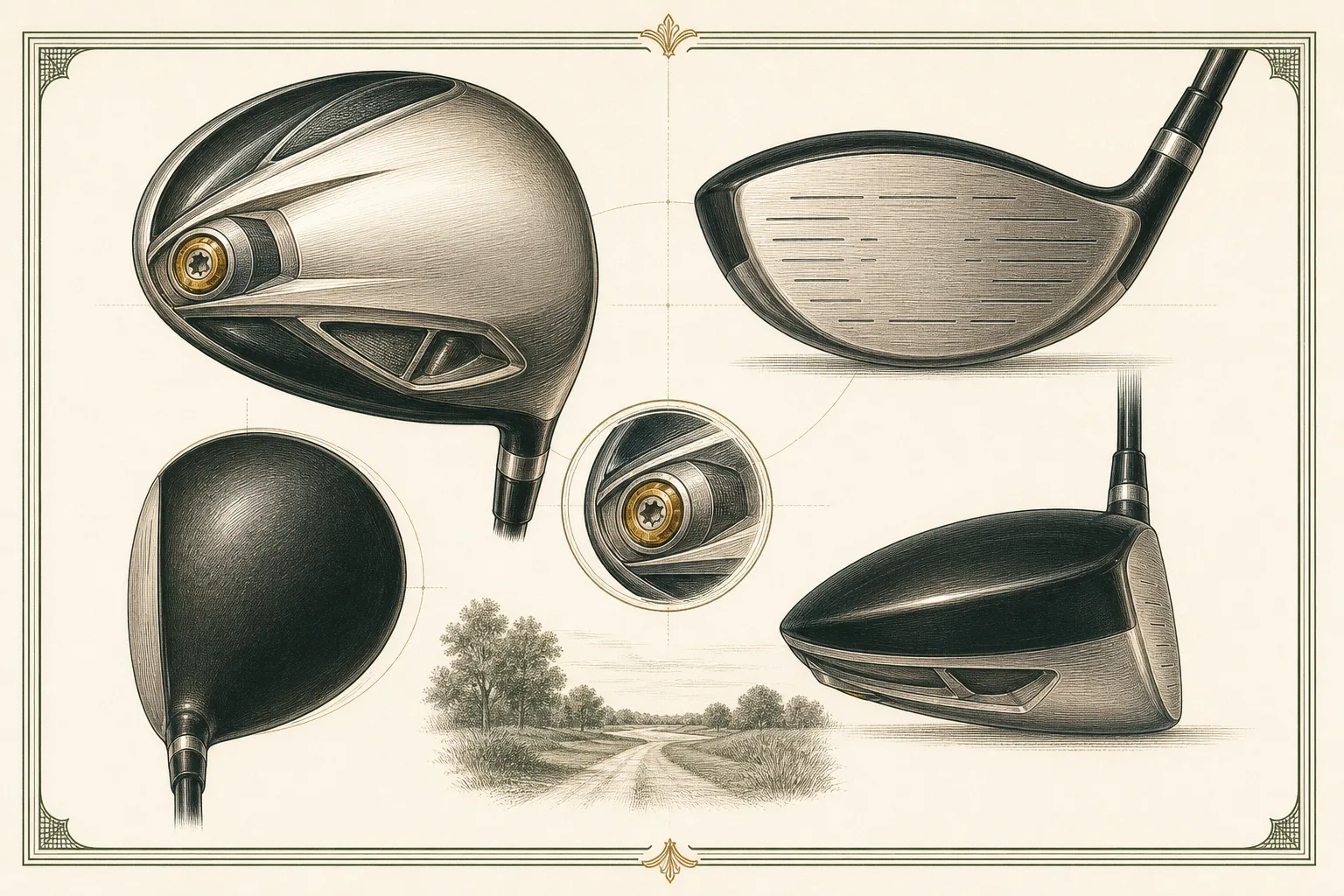
Draw-biased head intended to reduce a right miss.
“A fixed draw-bias r7 for the persistent slice. A rung-1 head-choice band-aid, honestly labeled.”
TaylorMade's mid-2000s answer to the recreational slice: a 460cc titanium head with 'Draw-Weighted Technology' — extra mass packed into the heel and a face angle closed relative to the standard r7 — moving the CG closer to the shaft axis to speed up how fast the clubface releases and squares through the downswing. TaylorMade marketed the face as more closed than any driver it had sold before. Priced at $299, well below premium tour-spec drivers of the day, it targeted the high-handicap golfer wanting an off-the-rack fix rather than a fitting. Contemporary reviewers found it did exactly what it promised — testers who fought a slice saw it die — while noting it simply is not a club for anyone who already draws the ball.
Well regarded in its own right — golfreview.com users rate it 4.4/5 across 37 reviews and period write-ups called the r7 line among the best drivers available in 2006 — but that reputation is functional rather than cultural. There is no scarcity, no tour legend, and no ongoing forum hunt for clean examples; it earned a solid name as an honest, affordable slice-fix and nothing more.
Mid-to-high handicap slicers and fade-fighters who want an inexpensive, no-fitting-required fix. A player with a neutral or draw-tending swing, or anyone chasing modern ball speed, should look elsewhere — the deliberately closed face/heel bias actively works against them, and 20-year-old titanium and shaft technology is well behind current drivers.
Launched as TaylorMade's budget-friendly ($299) counterpart to the standard r7 460 and the movable-weight r7 Quad, competing against Callaway's Big Bertha Fusion Draw-biased offerings and Ping's G5 draw/offset variants of the same period. It predates TaylorMade folding true movable-weight tech into every driver tier; a modern equivalent is a fixed draw-bias driver like a Callaway Rogue ST Max D or Cobra Air-X, built on the same heel-CG principle with two decades more aerodynamic and material refinement.
Deep-faced 460cc titanium head built for a high moment of inertia, on top of the deliberate heel weighting that helps square a habitually open face — off-center hits and mis-timed releases are both cushioned. It shares the ceiling-size head of the standard 460cc r7, so raw MOI-driven forgiveness is strong; the score reflects that plus the added slice-correction, not a neutral player's experience (a neutral or draw-prone swing will simply see the ball go left).
Calibrated across the whole catalog — a tour blade scores low here on purpose; it means control, not ease.
Realistic 2026 private-party prices run roughly $40-80 for a clean head-and-stock-shaft example on eBay/SidelineSwap; graded retailer listings (2nd Swing, Golf Avenue) price higher but that reflects warranty/condition grading, not desirability. It is a cheap, plentiful 20-year-old driver with no collector premium.
Reading is one thing — hitting is another. Book a bay and see the numbers for yourself before you buy anywhere.
Draw-biased head intended to reduce a right miss.
“A fixed draw-bias r7 for the persistent slice. A rung-1 head-choice band-aid, honestly labeled.”
TaylorMade's mid-2000s answer to the recreational slice: a 460cc titanium head with 'Draw-Weighted Technology' — extra mass packed into the heel and a face angle closed relative to the standard r7 — moving the CG closer to the shaft axis to speed up how fast the clubface releases and squares through the downswing. TaylorMade marketed the face as more closed than any driver it had sold before. Priced at $299, well below premium tour-spec drivers of the day, it targeted the high-handicap golfer wanting an off-the-rack fix rather than a fitting. Contemporary reviewers found it did exactly what it promised — testers who fought a slice saw it die — while noting it simply is not a club for anyone who already draws the ball.
Well regarded in its own right — golfreview.com users rate it 4.4/5 across 37 reviews and period write-ups called the r7 line among the best drivers available in 2006 — but that reputation is functional rather than cultural. There is no scarcity, no tour legend, and no ongoing forum hunt for clean examples; it earned a solid name as an honest, affordable slice-fix and nothing more.
Mid-to-high handicap slicers and fade-fighters who want an inexpensive, no-fitting-required fix. A player with a neutral or draw-tending swing, or anyone chasing modern ball speed, should look elsewhere — the deliberately closed face/heel bias actively works against them, and 20-year-old titanium and shaft technology is well behind current drivers.
Launched as TaylorMade's budget-friendly ($299) counterpart to the standard r7 460 and the movable-weight r7 Quad, competing against Callaway's Big Bertha Fusion Draw-biased offerings and Ping's G5 draw/offset variants of the same period. It predates TaylorMade folding true movable-weight tech into every driver tier; a modern equivalent is a fixed draw-bias driver like a Callaway Rogue ST Max D or Cobra Air-X, built on the same heel-CG principle with two decades more aerodynamic and material refinement.
Deep-faced 460cc titanium head built for a high moment of inertia, on top of the deliberate heel weighting that helps square a habitually open face — off-center hits and mis-timed releases are both cushioned. It shares the ceiling-size head of the standard 460cc r7, so raw MOI-driven forgiveness is strong; the score reflects that plus the added slice-correction, not a neutral player's experience (a neutral or draw-prone swing will simply see the ball go left).
Calibrated across the whole catalog — a tour blade scores low here on purpose; it means control, not ease.
Realistic 2026 private-party prices run roughly $40-80 for a clean head-and-stock-shaft example on eBay/SidelineSwap; graded retailer listings (2nd Swing, Golf Avenue) price higher but that reflects warranty/condition grading, not desirability. It is a cheap, plentiful 20-year-old driver with no collector premium.
Reading is one thing — hitting is another. Book a bay and see the numbers for yourself before you buy anywhere.