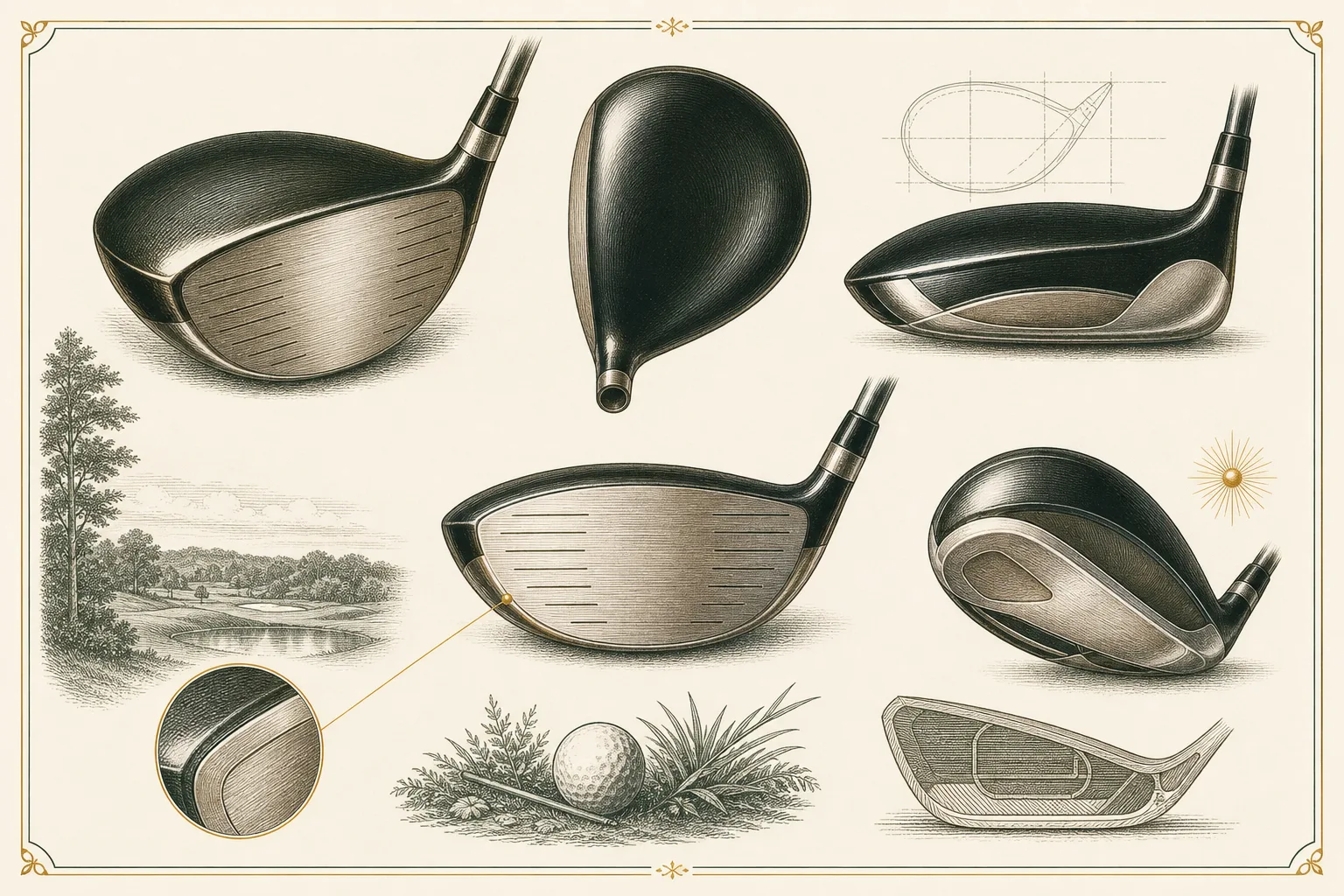
“The 330cc launch model kicked off the Launcher name with a thin, high-COR titanium face for players who wanted a smaller, more workable head. The tighter footprint pushes it toward the low-spin/players rung rather than max forgiveness.”
Cleveland's original Launcher, launched in 2002, was the company's answer to a market suddenly obsessed with thin, spring-faced titanium drivers: rather than chase the biggest possible head, Cleveland built a deliberately compact 330cc clubhead around a welded Beta-titanium face pushed to the USGA's legal coefficient-of-restitution ceiling. It launched at $399 in the thick of the early-2000s 'COR wars,' when Callaway's ERC II and other high-spring designs were being sold as non-conforming or grey-market clubs and the USGA and R&A were mid-negotiation over a universal spring-like-effect limit. Cleveland's pitch was different: stay legal, keep the head small and shapeable like the persimmon-and-steel drivers better players still trusted, but use the thin face to make a 330cc head play as long as rivals' oversized heads. It shipped alongside a 400cc sibling built on the same face technology for players who wanted more forgiveness instead of more shape control.
No tour legend or lawsuit attaches to it, but it built a genuine quiet following among players who wanted a smaller, more shapeable titanium head in an era rushing toward bigger heads — golfreview.com users rate it 4.4/5 across 42 reviews, and period forum posters singled out its stock Fujikura shaft and Golf Pride grips as better than what rivals shipped stock at the time.
Suited early-2000s players who wanted the speed benefit of a legal-limit thin titanium face without giving up the smaller, more workable head shape and feel of a traditional-sized driver — better ball-strikers and those transitioning off steel or persimmon. A high-handicapper chasing maximum forgiveness was better served even then by the companion Launcher 400, and by far more forgiving designs since.
It arrived the same year Callaway's Great Big Bertha II and non-conforming designs like the ERC II were pushing at or past the USGA's coefficient-of-restitution ceiling, and Titleist's 975D and TaylorMade's early titanium drivers were chasing the same forgiveness-and-distance buyer. Cleveland's own answer to the industry's rush toward bigger heads arrived fast: the 460cc Launcher followed in 2003 as one of the first 460cc heads to reach full retail, and by mid-decade 400cc-plus had become the default, leaving the compact 330 a brief detour rather than a template.
At 330cc it sits deliberately on the compact, workable end for a titanium driver of its generation — more forgiving than the persimmon- and steel-era clubs it was replacing in bags, but noticeably less forgiving than its own 400cc sibling or the 460cc-plus heads the whole industry pivoted to within a year or two. It rewards a repeatable center-face strike more than it bails out a mis-hit.
Calibrated across the whole catalog — a tour blade scores low here on purpose; it means control, not ease.
Largely cycled out of circulation: 2nd Swing and SidelineSwap listings (when in stock) show used asking prices roughly in the $30-$65 range in 2024-2026, down from its $399 MSRP, driven mainly by shaft and cosmetic condition rather than any collector premium — it trades as a cheap, functional old driver, not a sought-after piece.
Reading is one thing — hitting is another. Book a bay and see the numbers for yourself before you buy anywhere.
“The 330cc launch model kicked off the Launcher name with a thin, high-COR titanium face for players who wanted a smaller, more workable head. The tighter footprint pushes it toward the low-spin/players rung rather than max forgiveness.”
Cleveland's original Launcher, launched in 2002, was the company's answer to a market suddenly obsessed with thin, spring-faced titanium drivers: rather than chase the biggest possible head, Cleveland built a deliberately compact 330cc clubhead around a welded Beta-titanium face pushed to the USGA's legal coefficient-of-restitution ceiling. It launched at $399 in the thick of the early-2000s 'COR wars,' when Callaway's ERC II and other high-spring designs were being sold as non-conforming or grey-market clubs and the USGA and R&A were mid-negotiation over a universal spring-like-effect limit. Cleveland's pitch was different: stay legal, keep the head small and shapeable like the persimmon-and-steel drivers better players still trusted, but use the thin face to make a 330cc head play as long as rivals' oversized heads. It shipped alongside a 400cc sibling built on the same face technology for players who wanted more forgiveness instead of more shape control.
No tour legend or lawsuit attaches to it, but it built a genuine quiet following among players who wanted a smaller, more shapeable titanium head in an era rushing toward bigger heads — golfreview.com users rate it 4.4/5 across 42 reviews, and period forum posters singled out its stock Fujikura shaft and Golf Pride grips as better than what rivals shipped stock at the time.
Suited early-2000s players who wanted the speed benefit of a legal-limit thin titanium face without giving up the smaller, more workable head shape and feel of a traditional-sized driver — better ball-strikers and those transitioning off steel or persimmon. A high-handicapper chasing maximum forgiveness was better served even then by the companion Launcher 400, and by far more forgiving designs since.
It arrived the same year Callaway's Great Big Bertha II and non-conforming designs like the ERC II were pushing at or past the USGA's coefficient-of-restitution ceiling, and Titleist's 975D and TaylorMade's early titanium drivers were chasing the same forgiveness-and-distance buyer. Cleveland's own answer to the industry's rush toward bigger heads arrived fast: the 460cc Launcher followed in 2003 as one of the first 460cc heads to reach full retail, and by mid-decade 400cc-plus had become the default, leaving the compact 330 a brief detour rather than a template.
At 330cc it sits deliberately on the compact, workable end for a titanium driver of its generation — more forgiving than the persimmon- and steel-era clubs it was replacing in bags, but noticeably less forgiving than its own 400cc sibling or the 460cc-plus heads the whole industry pivoted to within a year or two. It rewards a repeatable center-face strike more than it bails out a mis-hit.
Calibrated across the whole catalog — a tour blade scores low here on purpose; it means control, not ease.
Largely cycled out of circulation: 2nd Swing and SidelineSwap listings (when in stock) show used asking prices roughly in the $30-$65 range in 2024-2026, down from its $399 MSRP, driven mainly by shaft and cosmetic condition rather than any collector premium — it trades as a cheap, functional old driver, not a sought-after piece.
Reading is one thing — hitting is another. Book a bay and see the numbers for yourself before you buy anywhere.