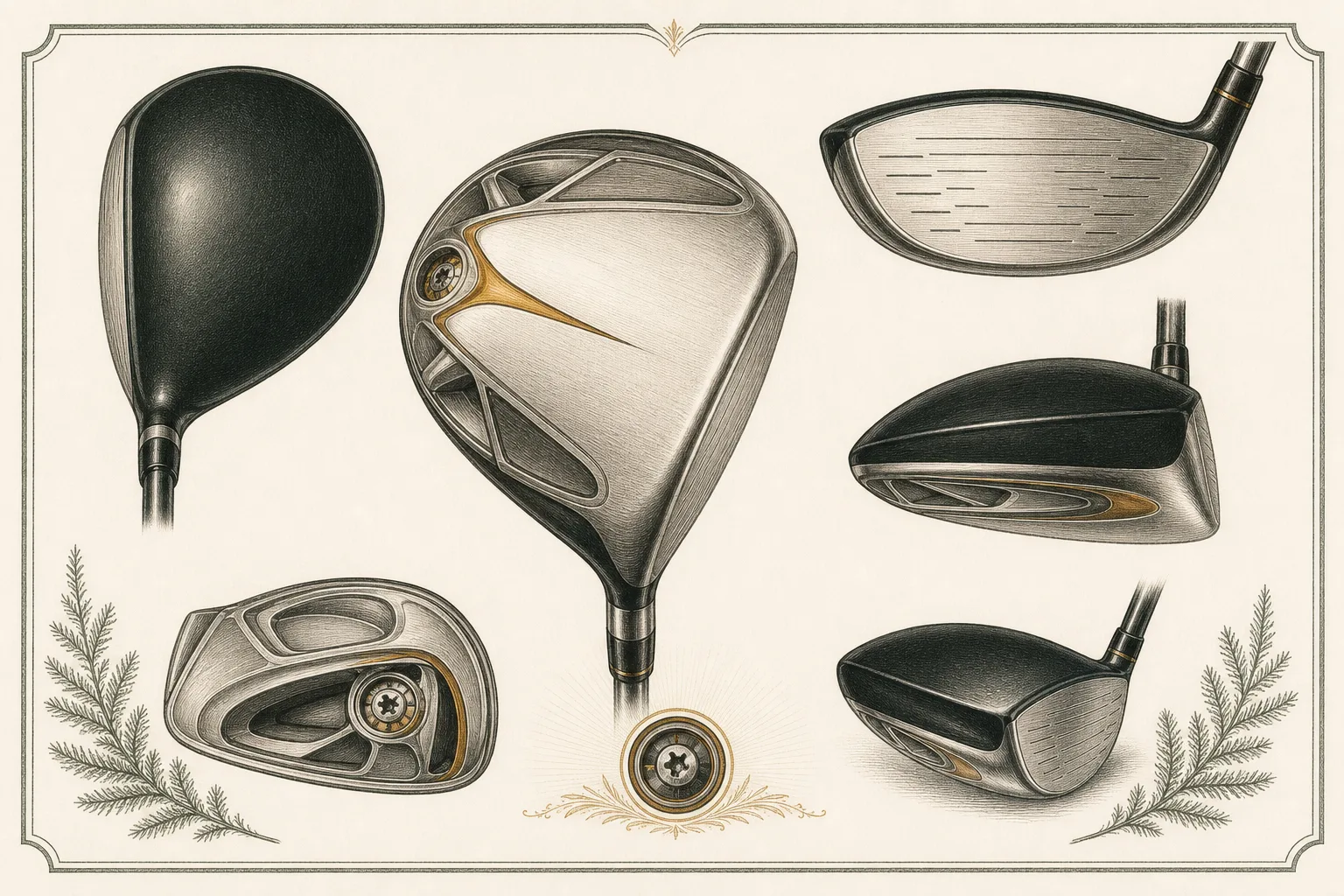
A distinct SuperQuad generation; match the full name printed on the head.
“Announced January 2007, on shelves that February - the 460cc SuperQuad's four-port MWT (26 total grams) let players dial draw/fade bias, heavier-feeling (D5 swingweight) than the plain r7 460. Confirmed via TaylorMade's own spec sheet.”
Announced January 2007, on shelves the next month, the SuperQuad took the movable-weight idea the original r7 Quad introduced three years earlier and applied it to a full 460cc, maximum-legal titanium head — four TLC weight ports totaling 26 grams versus the Quad's 24, paired with Inverted Cone and Pull-Face tech for higher ball speed on off-center hits. TaylorMade's spec sheet lists a D5 swingweight, heavier-feeling than the standard r7 460, with RE*AX 65 by Fujikura as stock shaft across M/R/S/X flex. It became one of the best-selling, reviewed drivers of its era — golfreview.com users rate it 4.3/5 across 61 reviews — and a MyGolfSpy thread years later, asking whether it is 'one of the best drivers ever made,' shows owners still pulling it from storage to compare against modern drivers.
It has real, sustained enthusiast affection — the MyGolfSpy forum thread of owners re-testing decade-old SuperQuads against current drivers, and its frequent mention alongside the r7 Quad in 'best TaylorMade driver ever' style retrospectives — but this reads as genuine nostalgia for a well-loved mainstream product rather than the active-hunt, scarcity-driven behavior that defines a true cult classic. It was a mass-market bestseller, not a rare or hard-to-find piece.
A broad range of moderate-to-fast swing speeds (roughly 90-108 mph) wanting a forgiving, tunable 460cc driver without a full custom fitting — its combination of max legal head size and adjustable weighting made it a genuine do-it-yourself fitting tool for its day. It suits recreational and better players alike; only someone wanting a compact, low-spin players' head (the r7 TP or r7 Limited) should look elsewhere in the same family.
Released in 2007 as the full-size flagship successor to the smaller-headed 2004 r7 Quad and sat above the standard r7 460 in TaylorMade's lineup, competing with Callaway's Big Bertha Fortune/FT-5 and Titleist's 905/909 drivers of the period, all racing to fill out the newly legal 460cc ceiling. TaylorMade itself later used it as its own internal benchmark, running a public 'M1 vs. r7 SuperQuad' comparison to show a decade of ball-speed and spin gains. A modern equivalent is a mainstream adjustable 460cc driver like a TaylorMade Qi35 Max or Callaway Elyte Max.
A full 460cc head — the maximum legal size — with four movable weight ports (26 grams total) for CG tuning plus Inverted Cone Technology for ball-speed retention on off-center strikes gives it strong, era-appropriate forgiveness; period reviews specifically praised it as forgiving and easy to launch with consistent ball speed on mis-hits. It trails today's multi-material, AI-optimized max-forgiveness heads, but among 2007-era 460cc drivers it sat at the forgiving end.
Calibrated across the whole catalog — a tour blade scores low here on purpose; it means control, not ease.
Realistic 2026 private-party value runs roughly $45-90 for a clean example with stock shaft on eBay/SidelineSwap; graded retailer listings (2nd Swing) price higher, reflecting condition warranty rather than genuine scarcity. It remains one of the more commonly found and still-played 2000s TaylorMade drivers on the used market.
Reading is one thing — hitting is another. Book a bay and see the numbers for yourself before you buy anywhere.
A distinct SuperQuad generation; match the full name printed on the head.
“Announced January 2007, on shelves that February - the 460cc SuperQuad's four-port MWT (26 total grams) let players dial draw/fade bias, heavier-feeling (D5 swingweight) than the plain r7 460. Confirmed via TaylorMade's own spec sheet.”
Announced January 2007, on shelves the next month, the SuperQuad took the movable-weight idea the original r7 Quad introduced three years earlier and applied it to a full 460cc, maximum-legal titanium head — four TLC weight ports totaling 26 grams versus the Quad's 24, paired with Inverted Cone and Pull-Face tech for higher ball speed on off-center hits. TaylorMade's spec sheet lists a D5 swingweight, heavier-feeling than the standard r7 460, with RE*AX 65 by Fujikura as stock shaft across M/R/S/X flex. It became one of the best-selling, reviewed drivers of its era — golfreview.com users rate it 4.3/5 across 61 reviews — and a MyGolfSpy thread years later, asking whether it is 'one of the best drivers ever made,' shows owners still pulling it from storage to compare against modern drivers.
It has real, sustained enthusiast affection — the MyGolfSpy forum thread of owners re-testing decade-old SuperQuads against current drivers, and its frequent mention alongside the r7 Quad in 'best TaylorMade driver ever' style retrospectives — but this reads as genuine nostalgia for a well-loved mainstream product rather than the active-hunt, scarcity-driven behavior that defines a true cult classic. It was a mass-market bestseller, not a rare or hard-to-find piece.
A broad range of moderate-to-fast swing speeds (roughly 90-108 mph) wanting a forgiving, tunable 460cc driver without a full custom fitting — its combination of max legal head size and adjustable weighting made it a genuine do-it-yourself fitting tool for its day. It suits recreational and better players alike; only someone wanting a compact, low-spin players' head (the r7 TP or r7 Limited) should look elsewhere in the same family.
Released in 2007 as the full-size flagship successor to the smaller-headed 2004 r7 Quad and sat above the standard r7 460 in TaylorMade's lineup, competing with Callaway's Big Bertha Fortune/FT-5 and Titleist's 905/909 drivers of the period, all racing to fill out the newly legal 460cc ceiling. TaylorMade itself later used it as its own internal benchmark, running a public 'M1 vs. r7 SuperQuad' comparison to show a decade of ball-speed and spin gains. A modern equivalent is a mainstream adjustable 460cc driver like a TaylorMade Qi35 Max or Callaway Elyte Max.
A full 460cc head — the maximum legal size — with four movable weight ports (26 grams total) for CG tuning plus Inverted Cone Technology for ball-speed retention on off-center strikes gives it strong, era-appropriate forgiveness; period reviews specifically praised it as forgiving and easy to launch with consistent ball speed on mis-hits. It trails today's multi-material, AI-optimized max-forgiveness heads, but among 2007-era 460cc drivers it sat at the forgiving end.
Calibrated across the whole catalog — a tour blade scores low here on purpose; it means control, not ease.
Realistic 2026 private-party value runs roughly $45-90 for a clean example with stock shaft on eBay/SidelineSwap; graded retailer listings (2nd Swing) price higher, reflecting condition warranty rather than genuine scarcity. It remains one of the more commonly found and still-played 2000s TaylorMade drivers on the used market.
Reading is one thing — hitting is another. Book a bay and see the numbers for yourself before you buy anywhere.