
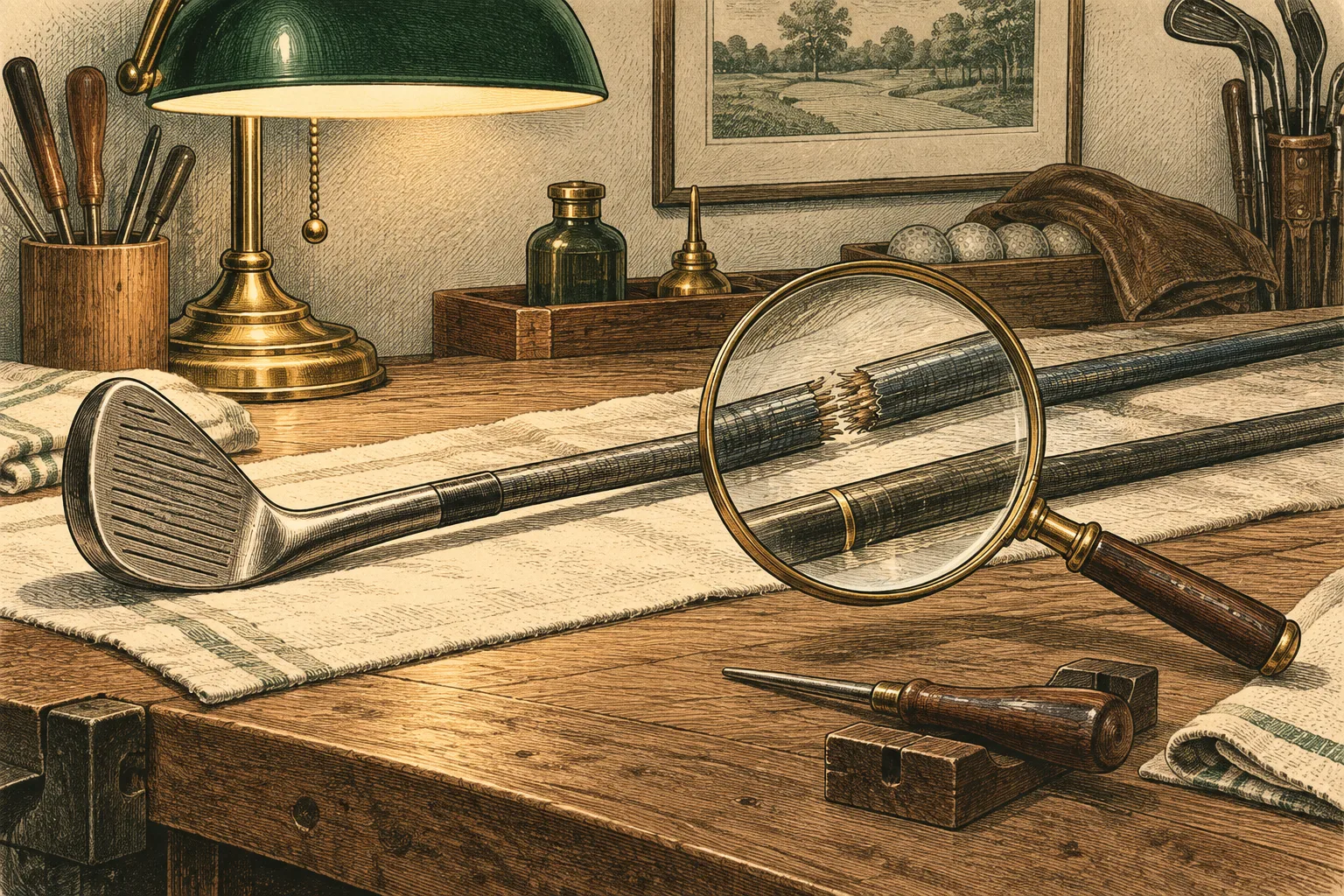
Almost everybody who asks this question asks it for the wrong reason — my shafts are old — and almost nobody asks it for the reason with the best evidence behind it. Let's fix both.
First, the myth: shafts do not expire
You will read that steel work-hardens and gets stiffer, and that graphite goes soft over the years. The popular articles making those claims offer no data behind them: no cycle counts, no frequency measurements taken years apart, no named study. It is folklore repeated confidently.
What those same articles describe accurately are failure modes, and every one of them is physical damage you can see or find:
- Rust in steel, usually because moisture gets in through the grip end and works on the inside of the tube.
- Bending, from hitting the ground, a root, or a range mat divider.
- Abrasion in graphite, where the protective coating wears through — commonly from a club rubbing in the bag or in a car boot — exposing the fibres underneath.
- Stress fractures in graphite, which are small, findable, and get worse.
That is damage, not ageing. If your shaft is straight, unrusted and uncracked, its stiffness has not quietly walked out of the bag while you weren't looking. "It's seven years old" is not a reason.
Five reasons that genuinely are
1. You are changing the head. You are touching the shaft anyway. And it matters more than people think — as the trimming chapter covers, the same shaft model behaves differently going into a thru-bore hosel that swallows two and a half inches of tip than into a blind-bore one that swallows none.
2. Your speed has genuinely changed — in either direction. Age, injury, a winter in the gym, a swing rebuild. Speed moves the weight band first and the flex letter second.
3. Your hands, wrists or elbows hurt. This is the reason with the strongest published evidence, and the evidence is new.
The elbow evidence, and its own small print
A 2026 prospective case series in BMC Musculoskeletal Disorders put 40 right-handed golfers — 9 women and 31 men, mean age 51, mean handicap 16, mean 15 years of golf — through surface EMG on four forearm muscles in both arms across five phases of the swing, with a Trackman IV recording performance. The comparison was a graphite shaft (PING Alta CB, 72 g, 2.1° torque) against steel (True Temper Dynamic Gold 105, 101 g, 1.8° torque).
With graphite, the lead arm showed significantly lower activity in the flexor carpi ulnaris (p = 0.027) and the pronator teres (p = 0.009) during late follow-through. Golfers without pre-existing elbow pain showed lower pronator teres activity in both arms (p = 0.002 and p = 0.032). The professionals in the group produced higher clubhead speed with graphite (p = 0.011). Carry distance did not differ significantly. The authors' conclusion: graphite shafts "may serve as a non-medical treatment for overuse injuries like lateral and medial epicondylitis."
Now the part we print because the authors printed it. The two shafts differed in weight and torque, not only in material, so "the impact on muscle activity cannot be fully attributed to the material alone." Note the direction of that torque difference, too: the graphite shaft was the higher-torque one, 2.1° against steel's 1.8°. The stereotype does not survive contact with an actual spec sheet.
Two more, quickly
4. A persistent, one-directional miss you have already taken to a coach. Order matters and it is not negotiable: coach first, fitting second, re-shaft third. A shaft cannot fix a path.
5. A length change — but not for the reason usually given. Plugged In Golf built one head with one shaft at 44, 45 and 46 inches with swingweight held constant, and had five golfers hit seven drives at each. None of the five had their best dispersion at 44 inches, and the authors found "no clear link between shaft length and accuracy." Change length because a fitting says so, never because shorter sounds safer.
Four reasons that are not
"It's five years old." Covered above.
"The tour switched to something new." Tour players change shafts for reasons that include being paid.
"My friend gained fifteen yards." In the tightest blinded shaft experiment available — 33 golfers, two stiffnesses, MOI-matched, swapped without their knowledge — half the field showed no significant clubhead speed difference at all, and nobody differed by more than 1 m/s. Your friend may be one of the seventeen. You may be one of the sixteen.
"I want it to feel different." Feel is worth chasing, but a grip change and a swingweight adjustment are the cheap experiments and they should come first.
What actually happens on the bench
Worth knowing, because it explains the bill and the risk. Mitchell Golf's published process runs like this: slit and strip the grip and its tape; heat the hosel with a heat gun held six to eight inches away, moving constantly, for 30 to 60 seconds; pull the shaft with a mechanical puller, never twisting or prying.
The warning that should stop any DIY plan involving a blowtorch is theirs: "Never use a propane or butane flame directly on a graphite shaft. An open flame generates 1,500°F+ surface temperature."
Then the hosel gets cleaned — a wire or bronze brush for steel hosels, nylon only for graphite-insert hosels, because wire bristles leave metal contamination. The ferrule's inner diameter has to match the tip, .355" taper or .370" parallel. Epoxy is mixed for a full minute and applied thinly to both surfaces. Cure is one to four hours for quick-cure epoxy, a full 24 for slow-cure, and that assumes the room is above 65°F.
Two things follow. A properly pulled shaft usually survives, so a re-shaft is reversible and the old shaft has resale value. And the labour is the small half of the bill — with premium aftermarket shafts, the component is the expense, which is why the parts decision deserves more of your attention than the shop rate does.
Trimming is part of the job
A re-shaft into a different head is not always a straight swap. Fujikura's own guidance is that they "generally do not recommend tip trimming on a driver or 3 wood shaft," while publishing a trim table for fairway woods and hybrids that runs from zero to 1.5 inches. If you are moving a shaft from a fairway into a driver or the reverse, the trim it already carries is part of what you are buying.
The one-club rule
Re-shaft the driver first. On its own. Then play it for a month before you commit the irons.
A full set re-shaft is a decision made once and repeated thirteen times, and it is where most of the regret in this hobby lives. One club, one variable, one month.
Then come and prove it
Book a bay before you change anything and bank a baseline: twenty shots with the club as it stands, and write down peak height, spin and spread — not just carry. Do it again after. That is the whole test, and it is the only version of this question that ever gets a real answer.
Keep the pulled shaft. It is your control group, and it is worth something to the next person.
From the glossary
Related reading: The Clubhouse Guide to Golf Shafts · Steel vs. Graphite: The Stereotype Is a Decade Out of Date · Raw vs. Cut: The Shaft You Buy Is Not the Shaft You Play · Is a Shaft Fitting Worth It? The Honest Version
Golf Balls: What You Should Actually Play
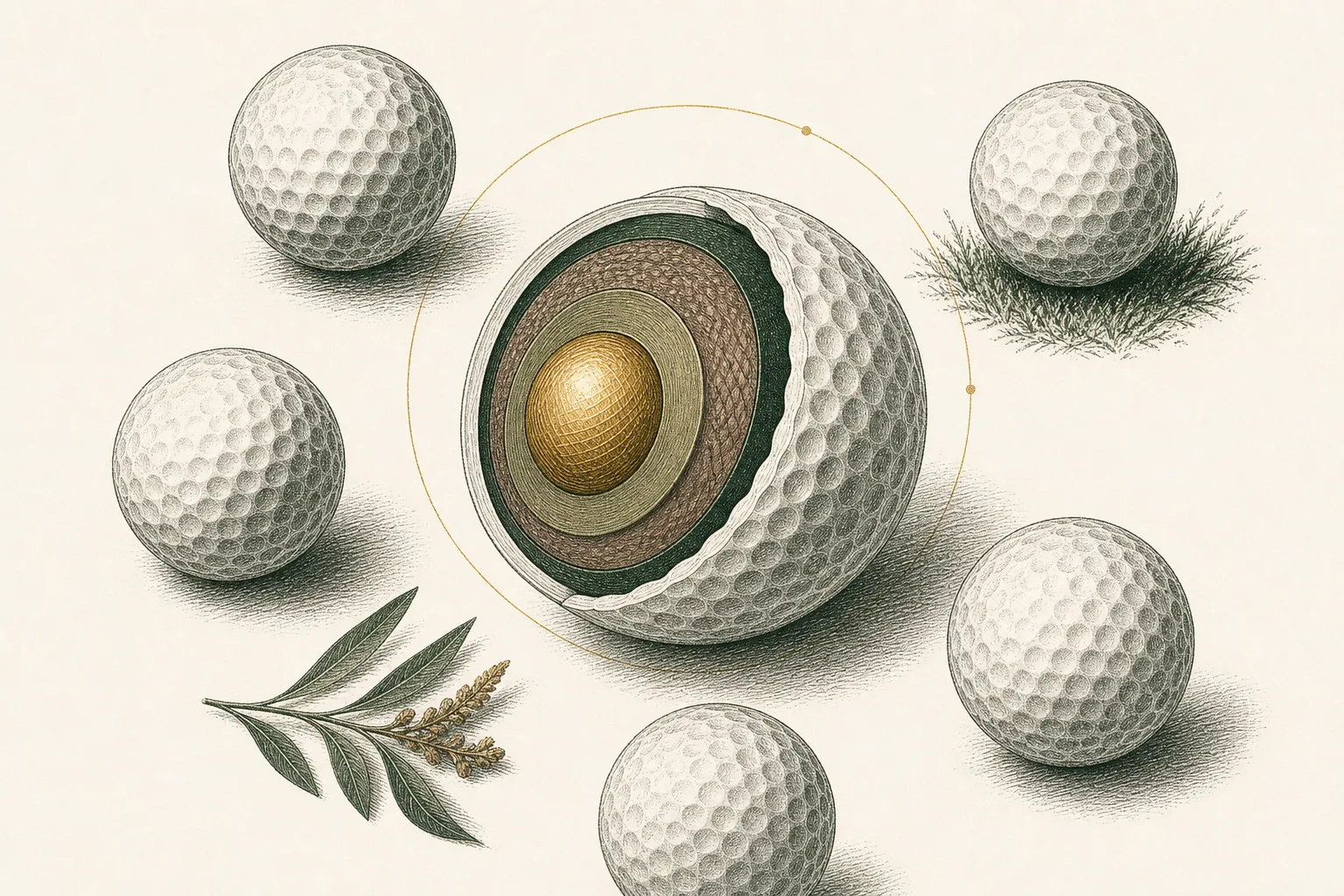
You can spend $600 on a new driver and gain four yards. Or you can spend $35 on the right dozen golf balls and change how every single shot behaves — off the tee, into the green, and on those little pitches that decide whether you make bogey or double. The ball is the only piece of equipment you use on literally every stroke, and it's the cheapest thing in your bag to get right. Most golfers never think about it. Here's what's actually going on inside that little sphere, and what you should really be playing.