

No magazine can write this chapter for you, because nobody else has your shot record. We do. So this is the Clubhouse article in the series — and it opens with what the bay cannot tell you, because that is the honest order to put things in.
What every single shot carries
Whatever else happens, a shot in one of our bays records ball speed, launch angle, launch direction, total spin and spin axis. Those are never missing. Almost always you also get carry, total distance, offline, peak height and descent angle.
Look at that list again, because it is better news than it sounds. Ball speed, launch, spin, peak height, descent and left-right miss is exactly the set that the published shaft tests are built on. Today's Golfer compared 34 iron shafts on a Foresight GC Quad with one head, one ball and one tester. That is the same instrument class and the same numbers you get every time you walk in.
What the bay usually does not record
Club speed and smash factor are marker-gated, and so is everything about how the club arrived.
Foresight's own support documentation is clear about how this works. Without the Club Analysis add-on, or when markers are not being detected, the device falls back to 1-Dot mode, which "provides Club Head Speed and Smash Factor only." The full delivery set — "Path, Face Angle, Loft, Lie, Attack Angle, Closure Rate, and more" — requires 4-Dot mode. And crucially: "Even 4-Dot capable devices will default to 1-Dot Mode if markers are applied incorrectly, damaged, or not visible to the cameras."
In practice, in our bays, that means club speed is absent from the large majority of ordinary shots, and the club-delivery block is absent from almost all of them. Shots that come through the simulator's own path rather than the Foresight capture carry no club-delivery data whatsoever.
So here is the first practical rule, and it is the one that saves people the most wasted effort: do not build a shaft comparison on smash factor. You will have a handful of shots carrying it and hundreds without, and that handful is not a random sample — it is the set of shots you happened to be wearing markers for.
And the gap we are not going to talk around
Our shot record does not currently store which shaft was in the club.
Your bag club carries a shaft — the one you told us about, stamped from your entry, not measured by us — and a shot knows which bag club it was hit with. But that is a live link, not a snapshot. Re-shaft the club and the link is rewritten backwards: shots you hit last spring quietly start claiming the shaft you fitted last week.
Which means the product cannot yet hand you a clean, trustworthy shaft-by-shaft page, and we would rather say that here than serve you a chart that is wrong in a way you cannot see. The fix is a shaft stamped onto each shot at the moment it is recorded, plus a proper history of when each club changed shafts. It is on the engineering list. Until it lands, you are the shaft history — and that is genuinely workable, because it is exactly what the published studies do.
The protocol, borrowed from the people who do this properly
Change one thing. MacKenzie and Boucher's driver study used a single Ping i25 head and matched the two builds for mass and moment of inertia with lead tape, so the only difference left was the shaft. Today's Golfer held head, ball and tester constant across all 34 shafts. Same head, same ball, same you. One variable.
Same session. Not this month against last month. Your warm-up, your body, the mats and your expectations all drift, and every one of them is bigger than the effect you are hunting.
Enough shots. The published counts are your guide: seven drives per condition in Plugged In Golf's shaft-length test, twelve accepted shots per shaft at Today's Golfer, fourteen per shaft in MacKenzie and Boucher. Fourteen is a good target. Below seven you are measuring noise and calling it a shaft.
Alternate in blocks. MacKenzie's participants hit in blocks of seven with rest between. Never all of A and then all of B — you get looser, then you get tired, and both will show up in your data wearing a shaft's clothing.
Blind it if you possibly can. MacKenzie swapped the shaft at the halfway point without telling the golfers, who believed they were in a study about something else entirely. Plugged In Golf withheld the brand names from its testers. Handing the club to a friend and looking away is the cheapest upgrade available to your own data.
Label the block. Put the shaft in the session note when you start. The shot rows will not carry it, but the block will, and in six months that note is the only thing standing between you and a guess.
What to read, in this order
- Dispersion. Your left-to-right spread. This is where a shaft's effect is largest and most repeatable, and it is the number that changes your scores.
- Peak height and descent angle. This is the shaft's tip section speaking. A stouter tip shows up here before it shows up anywhere else.
- Spin. Expect a difference of a few hundred rpm. If you are seeing thousands, something other than the shaft changed.
- Ball speed. Real, and small.
- Carry and total. Last. They are the noisiest numbers on the screen and they are the ones everybody looks at first.
Medians, and your best strikes only
Take the discipline from how your own club numbers are built here: a club's headline is the median of your twenty best-struck shots, and if you have not produced twenty clean strikes the system shows you a calibration count instead of a number it cannot stand behind.
Apply the same rule to a shaft test. Use medians, not averages — one flushed seven-iron should not outrank a tighter group of fourteen. And if you cannot produce fourteen strikes you would sign for, the honest reading is that you are not currently in a position to be fitted, which is itself worth knowing.
What a real result looks like
Not "the new one went six yards further."
It looks like: the group is a fifth narrower, the window sits three yards higher and repeats, and spin is 250 rpm lower — over fourteen shots each, alternating, on one afternoon, with someone else making the swap.
And a null result is a result. In the blinded 33-golfer study, roughly half the field showed no significant difference between two shafts of genuinely disparate stiffness, and nobody differed by more than about two miles an hour of clubhead speed. If your two shafts land on top of each other, you have just saved yourself the price of the upgrade, and that is a good day.
Five lines in a notebook
Because the database will not do this for you yet, write down after every shaft session: the date, the head, the shaft (brand, model, weight, flex), the length, the grip, and your six medians.
That is a longitudinal shaft history. It is the one thing this product does not have and cannot reconstruct later, and you can start keeping it today, in a bay, this week — with a friend, two shafts, a roll of tape and no idea which one is in the club.
Related reading: The Clubhouse Guide to Golf Shafts · Is a Shaft Fitting Worth It? The Honest Version · Tempo and Transition: Why Your Swing Speed Can't Fit You · What the Bay Measures, and What It Does Not
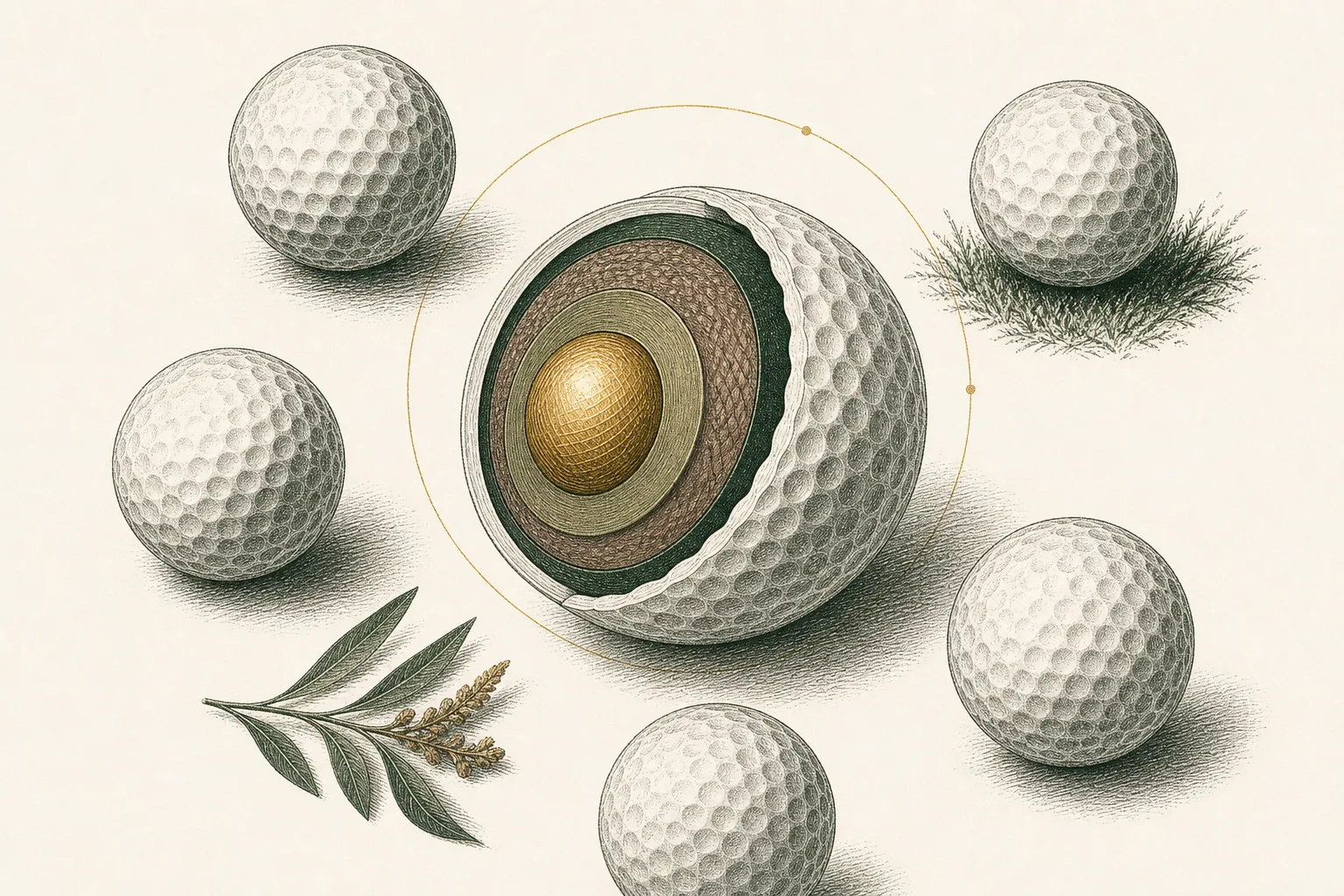
Golf Balls: What You Should Actually Play
You can spend $600 on a new driver and gain four yards. Or you can spend $35 on the right dozen golf balls and change how every single shot behaves — off the tee, into the green, and on those little pitches that decide whether you make bogey or double. The ball is the only piece of equipment you use on literally every stroke, and it's the cheapest thing in your bag to get right. Most golfers never think about it. Here's what's actually going on inside that little sphere, and what you should really be playing.