
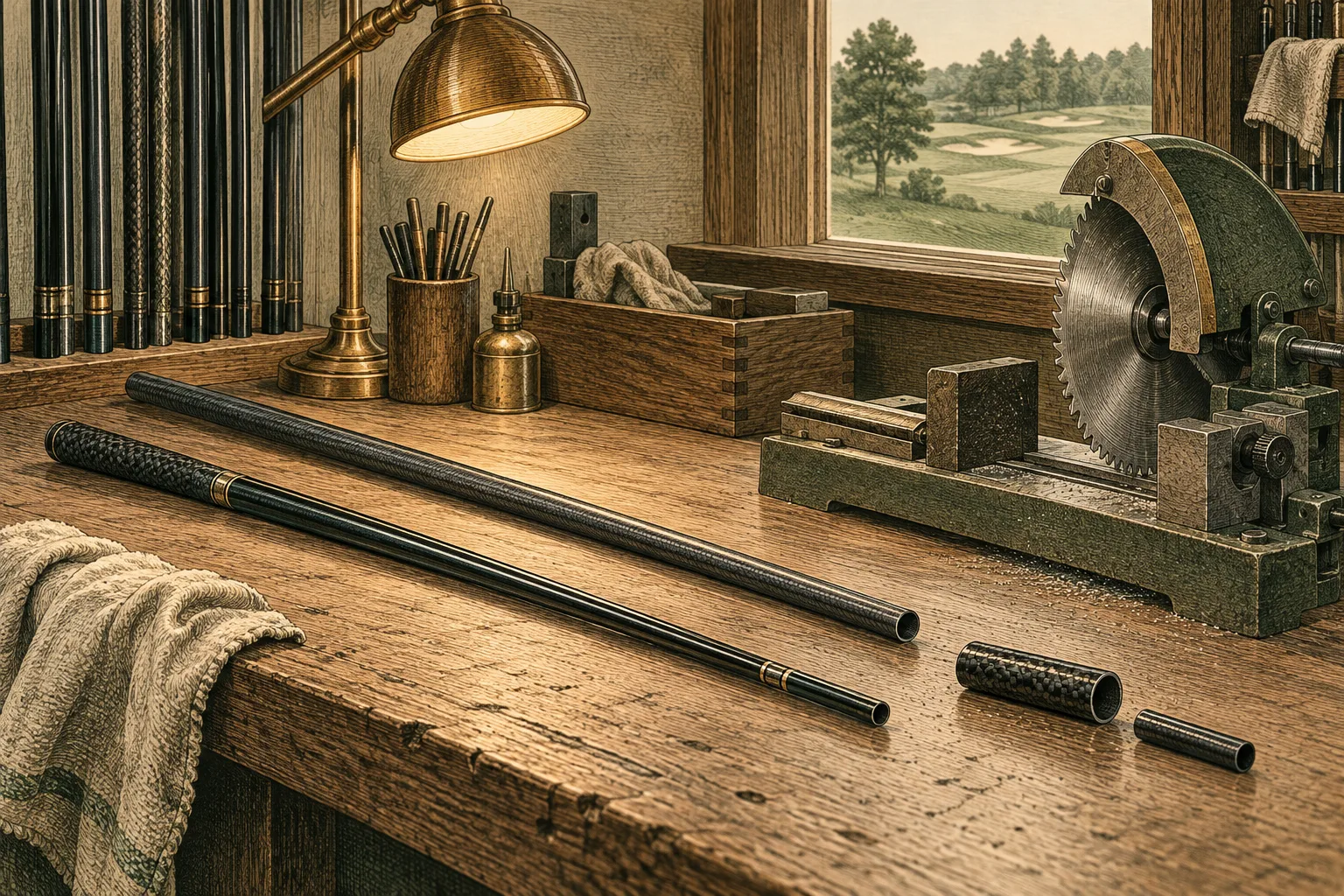
The shaft in the box is not the shaft in your club. Every aftermarket shaft arrives raw — longer than any club it will ever go into, and softer than it will play once it is cut. What happens between the box and the bench is a fitting decision, it is made by whoever builds the club, and it is almost never printed on the label you end up looking at three years later.
What "raw" actually looks like
Fujikura's VENTUS TR wood shafts are listed at 46 inches, with a parallel tip section of 3.0 inches. Your driver is probably 45 inches or shorter. True Temper's Dynamic Gold in .370 parallel comes at 41 inches raw; the .355 taper version arrives already stepped to club-specific lengths from 40 inches down to 36.5. Nippon's ZELOS 7 is listed as 38.5 down to 35.0 inches across the set.
Those extra inches are not packaging. They are the builder's adjustment range, and they get spent at one end or the other.
Two ends, two entirely different jobs
Butt trimming sets length. Tip trimming sets stiffness. They are not interchangeable, and the reason is that a shaft is not uniformly stiff along its length.
Dave Tutelman's clubmaking analysis puts a number on it: "the butt is between three and five times stiffer than the tip, depending on its construction," and he works with an approximation of four times. Which leads directly to the consequence: "if we trim from the butt, we still leave a lot of flexible tip; if we trim from the tip, we leave very little of the flexible tip. Thus, the shaft is a lot stiffer if we trim from the tip than if we trim the same amount from the butt."
Cut an inch off the grip end and you have a shorter club that plays slightly stiffer for the obvious reason. Cut an inch off the tip and you have removed the softest, most active inch of the whole shaft.
How much a tip trim is worth
Fujikura publishes the industry's working rule on its own site: "Tip trimming 1" is equivalent to one flex."
Tutelman's version of the same relationship is a ratio rather than an absolute: "the trim length between flexes is four times the trim length between clubs, for any model of shaft." A shaft that steps a quarter inch between successive irons therefore has a one-inch step between flexes.
And here is the measured version, which is the one worth trusting. KZG's head builder Matthew Mora published frequency readings for KBS shafts across KBS's own trim schedules. Take a KBS Tour 90 Regular six-iron: at one inch of tip trim it reads 257 CPM, at 2.5 inches 264 CPM, at four inches 272 CPM. Three inches of extra tip trim, fifteen cycles — call it five CPM per inch on that shaft, in that build. Not a rule of nature. A number, from a bench, with the head weight and length printed beside it.
One part number, four flexes
The KBS Tour Regular — one shaft, about 118 grams — built to KBS's 4.0, 4.5, 5.0 and 5.5 trim schedules produces a seven-iron reading 284, 291, 294 and 297 CPM, and the chart's own trajectory notes walk from "High" to "Low" across that range. Same box. Same label. A different club four times over.
Some makers are entirely open about this. Pro's Choice's trimming guide describes a "combo flex" wood and iron line where the blanks are sold in exactly two versions, L/A and R/S, and states plainly that the amount of tipping at installation is what determines the final shaft flex. The flex is not in the shaft. It is in the build.
Parallel tip versus taper tip
This is why the two constructions exist.
A taper tip iron shaft (.355") is made per club at the factory — it arrives already the right stiffness for a seven-iron or a five-iron. The builder's instruction is short: for taper-tip Tour AD iron shafts, Pro's Choice says "No Tipping. Insert straight in and butt trim to desired final club length."
A parallel tip shaft (.370") is one blank for the whole set. The builder tip-trims progressively — more off the short irons than the long ones — which is what creates the stiffness staircase through the bag. It is more work and more control, and it is where a set can be built wrong.
Neither is better. But if you are buying single shafts, you need to know which one you are looking at, because a parallel blank that has not been trimmed and a taper shaft that has been are not the same object.
The trimming your clubhead does without asking
Here is the part almost nobody knows. Hosel design tips your shaft for you.
Pro's Choice's guide lists driver trim for Tour AD wood shafts as 0.0 inches into a standard-bore or blind-bore hosel — and "Insert 2.5" only" into a thru-bore hosel. A thru-bore head swallows two and a half inches of tip. That is a materially different shaft from the same model in a blind-bore head, and nothing on the club will ever tell you.
The same guide carries the constraint that keeps builders honest: "Always leave a minimum of 0.5" of the parallel tip section of the shaft above the hosel." With VENTUS TR's parallel tip section at 3.0 inches and a hosel 1.5 inches deep, the tip-trim budget is one inch. Not a preference — a limit.
What the makers tell you not to do
Fujikura's own guidance: "We generally do not recommend tip trimming on a driver or 3 wood shaft based on the shaft composition and how tipping could affect performance." Their published table for fairway woods and hybrids runs from zero to 1.5 inches depending on the club.
Take that seriously. A modern driver shaft's tip section is engineered as a system, and an inch removed from it is not the tidy "one flex stiffer" the rule of thumb promises.
Why this matters most when you buy used
A pulled shaft on the second-hand market has already been trimmed, by someone, for a head you have never seen. Two listings reading "Stiff, good condition" can be more than a flex apart if one was tipped an inch and a half for a fairway and the other went into a driver untouched. The label survives the surgery; the shaft does not.
Before you buy a used pulled shaft, ask two questions: what club was it in, and how much was taken off the tip. If the seller does not know, price it as an unknown — which is what it is.
Then take it to a bay
Trimming is a bench decision with an on-course consequence, so close the loop where the numbers are. Build it, then hit twenty balls behind the launch monitor and watch peak height and spin, not carry. Tipping generally shows up as a lower window and less spin before it shows up as anything else — and if you cannot see it in the trajectory, you did not need it.
Related reading: The Clubhouse Guide to Golf Shafts · Frequency and CPM: What the Number Actually Measures · Weight Before Flex: The Shaft Spec That Decides the Rest · How to Read a Shaft Spec Sheet Skeptically

Sleeper Classics: Great Clubs the Market Forgot
The used-club market has a memory problem. Prices track two things — marketing budgets and recency — and neither has much to do with how a club actually performs. A driver that led forgiveness testing in its day gets lapped by nine model cycles and lands in the $100 bin next to genuine junk. A forged iron a Champions Tour pro carried in his own bag sells for less than a single new wedge because the brand never bought enough American ad pages. That inefficiency is your opening.