
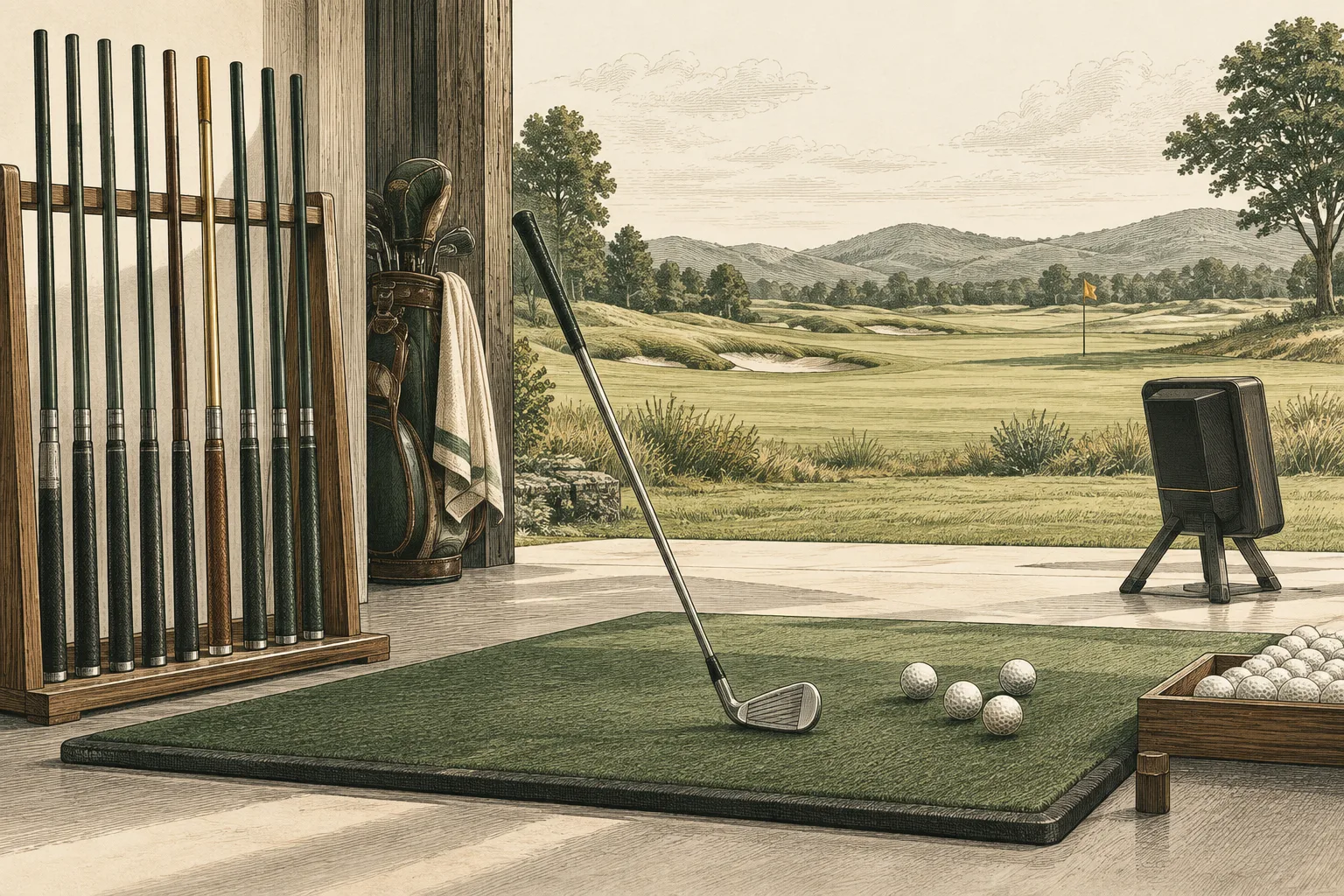
Short answer: for most golfers, yes — but not for the reason the fitting industry sells, and not at every moment in your golfing life. The case for a fitting is much better than the marketing, and much smaller than the marketing, at the same time. Here is the evidence, including the parts that cut against it.
The best numbers available, with their fingerprints on
Plugged In Golf ran the study most often quoted on this question: 25 golfers who had been through full-bag fittings, with data from their own clubs and from the clubs they were fitted into.
The realized results were genuinely strong. Every one of the 25 gained driving distance. Sixteen gained over ten yards, six gained over twenty, two gained over forty, and the average was more than sixteen yards. On accuracy, 15 of 22 improved, hitting the ball over five yards closer to the centreline.
Now the fingerprints, because they matter. The fitting partner was Club Champion — a fitting company, supplying data about its own fittings. And the study's most eye-catching numbers are not gains at all: lines like "22 of 24 golfers are leaving over 10 yards of carry distance on the table" describe distance lost against a modelled optimum, not distance anyone actually picked up. The honest figure to carry away is the sixteen yards that were measured, not the thirty-four that were computed.
The number that keeps everyone honest
Set that beside the tightest experiment in the field. MacKenzie and Boucher put 33 golfers behind one Ping i25 head with two shafts of very different stiffness — matched for mass and moment of inertia, disguised with identical tape, swapped without telling the golfers. Fourteen drives each.
Group result: no significant difference in clubhead speed at all. Individual result: 17 of the 33 golfers differed significantly, in both directions. And nobody differed by more than 1 m/s.
Those two studies are not in conflict; they are measuring different things. Changing only shaft stiffness is a small, genuinely individual effect. A full fitting changes weight, length, loft, lie, head and shaft together — which is exactly why fitting studies produce bigger numbers than shaft studies do. Anyone quoting the fitting number while selling you a shaft is doing something dishonest with arithmetic.
What you are actually buying
Not yards. Options, and a controlled comparison you cannot run alone.
A serious fitting bay carries inventory you will never assemble yourself — Golf Monthly's piece on PXG's fitting operation describes "over 400 different shafts from driver, woods, and hybrids, right through to wedges." Hitting eight of those back-to-back, on one head, with a launch monitor and someone else recording, is the product. The shaft that wins is a by-product.
The excuse that keeps people at home
Golf Monthly put the standard objections to two senior PXG fitters, and the first one on the list is the one you have probably said out loud: my swing isn't consistent enough to be fitted.
The fitters' answer is the exact inverse. "It's the mid to high handicapper who stands to improve the most from a custom fitting," because for the amateur "that range is huge." A tour player is optimising the last two percent. You are not.
A rule of thumb this series is retiring
Everyone repeats that shortening your driver tightens your dispersion. It is stated as settled. It was tested.
Plugged In Golf built the same head with the same shaft at 44, 45 and 46 inches, held swingweight constant, and had five golfers hit seven drives at each length. Result: "None of our players had their best dispersion at 44″." Four of the five produced their longest total distance at 46 inches. The authors' conclusion is unambiguous — there is "no clear link between shaft length and accuracy," and shorter shafts "are not an automatic means for producing consistent distance."
Shorter may still be right for you. It is not right by default, and that is precisely the kind of thing a fitting exists to settle.
When a fitting is genuinely not worth it
Four honest cases.
You are mid-rebuild with a coach. If your swing is deliberately changing this month, you will fit the swing you are leaving. Fit after, not during.
You cannot produce twenty repeatable strikes with the club. Below that, you are fitting your miss. Go and build the twenty first — that is a coaching problem wearing an equipment costume.
You are assembling a first full bag on a budget. Correct lofts, sensible gapping and a putter you like will beat an exotic shaft by a distance. Shafts are a refinement, not a foundation.
You want a guarantee. Seventeen of thirty-three is not a guarantee. It is a good bet.
What it costs, in bands
A shaft-only session at a local shop sits at the entry tier and often gets credited against a build. A full-bag fitting at a national chain sits a tier or two above that, and the components are always extra. Worth knowing before you book: for premium aftermarket shafts, the parts routinely cost more than the fitting did. Budget for the build, not the appointment.
The DIY path, which is a real path
You can run a defensible shaft test yourself. Six steps, all borrowed from the studies above.
- Baseline properly. Twenty shots with your current club. Write down the median carry, the peak height, the spin and the spread — and how much the spread varies, not just its centre.
- Change one thing. Weight first; it is the biggest and most reliable lever. Never two variables at once.
- Blind it if you possibly can. Have someone else swap the club. This is not theatre — it is the single design feature that made the 33-golfer study trustworthy.
- Fourteen shots per condition, minimum, alternating in blocks. That is the study's own protocol and it is achievable in one session.
- Judge dispersion and repeatability of your window, not the longest ball of the day. The longest ball is noise wearing a medal.
- Accept a null result. If nothing separates, you are one of the sixteen, and you have just saved yourself a premium shaft.
Do it here
A bay is the cheapest controlled A/B in golf, and it is the environment those studies were run in. Book one, bring the club you are questioning, and ask Pat to swap shafts while you look away.
One honesty note about the numbers on the screen, because this series does not overpromise: every shot the bay records carries ball speed, launch and spin. Club speed and smash are captured only when the club is wearing a marker, so plan your comparison around ball speed, launch, spin, peak height and dispersion — which are the five that decide a shaft fit anyway.
From the glossary
Related reading: The Clubhouse Guide to Golf Shafts · Tempo and Transition: Why Your Swing Speed Can't Fit You · Weight Before Flex: The Shaft Spec That Decides the Rest · Reading Your Own Bay Data by Shaft

Sleeper Classics: Great Clubs the Market Forgot
The used-club market has a memory problem. Prices track two things — marketing budgets and recency — and neither has much to do with how a club actually performs. A driver that led forgiveness testing in its day gets lapped by nine model cycles and lands in the $100 bin next to genuine junk. A forged iron a Champions Tour pro carried in his own bag sells for less than a single new wedge because the brand never bought enough American ad pages. That inefficiency is your opening.