
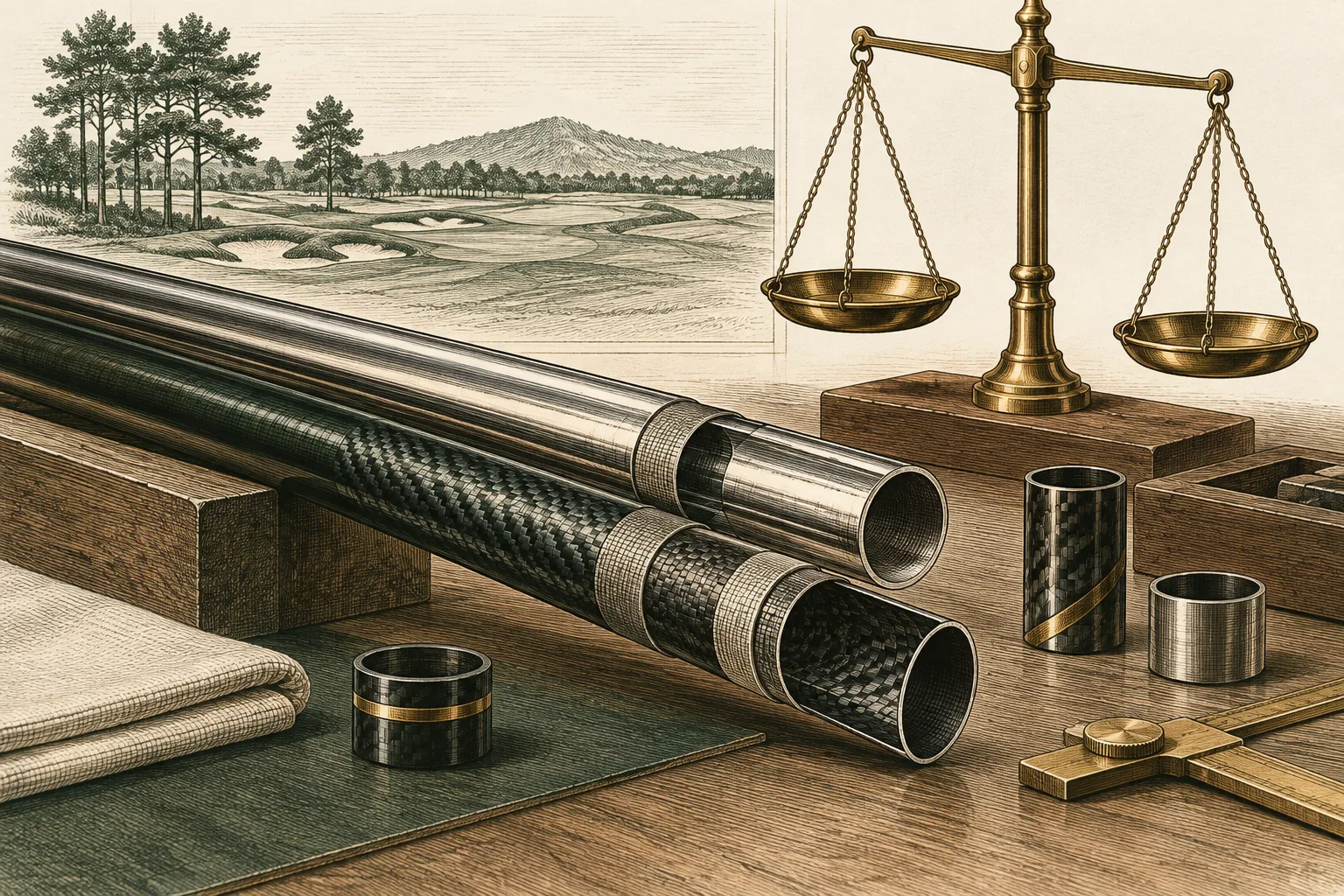
Golfers ask this one as though it were a question about identity. Am I a steel guy or a graphite guy? It gets answered with a stereotype: steel is heavy, accurate, for good players; graphite is light, whippy, for seniors and beginners. Both halves of that sentence were roughly true in about 1998. Neither is true now, and the spec sheets prove it in about ninety seconds.
What the two things actually are
A steel iron shaft is a drawn high-carbon tube — one piece of metal, pulled and stepped down to diameter. A graphite shaft is layers of carbon-fibre sheet, cut to shape, rolled onto a mandrel and cured. The steel one is simpler and cheaper to make consistently at the low end. The composite one is a design surface: change the fibre, the angle, the wall, the resin, and you change the shaft's behaviour anywhere along its length independently.
That is the real difference. Steel is found stiffness; graphite is designed stiffness. Everything below follows from it — including the fact that Aerotech's whole pitch for SteelFiber, a steel-fibre wrap over a graphite core, is that it "produces a shaft more consistent in flex, geometry and straightness than steel iron shafts."
The weight stereotype is dead
Here is the part that ends the argument, straight off manufacturers' own pages.
Fujikura, describing its AXIOM graphite iron shafts, puts steel at "typically heavier (90–130 grams)" and offers AXIOM in 75, 105 and 125 grams. True Temper's Dynamic Gold page lists R300 at 127 g, S300 at 130 g, S400 at 132 g and X100 at 130 g. So far the stereotype holds.
Then look at Nippon's N.S. PRO ZELOS 7 — a steel shaft, published at 73.5 g in R2, 74.0 g in R and 77.5 g in S. That is lighter than the lightest AXIOM. There is now more weight overlap between the two materials than there is separation, and a 75-gram steel shaft and a 125-gram graphite shaft sit on opposite sides of every stereotype you have.
If you have read that "steel starts around 120 grams," that number is a decade out of date and the makers' own tables say so.
Torque: the spec that steel doesn't publish
Torque should settle it, because "steel is low torque" is the one line everybody repeats. Go and look.
True Temper's Dynamic Gold page gives torque as a single word: "Low." Not a number. The biggest iron-shaft house in the sport does not print a degree figure for its flagship. Nippon does print one — the ZELOS 7 is listed at 2.9° in R2, 2.8° in R and 2.6° in S, which is squarely in the range plenty of graphite driver shafts occupy.
So the honest version is: steel is generally lower-torque than graphite of comparable weight, and lightweight steel is not automatically low-torque, and you frequently cannot check because the number is not published. Treat any tidy "steel is 1.5 to 2.5 degrees" claim as folklore until somebody shows you the maker's table.
Damping is the real material difference
This is where graphite earns its money, and it is worth stating at exactly the confidence the evidence supports.
Carbon composite absorbs high-frequency vibration better than a steel tube does. Fujikura says so; Today's Golfer's test team says so in almost the same words — "graphite is better at dampening vibration than steel so if shock, injury, or joint pain are part of your golf game graphite could well be a decent option." What neither offers is a controlled clinical study showing reduced injury rates. It is a well-founded engineering expectation and a very consistent player report, not a medical finding. If your hands sting off a thin one and your elbow remembers it on Tuesday, that is a real reason to try graphite. It is not a promise.
What the independent testing measured
Today's Golfer put 34 iron shafts through one head in 2026 — a Callaway Apex 24 CB seven-iron, Chrome Tour X balls, test pro Neil Wain, a Foresight GC Quad, twelve accepted shots per shaft.
- The Fujikura AXIOM 125 in X (130 g) produced 2.9 mph more ball speed and 5.6 yards more seven-iron carry than Dynamic Gold X100.
- The AXIOM 105 produced 1.5 mph more ball speed and 2.8 more yards than the heavyweight average, with a shot area 21.7% tighter than the test average.
Now set that beside Fujikura's own marketing line on the same product: "Testers report 5–10 yards more carry with AXIOM compared to steel." The independent measurement landed at the bottom of the maker's claimed range, with one tester, one head, twelve shots. That is not a scandal — it is what honest numbers usually look like next to advertising, and it is the right way to read every material claim in this category.
The tighter shot area is the finding that should interest you more than the yards.
Two philosophies of a set
Weight is not one number across a set, and the materials handle that differently. True Temper's AMT ascends in three-gram increments from the 4-iron through the wedge — lighter long irons for speed and height, heavier short irons for control. Aerotech's taper-tip SteelFiber goes the other way with a constant-weight design, every shaft in the set weighing the same regardless of length.
Neither is correct. They are different answers to how you want the bag to feel from the 4-iron to the pitching wedge, and it is a fitting conversation, not a materials one.
So who should actually switch
Try graphite irons if: your hands or elbows hurt after a session, you have lost speed and your long irons no longer get up, you are fighting for height and consistency in the top of the set, or your misses are heel-and-toe rather than fat-and-thin. Modern heavy graphite in the 100–125 g range makes the change from steel almost invisible in feel.
Stay in steel if: you have an aggressive transition and steel is behaving. Plugged In Golf's review of the ultralight ZELOS 7 is blunt about the limit — "these shafts are not meant for really aggressive transitions, at least not with standard installation." The same caution applies to any big weight drop, in either material.
Ignore entirely: your age, your handicap, and what anybody at your club plays.
On cost, graphite iron shafts sit a tier above stock steel and a full set is a real spend once you add labour and grips — which is exactly why you test before you commit.
Test it properly in a bay
This is the easiest A/B in golf and almost nobody runs it. Bring your seven-iron. Hit twenty balls. Then hit twenty with the same head in the other material, or with a demo iron in it. Look at the dispersion ellipse and the peak height first, carry second. If the graphite build is two yards longer and forty percent tighter, you have your answer — and if it is two yards longer and no tighter, you have saved yourself a set.
From the glossary
Related reading: The Clubhouse Guide to Golf Shafts · Weight Before Flex: The Shaft Spec That Decides the Rest · How to Read a Shaft Spec Sheet Skeptically · Is a Shaft Fitting Worth It? The Honest Version

Sleeper Classics: Great Clubs the Market Forgot
The used-club market has a memory problem. Prices track two things — marketing budgets and recency — and neither has much to do with how a club actually performs. A driver that led forgiveness testing in its day gets lapped by nine model cycles and lands in the $100 bin next to genuine junk. A forged iron a Champions Tour pro carried in his own bag sells for less than a single new wedge because the brand never bought enough American ad pages. That inefficiency is your opening.