
You buy a driver off the rack. The shaft carries a famous name in famous paint. There is a decent chance it is not that shaft — and nobody lied to you. That gap, between a name and a product, is the single most expensive misunderstanding in retail golf, and it is entirely legal, entirely open, and almost never explained.
Two different products, one name
John Oldenburg — now chief product officer at LA Golf, formerly at Aldila — is the person who says this out loud. On the made-for version of an aftermarket shaft: "[It's] a different product. It has the same outer appearance."
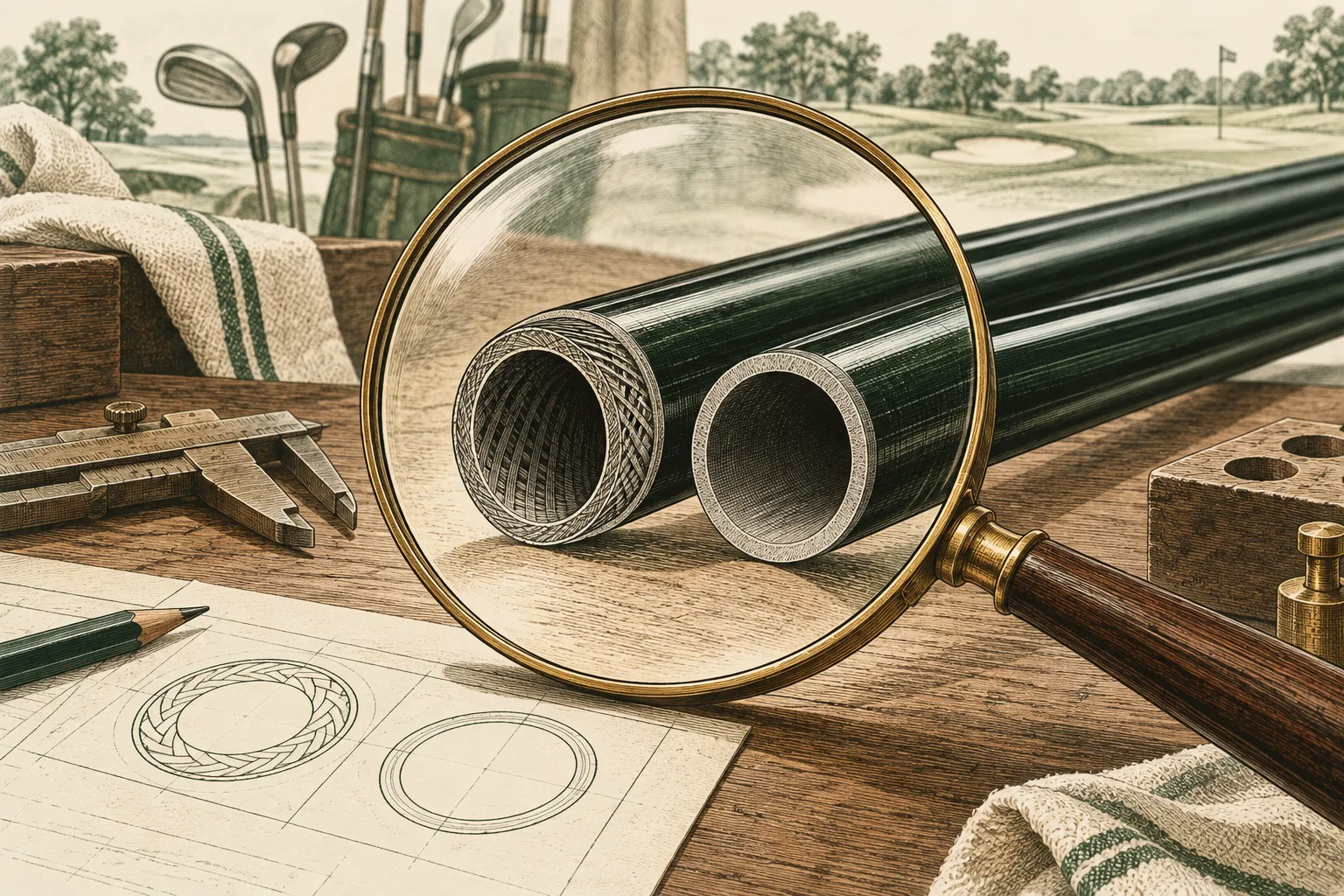
Same name. Same colour. Same graphics. Different layup, different materials, different behaviour.
Where the corner gets cut, and why
Oldenburg explains the economics better than anyone. On materials: "As you go up in grade of material, which is actually going up in stiffness and strength of the material, you essentially double the cost of the material for every step you take up." Premium shafts blend high-end carbon fibres — sometimes five or six different versions in a single design — with materials like boron and Zylon.
Then the specific consequence. "The most expensive thing to control on a golf club is torque, so when companies go and design these in-line products, that's usually the first thing to go." And the size of it: "The torque will normally go up one or two-plus degrees because you have to take that expensive material out."
A degree or two of torque is not a rounding error. On a 60-gram driver shaft it is the distance between two different models in the same family.
There is a construction cost too: "The best way to make a shaft, unfortunately, is the most expensive way to make a shaft. And that's to do it in a lot of pieces." More pieces means a more concentric, more symmetric shaft. Fewer, thicker pieces are cheaper and less consistent.
Nobody is lying, and that is the trap
The most useful thing Oldenburg says is the most generous: "I don't think anybody's out there directly lying to the consumer, because they're not out there saying, 'Hey, this is the exact same thing.'"
Exactly. No claim is made, so no claim is false. The name does the work, and the name is doing it in a shop where nobody will be asked a follow-up question.
What the difference actually measures
Plugged In Golf ran the comparison properly. Five golfers, four shafts — two stock and their two aftermarket counterparts, all 60 grams in stiff flex — seven shots each on Trackman, with the brands deliberately withheld from the testers to prevent bias.
- Aftermarket shafts won 8 of 10 trials by an average of 10 yards.
- Clubhead speed favoured the aftermarket shafts in 9 of 10 trials, by 1.36 mph on average.
- Spin was about 150 rpm lower with the aftermarket shafts, but varied a lot between trials.
- Left-to-right dispersion was 7.6 yards tighter, with the aftermarket shafts winning 7 of 10.
- Offline averages were an even 5-to-5 split — no separation at all.
And feel was not close. The testers reported the stock shafts "felt nothing like the aftermarket versions," describing them as softer and whippier.
Read that honestly and it says something specific: the reliable differences were feel, clubhead speed and left-right spread. Straightness at the centre line did not separate. A made-for is a genuinely different and generally worse shaft; it is not the reason you missed the fairway.
Notice who is telling you this
Almost every article arguing for aftermarket shafts is written by someone who sells fittings. GOLF.com's case for the upgrade is authored by the Vice President of Tour and Education at True Spec Golf. Club Champion's blog quotes its founder saying he "nearly never" sees a stock shaft outperform an aftermarket option.
None of that makes them wrong. It means the blinded five-golfer test above deserves more weight than either, and the honest summary is the one that test produced — real, measurable, and smaller than the sales pitch.
How to tell which one you have
Start with the bad news, from both sides of the counter. Club Champion: "There's generally not a lot of visual cues to tell you that a club is stock or aftermarket." Oldenburg: "It has the same outer appearance." You mostly cannot tell by looking. So do this instead.
1. Match it against the maker's own table. This is the strongest check available to you. True Temper publishes Denali FROST Black at 66 g / 3.6° in 6.0, 67 g / 3.5° in 6.5 and 68 g / 2.8° in TX. Fujikura publishes weight and torque for every VENTUS TR model. If the shaft in your club claims a name and a flex whose published weight or torque does not appear in the maker's table, it is not that shaft.
2. Check the technology designation printed on the label against the maker's page for that exact model — the aftermarket family's marquee technology is named on the maker's product page, model by model.
3. Remember what raw looks like. Aftermarket wood shafts ship uncut: VENTUS TR and Denali FROST are both listed at 46 inches. Anything already trimmed and glued into an adapter was built by somebody for something.
4. Look at where it sits on the menu. Made-fors have historically lived in the no-upcharge tier. That heuristic is weakening — stock menus have genuinely improved and some no-upcharge options really are the aftermarket product — so use it as a prompt to ask, not as a verdict.
5. Just ask, in these words: "Is this the aftermarket version of this shaft, or the OEM version?" A shop that knows its inventory answers instantly. A shop that gets vague has told you something anyway.
When the made-for is completely fine
Often. A made-for that fits you beats a real-deal that does not, every single time, and no amount of carbon-fibre grade changes that. If your stock shaft produces the window and the dispersion you want, you are finished — go and buy golf balls with the money.
The made-for problem is not that the shaft is bad. It is that you may be choosing it under the impression that you already tested the aftermarket one, because you saw its name. You did not.
And if you do want the real deal, the used market is where the maths works: a pulled aftermarket shaft with an adapter is regularly cheaper than the upcharge on a new build.
Settle it in a bay
Same head, two shafts, twenty balls each, and get somebody else to make the swap so you do not know which is in there — the study that produced the cleanest numbers here withheld the brands for exactly that reason. Watch your dispersion and your peak height, and pay attention to feel, because feel is the one thing every tester in that study noticed immediately.
From the glossary
Related reading: The Clubhouse Guide to Golf Shafts · How to Read a Shaft Spec Sheet Skeptically · Torque: What Makes a Shaft Stable, and What Makes One Loud · The Smart Used-Shaft Market

Golf Balls: What You Should Actually Play
You can spend $600 on a new driver and gain four yards. Or you can spend $35 on the right dozen golf balls and change how every single shot behaves — off the tee, into the green, and on those little pitches that decide whether you make bogey or double. The ball is the only piece of equipment you use on literally every stroke, and it's the cheapest thing in your bag to get right. Most golfers never think about it. Here's what's actually going on inside that little sphere, and what you should really be playing.