
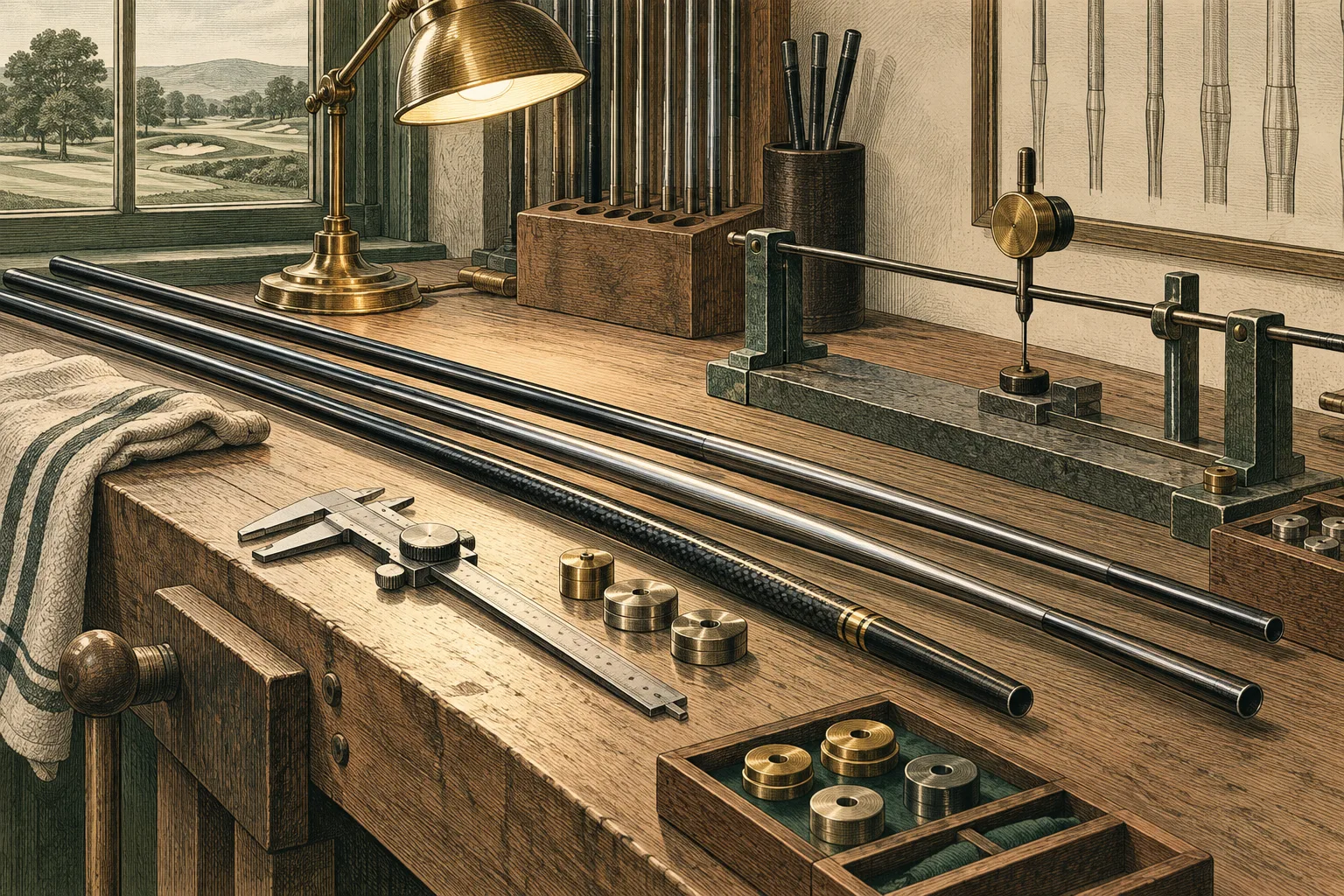
Every club in your bag is two decisions, and most golfers only ever make one of them. The head decides what happens at impact — how much loft is on the face, where the weight sits, how forgiving the thing is when you catch it thin. The shaft decides how that head arrives: how fast, at what angle, with the face pointing where, and how the whole swing felt on the way down. Bolt two different shafts onto two identical heads and you own two different golf clubs.
That is the premise of this series. It is also, quietly, the answer to the question we get asked most in the bays: why do I hit that club so well and this one so badly? Often it is not the head. It is the stick underneath it.
The rulebook's definition is shorter than you'd guess
The R&A and USGA Equipment Rules give the shaft about a page. It must be straight from the top of the grip to a point not more than five inches above the sole. Then, in Part 2: "At any point along its length, the shaft must: (i) bend in such a way that the deflection is the same regardless of how the shaft is rotated about its longitudinal axis; and (ii) twist the same amount in both directions." The whole club must be at least 18 inches long and, putters excepted, no more than 48.
Straight. Symmetric. Inside a length band. That is the entire legal specification. Weight, flex, torque, bend profile, materials — none of it is regulated, and no governing body anywhere defines the word "stiff." Hold onto that, because it explains almost every confusing thing about buying a shaft.
Four numbers describe every shaft ever made
Weight, in grams. The whole field runs from roughly 45 g in an ultralight graphite driver shaft to about 137 g in the heaviest steel. It is the first thing you feel and the first thing a good fitter sets.
Flex — L, A, R, S, X. A letter that means whatever the company printing it wants it to mean.
Torque, in degrees: how far the shaft twists under a fixed twisting load. Fujikura publishes it model by model, and the numbers show you the trade in one glance — a Ventus White 4 lists 5.0 degrees, a Ventus Red 5 in R2 lists 3.8, and a Ventus Red 9 in X lists 2.8. Lighter and softer twists more; heavier and stiffer twists less.
Bend profile — where along its length the shaft is soft and where it is stiff. Marketing calls this kick point and gives you one word for it. The measurement underneath is an EI curve, and it has an entry per inch.
Then three build numbers that decide what a shaft fits rather than how it plays: raw length, tip diameter, butt diameter.
What a shaft actually changes, honestly
Not distance, mostly. Today's Golfer ran 34 iron shafts in 2026 through a single head — a Callaway Apex 24 CB seven-iron — with one ball, one test pro and a Foresight GC Quad, twelve accepted shots per shaft. Real differences showed up: better than ten percent spread in backspin between the highest and lowest spinning shafts in a weight category, and a few yards of carry between a heavy graphite iron shaft and its steel equivalent. Real — and measured in a few yards and a few hundred rpm, not the thirty the advertising implies.
The bigger effect is consistency. Plugged In Golf put seven golfers, from about 70 mph to over 110 mph, through five Nippon Regio MB driver shafts — three weights in stiff, plus three flexes at one weight — on Trackman. Weight came out slightly more important than flex across swing speed, ball speed and distance. Six of the seven testers said the weight change was significantly more noticeable than the flex change. And the tidy theories broke: three players launched the heaviest shaft the highest, and no clean relationship between swing speed and preference appeared at all.
That is the honest headline. A shaft is a consistency instrument. Fit it properly and your good shots repeat; the extra yards are a byproduct of finding the middle more often.
The letter on the label is a shelf tag
There is no standard for flex, and the people who fit for a living say so plainly. Kris McCormack of True Spec Golf: "one company's 'Stiff' could be another company's 'X' could be another company's 'red'." His colleague Tim Briand puts a number on it — "A Modus 120X is like a 303 frequency, but Modus 130X is like 336 frequency, even though they're both X-flexes."
Frequency, in cycles per minute, is at least a real measurement. But even it is thin. Russ Ryden, who built the EI instrument several shaft companies now use and has profiled shafts continuously since 2014, found three shafts reading an identical 354 CPM that were "quite different when viewed with EI analysis." His conclusion is worth taping to the wall: the systems we have for rating shaft stiffness do not work across brands, or even across models inside one brand.
Made-for is not the real deal
When a stock club lists a famous shaft name, it is often a cheaper build wearing the same paint. John Oldenburg — now at LA Golf, formerly at Aldila — gave Golf.com the economics: "The most expensive thing to control on a golf club is torque," so torque control is the first thing cut, and made-for versions frequently carry a degree or two more of it than the aftermarket original. Same name, same colour, different shaft. There is a whole chapter on how to tell them apart later in this series.
Who actually makes them
Fewer houses than the paint suggests. Fujikura (Ventus, Speeder NX, Motore X, Axiom, MCI). Mitsubishi Chemical (Diamana, Tensei, Kai'li, Vanquish, MMT). Graphite Design. Nippon Shaft (Modus3, 950GH neo, Zelos, Regio Formula). KBS. UST Mamiya. And True Sports, which since 2019 has owned True Temper, Project X, ACCRA and Aerotech's SteelFiber under one roof. Two shafts you assumed were rivals are often cousins.
Where to start
Read the next four chapters in the order a fitter actually works: weight first, then flex and what the letter costs you, then torque, then bend profile. Weight is the lever with the biggest and most reliable effect on your golf. Profile is the last, finest adjustment, and it is worth nothing if the first three are wrong.
Then come run the only test that settles anything. Bring your driver to a bay, put a second shaft in the same head, and hit the two back to back on the launch monitor. Twenty balls each is plenty. You are not looking for the longest one. You are looking for the tighter cluster, and the ball flight you can still repeat when you are tired on the fourteenth.
From the glossary
Related reading: Weight Before Flex: The Shaft Spec That Decides the Rest · Shaft Flex Explained: Why the Letter on the Label Lies · Torque: What Makes a Shaft Stable, and What Makes One Loud · Bend Profile and the EI Curve: Under the Kick Point

Sleeper Classics: Great Clubs the Market Forgot
The used-club market has a memory problem. Prices track two things — marketing budgets and recency — and neither has much to do with how a club actually performs. A driver that led forgiveness testing in its day gets lapped by nine model cycles and lands in the $100 bin next to genuine junk. A forged iron a Champions Tour pro carried in his own bag sells for less than a single new wedge because the brand never bought enough American ad pages. That inefficiency is your opening.