
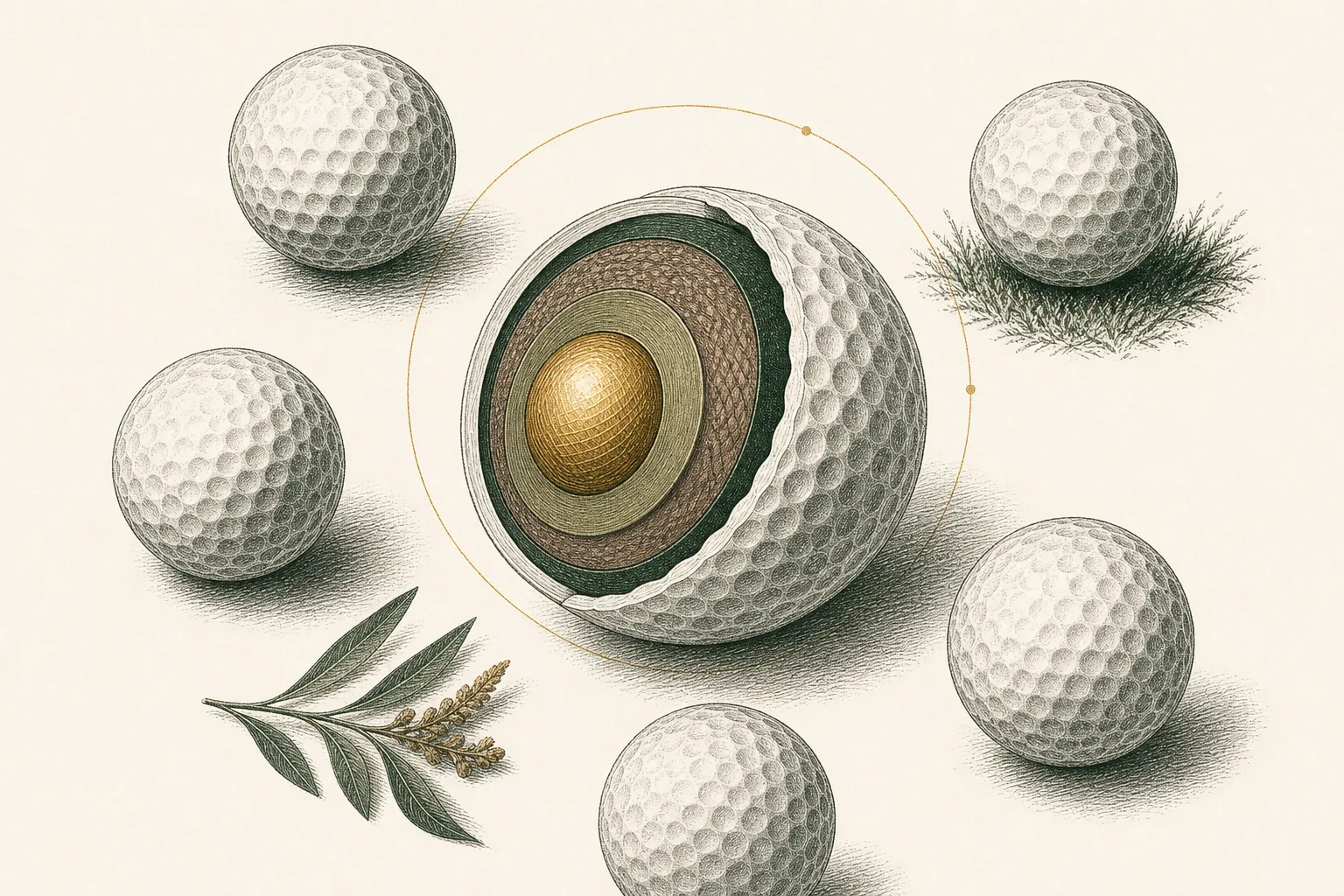
You can spend $600 on a new driver and gain four yards. Or you can spend $35 on the right dozen golf balls and change how every single shot behaves — off the tee, into the green, and on those little pitches that decide whether you make bogey or double. The ball is the only piece of equipment you use on literally every stroke, and it's the cheapest thing in your bag to get right. Most golfers never think about it. Here's what's actually going on inside that little sphere, and what you should really be playing.
What's inside: 2-piece vs. 3-piece (and beyond)
A 2-piece ball is as simple as it sounds: a big rubber core wrapped in a cover. That's it. The core is built for one job — turn your clubhead speed into ball speed — and the firm cover keeps spin low everywhere. Low spin off the driver is great (slices curve less, drives roll out more). Low spin on a wedge shot is not great, because the ball lands and keeps rolling like it owes you money.
A 3-piece (or 4- or 5-piece) ball adds one or more mantle layers between the core and the cover. That sandwich lets designers do something clever: make the ball behave differently depending on how hard it's struck. On a full driver swing, the fast, deep core dominates and spin stays low. On a soft pitch shot, the outer layers and cover dominate and spin goes up. One ball, two personalities. That's the entire magic trick of a "tour ball," and it's why they cost more — multilayer construction is genuinely harder to manufacture.
More layers is not automatically better, though. Past three or four pieces, you're into fine-tuning for very specific players, not a ladder where five beats three.
The cover is the part that actually matters
If you remember one thing from this article, make it this: cover material drives short-game spin more than anything else about a golf ball.
Covers come in two basic flavors. Ionomer (Surlyn is the classic brand name) is a firm, cheap, nearly indestructible plastic — it's what's on almost every ball under about $25 a dozen. Urethane is a softer, grippier material that lets wedge grooves actually bite into the cover at low speeds. Urethane is what's on the Pro V1 and every other ball the pros play.
The difference is not subtle. In robot testing of short wedge shots, spin rates from the highest-spinning urethane balls to the lowest-spinning ionomer balls differed by close to 4,000 rpm — on a 35-yard pitch. Ionomer balls routinely give up 1,500–3,000 rpm of greenside spin versus urethane. In plain English: the urethane ball takes a hop and stops near the flag; the ionomer ball lands in the same spot and releases 10, 15, 20 feet past it. No wedge upgrade on earth buys you back that difference. The ball either has the cover to spin or it doesn't.
The trade-offs: urethane costs more, scuffs easier, and spins more on your driver too — which slightly amplifies a slice. For most golfers who can keep a ball in play, those are prices worth paying.
Compression: mostly a feel thing
Compression is a number (roughly 30 to 110) describing how firm the ball is. You'll hear a rule of thumb that slow swingers "can't compress" a firm ball and must play soft, low-compression balls. Modern testing says that's mostly myth. Slow swing speeds don't fail to compress firm balls — and in MyGolfSpy's robot testing, some of the longest balls at slow swing speeds were actually firmer models, because performance differences come from flight and spin, not from some threshold where the ball refuses to activate.
What compression genuinely tells you is feel. Low-compression balls feel soft and quiet off the face; firm balls feel lively and clicky. Soft balls also tend to spin a bit less and fly a bit lower, which some players like and some don't. Pick the feel you enjoy — confidence is real — but don't let a "compression chart" convince you that a soft ball is automatically longer for you. At faster swing speeds (say, 105+ mph driver), very soft balls can actually leak ball speed, so fast swingers should lean firm.
Why the ball beats almost every upgrade
Think about what an equipment upgrade actually buys you. A new driver: maybe a few yards and some forgiveness, on 14 shots a round. New irons: mostly looks and feel. The right ball changes something on all of your shots — and the biggest change is concentrated exactly where scores live, inside 100 yards.
It's also the only "fitting" you can do for $70 total: buy a sleeve of three or four candidate balls and test them. This is something you can literally do at Clubhouse — bring a couple of different balls into a bay, hit 40-yard pitches with each, and watch the spin number on the launch monitor. The gap between an ionomer rock and a urethane ball will show up on the very first shot, in your own hands, with your own wedge. That's a more honest test than any review, including this one.
What you should actually play
If you're brand new or lose 4+ balls a round: play cheap 2-piece ionomer balls and don't look back — Srixon Soft Feel, Callaway Supersoft, Wilson Duo, or good used balls by the bucket. Greenside spin is not your bottleneck yet; keeping a ball in play and building a swing is. Spending $55 a dozen to donate Pro V1s to the woods is charity, not strategy.
If you're breaking 100 regularly and starting to hit real pitch shots: this is the moment to move to urethane, and the good news is you don't have to pay tour-ball prices. Direct-to-consumer and value urethane balls — Vice Pro, Snell MTB, Maxfli Tour, Kirkland Signature, Srixon Q-Star Tour — deliver most of the premium-ball short game for $22–$32 a dozen. This is the single best value in golf equipment, full stop.
If you're a single-digit handicap or swing the driver 105+ mph: play a true premium multilayer urethane ball — Pro V1/Pro V1x, TP5, Chrome Tour, Tour B — and pick the specific model by testing, not by brand loyalty. At your speed the differences in flight and driver spin between models are real and measurable.
Everyone, at every level: once you choose, play one ball. Not "whatever's in the bottom of the bag." Your distance control and greenside touch are calibrated to how one specific ball launches, spins, and rolls out. Switching from a Supersoft to a Pro V1x mid-round changes your pitch shots more than most swing flaws do. Pick your ball, buy a few dozen, and let every other part of your game stop guessing.
And if you're not sure which candidate suits you, book a bay, grab the wedge and the driver, and let the numbers settle the argument. The ball fitting is the cheapest fitting you'll ever do — and the one that pays off on every shot.
From the glossary
Related reading: Launch and Spin: the Flight Recipe · Wedges: Lofts, Gapping, Bounce and Grind · Buying Your First Set Without Getting Fleeced · Ball Speed, Club Speed, and Smash Factor

The Most Forgiving Drivers of the 2010s, Ranked by the Data
From roughly 2014 to 2019, every major manufacturer spent its entire driver budget chasing one number: MOI — how much the head resists twisting when you miss the middle. Carbon crowns, tungsten back weights, faces engineered to fight your specific mishit. Those flagships were the most forgiving drivers ever built to that point, and forgiveness does not expire. Your heel strike in 2026 is the same heel strike it was in 2018, and a head that held ball speed on it then holds ball speed on it now.