
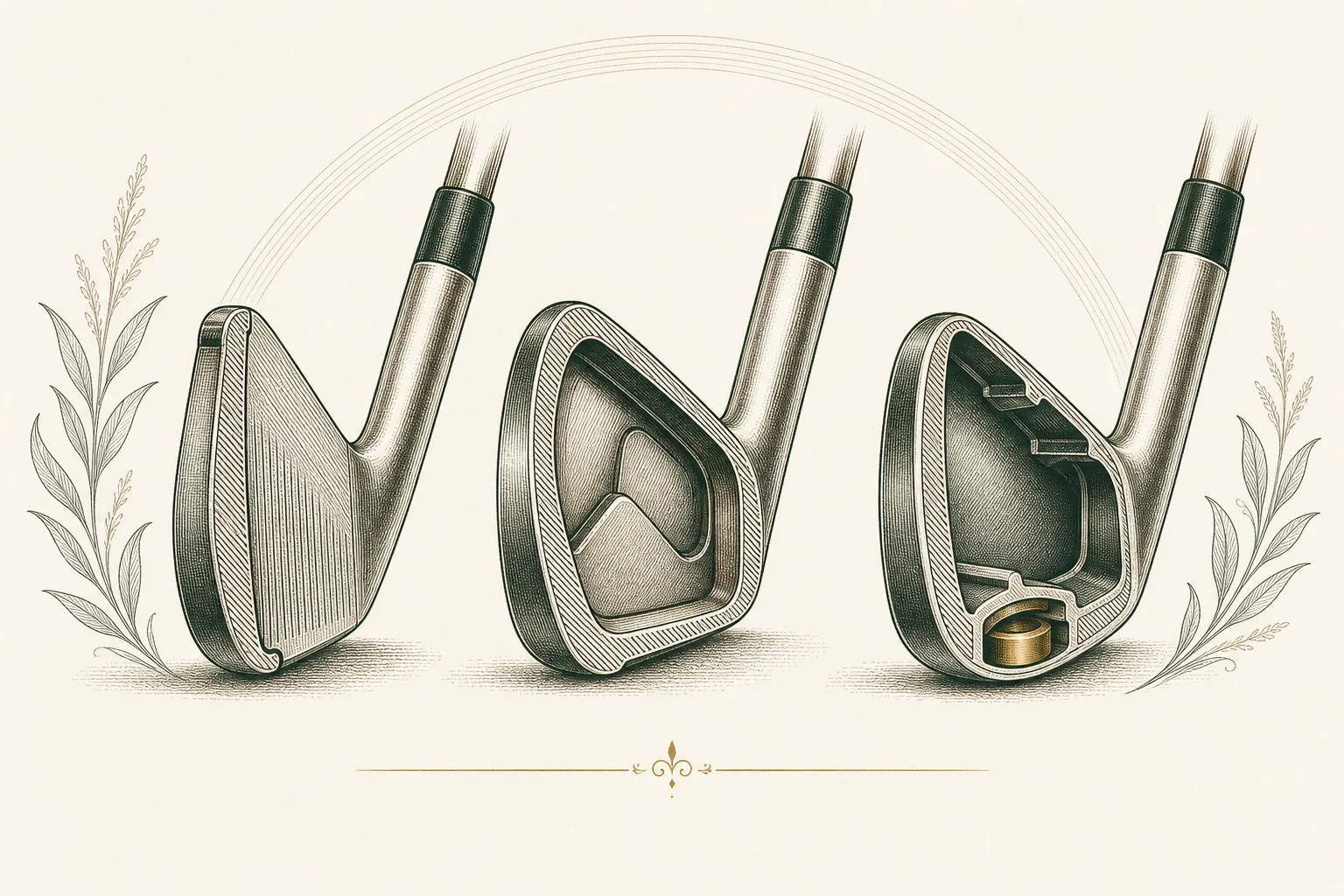
Walk into any golf shop and the iron wall looks like one long row of shiny, vaguely similar clubheads. It isn't. That wall spans five genuinely different machines, from razor-thin muscle-back blades to shovel-sized super-game-improvement irons, and picking the wrong end of it will quietly cost you strokes for years. The good news: the differences aren't marketing fog. They're physics, and once you understand three or four design levers, you can read any iron at a glance.
The physics: where the metal lives decides everything
Every iron head weighs roughly the same. What separates a blade from a game-improvement iron is where that mass sits.
Center of gravity (CG). Push mass low and deep in the head and the ball launches higher with more spin stability — a gift when your strike is imperfect. Keep the mass high and directly behind the face, like a blade does, and you get a lower, more penetrating flight that skilled players can bend on command.
Perimeter weighting and MOI. Scoop metal out of the back of the head and redistribute it around the edges — the "cavity" in cavity back — and you raise the club's moment of inertia. MOI is just resistance to twisting. Catch one off the toe with a high-MOI iron and the face stays closer to square, so the ball loses less speed and less direction. A blade concentrates its mass in a small zone behind the center; miss that zone and the head twists, and the ball tells on you immediately.
Offset. That's the amount the leading edge sits behind the hosel. More offset gives your hands a split second longer to square the face and encourages hitting the ball with the shaft leaning forward — both of which fight a slice. Game-improvement irons have lots of it; blades have almost none, because good players find offset makes the club feel sluggish and hook-prone.
Sole width. Wide soles put mass low (higher launch) and act like skis through the turf, so a slightly fat strike skids into the ball instead of digging a trench. Narrow soles let a precise striker nip the ball cleanly off tight lies. Wide sole = margin for error; narrow sole = precision tool.
Four levers. Every category below is just a different setting of those dials.
The five categories, honestly
Muscle-back blades. One solid piece of forged steel, all the mass behind the sweet spot. Tiny head, thin topline, no offset, narrow sole. Flushed, a blade gives the best feedback and feel in golf and lets you flight the ball high, low, left, right at will. Missed by half a groove, it punishes you in distance and direction. Blades are for players who hit the center of the face almost every time — think low single digits and pros, and honestly not even all of them.
Players cavity backs. Same compact look at address, but a shallow cavity milled into the back moves some mass to the perimeter. You keep most of the feel and workability and buy back a meaningful chunk of forgiveness. This is what a large share of tour players actually game, at least in the long irons. Suits solid ball-strikers — roughly single digits to low teens — who want feedback without the full blade tax.
Players-distance irons. The newest and sneakiest category. Compact, clean, blade-ish at address — but inside they're often hollow, with a thin, fast face and tungsten packed low to launch strong lofts. You get game-improvement ball speed in a players-iron costume. The trade: strong lofts mean a 7-iron that flies like a 6, and the flight can be harder to flight down or spin. Great for mid-handicappers who strike it decently and want distance without looking down at a shovel.
Game-improvement irons. Bigger head, thicker topline, wide sole, deep cavity, generous offset, big perimeter weighting. Everything is tuned for one job: making your bad swings playable. Toe strikes still fly, thin strikes still get airborne, fat strikes skid instead of dig. This is the right answer for most golfers shooting in the 90s and up, and there is zero shame in that — these clubs make golf more fun, which is the entire point.
Super-game-improvement irons. Turn every dial to max: very wide soles, maximum offset, sometimes hollow or hybrid-like heads. Built for beginners, slower swing speeds, and anyone who struggles to get the ball in the air. If your miss is low, thin, and right, these are your friend, full stop.
The ego trap (read this twice)
Here's the honest part your buddy won't say: most golfers play irons that are too hard for them, and almost nobody plays irons that are too easy. Blades look incredible in the bag. They signal "player." And every mid-handicapper has heard the myth that blades will force you to improve by punishing your misses.
They won't. What punishes your misses is doubles and triples, and you don't learn faster by making practice data noisier. A cavity back gives you the same feedback — you know when you flushed it — it just doesn't charge you two shots for the lesson. Meanwhile, the forgiveness you gave up shows up as shorter, crookeder mishits on every hole, forever.
The reverse ego trap exists too: a genuinely good ball-striker in a super-game-improvement iron can fight ballooning flight, too-strong lofts that wreck wedge gapping, and offset that turns a draw into a hook. The goal isn't the most forgiving iron or the prettiest one. It's the most club you can honestly handle, minus one notch of pride.
How to find your category with data, not vibes
This is where a sim bay beats a demo net in a parking lot. Bring your current 7-iron into a bay at Clubhouse and hit 15–20 shots on the launch monitor. Don't watch carry distance — watch the spread. How wide is your dispersion left-to-right? How much does carry vary between your best and worst strikes? If your 7-iron carry swings 20+ yards shot to shot, forgiveness is worth far more to you than workability, whatever your ego says.
Two more honest tests: check your strike pattern (foot spray or face tape works; so does the shot data), and check your ball flight window. If you're hitting all over the face, high-MOI heads are free strokes. If your misses cluster tight around center and you're already shaping shots on GSPro courses, you've earned a look at players cavities or players-distance.
Our Gear Shelf tags every iron in the library by these exact styles — blade, players cavity, players distance, game improvement, super game improvement — so once you know your category you can browse what actually fits instead of what's shiniest. And if you want a second opinion, a fitting session takes the guesswork out entirely: same swing, different heads, real numbers side by side.
The short version
Blades reward perfect strikes and punish everything else. Cavity backs move mass to the perimeter so mishits stay in play. Players-distance irons hide rocket faces in compact bodies. Game-improvement and super-GI irons stack every forgiveness lever — low CG, high MOI, offset, wide soles — for the people who need it most, which is most of us. Categories aren't a ranking of how good the clubs are. They're a ranking of how good you have to be to use them. Match the club to the golfer you are this season, not the one you're planning to become, and you'll get to that better golfer faster.
From the glossary
Related reading: The 14 Clubs in Your Bag (and What Each Is For) · Buying Your First Set Without Getting Fleeced · Reading Your Shot Data Like a Fitter · Shafts: Flex, Weight, and Your Swing Speed

Sleeper Classics: Great Clubs the Market Forgot
The used-club market has a memory problem. Prices track two things — marketing budgets and recency — and neither has much to do with how a club actually performs. A driver that led forgiveness testing in its day gets lapped by nine model cycles and lands in the $100 bin next to genuine junk. A forged iron a Champions Tour pro carried in his own bag sells for less than a single new wedge because the brand never bought enough American ad pages. That inefficiency is your opening.