
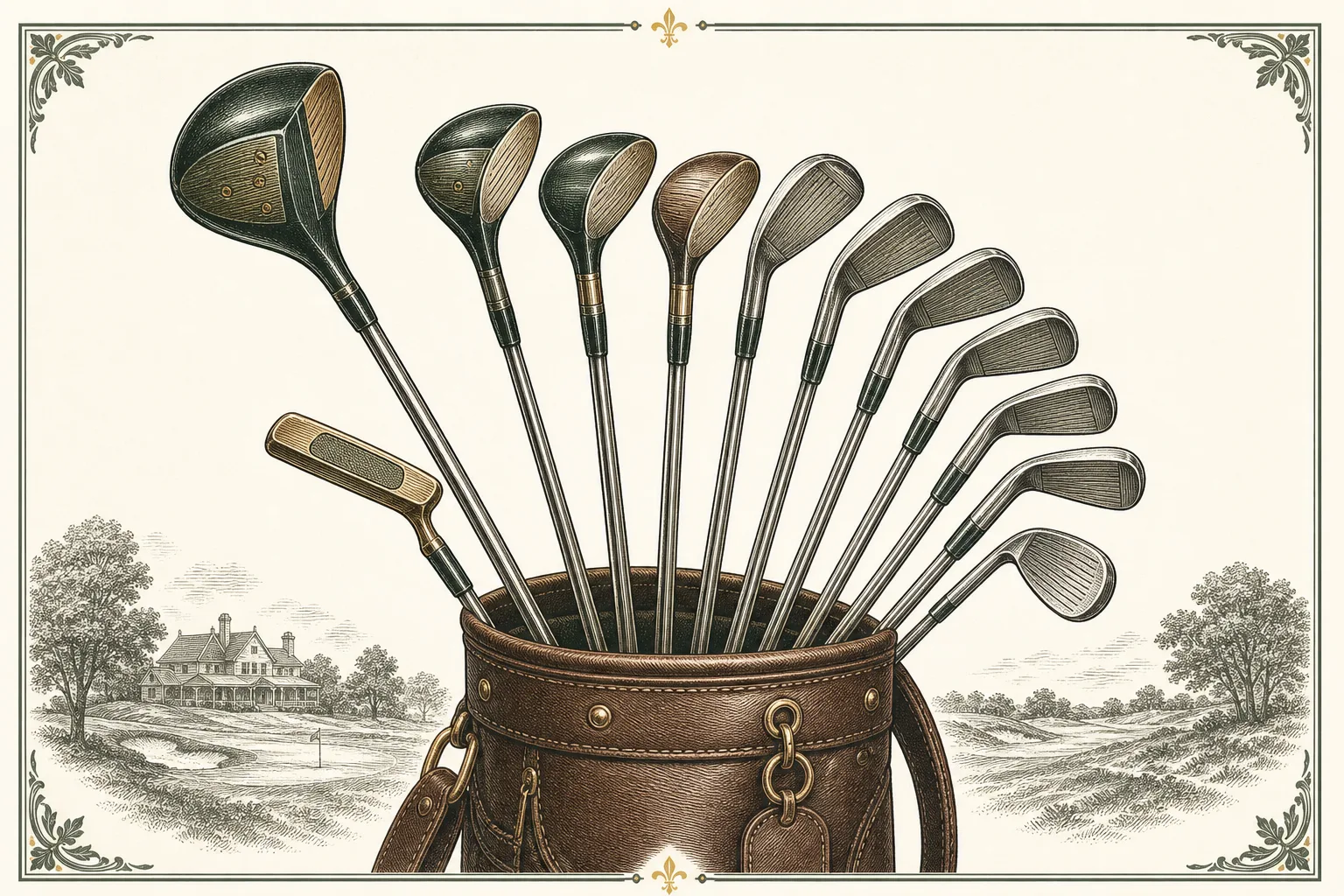
A full set of golf clubs looks intimidating from across the shop: fourteen sticks, all slightly different, all expensive. But a golf bag is just a toolkit, and like any good toolkit, every tool has one job. Once you know the jobs, the whole thing stops being mysterious. Here's the tour, top of the bag to bottom, with honest numbers about how far normal humans actually hit these things.
Why 14, anyway?
The limit is real: Rule 4.1b says you can't start a round with more than 14 clubs. It dates to 1938, when the USGA got tired of caddies hauling arsenals — Lawson Little, the great amateur of the era, sometimes carried around 30 clubs, and a survey at the 1935 U.S. Open found the average bag held 18. Steel shafts had just made clubs cheap to mass-produce, and the rulesmakers worried the game was becoming about who could buy the most specialized tools rather than who could hit the most shots. So they capped it, the R&A followed in 1939, and 14 it has been ever since.
Here's the part beginners miss: 14 is a maximum, not a requirement. Nobody is checking whether your bag is full. Most new golfers are better off with 8 to 10 clubs they understand than 14 they don't.
The driver: your longest, hardest-to-hit club
The driver is the big-headed club you hit off a tee on long holes. It has the least loft (usually 9 to 12 degrees), the longest shaft, and therefore the most distance — and the most ways to go wrong. Real-world data from Arccos, which tracks millions of actual amateur shots, puts the average male golfer's drive at about 225 yards and the average female golfer's around 178. Not the 300 you see on TV. If you drive it 210 and keep it in play, you are doing fine.
One honest tip: more loft is your friend. A 10.5- or 12-degree driver is easier to launch than the 9-degree one the low-handicapper next to you bought. Swallow your pride.
Fairway woods and hybrids: distance without the tee
A 3-wood (about 15 degrees of loft) and a 5-wood (about 18) are for long shots off the ground — second shots on par 5s, or off the tee when the driver is misbehaving. They're smaller-headed than a driver and a little more forgiving off the turf.
Hybrids are the best invention in golf equipment in decades. They replace long irons (the 3- and 4-iron), which are genuinely hard to hit — thin blade, little loft, no forgiveness. A hybrid does the same job with a small wood-shaped head that glides through the turf and gets the ball airborne. If you're new, you want hybrids instead of long irons, full stop.
The irons: the scoring workhorses
Irons are numbered 3 through 9, and the number tracks loft: higher number, more loft, higher and shorter the ball flies. Most people carry a 5-iron through 9-iron and cover the longer stuff with hybrids. Each iron is spaced to fly roughly 10 to 15 yards different from its neighbor, which is the whole point — you pick the club that matches the distance in front of you.
For reference, a mid-handicap male golfer carries a 7-iron about 140 to 155 yards; a typical female golfer, around 100 to 120. Skill level moves these numbers a lot, which is exactly why knowing your numbers beats memorizing anyone's chart.
And since we're being honest: most beginners should not buy blades — the sleek, thin, "players" irons the good sticks use. Blades punish off-center hits with brutal distance loss and sting, and beginners hit the center of the face maybe two swings in ten. Cavity-back or "game improvement" irons have weight pushed to the edges of the head, so your misses fly straighter and nearly as far. They look chunkier. They will save you shots for years. Buy those.
The wedges: where scores are actually made
Wedges are just very lofted irons, and they handle everything inside about 120 yards: full short shots, half-swing pitches, chips around the green, and escapes from sand.
- Pitching wedge (PW, ~44–46°): full shots, roughly 100–115 yards for an average male golfer, 60–80 for an average female golfer.
- Gap wedge (GW, ~50–52°): fills the distance hole between pitching and sand wedge.
- Sand wedge (SW, ~54–56°): bunkers and soft pitches. The wide sole is designed to skid through sand instead of digging.
- Lob wedge (LW, ~58–60°): high, soft, short shots. Fun, and mostly optional for beginners.
Roughly half your shots in a real round happen from wedge range and closer. This is the least glamorous part of the bag and the fastest place to get better.
The putter: the most-used club you own
The putter is for rolling the ball on the green, and you'll use it 30-plus times a round — more than any other club, usually more than driver and wedges combined. Shapes range from thin "blades" to spaceship-looking mallets; mallets are generally more stable and easier to aim for most people. There's no distance chart here. There's only practice.
What a sensible starter set actually needs
You do not need 14 clubs. A genuinely smart starter bag is about ten:
- Driver (loft 10.5° or higher)
- One fairway wood (3- or 5-wood — pick the 5 if you want easier)
- One or two hybrids (replacing the 3/4/5-iron)
- Irons: 6, 7, 8, 9
- Pitching wedge and sand wedge
- Putter
That covers every distance and every situation you'll face in your first couple of years. Boxed starter sets from reputable brands are built almost exactly this way, and a good used set (see our guide on how old is too old) is often the best money in golf. Add a gap wedge and a lob wedge later, when you actually feel the holes in your yardages.
Learn your numbers, not someone else's
Every distance in this article is an average, and you are not average — nobody is. The single most useful thing a new golfer can do is find out how far their clubs actually go. That's precisely what a launch monitor is for: hit ten 7-irons in a Clubhouse bay and you'll walk out knowing your real carry distance, not a hopeful guess. Do that for each club and you've built the one chart that matters — yours. And when the gaps between clubs look weird (two clubs flying the same distance, or a 30-yard hole in the middle), that's a fitting conversation, and a solvable one.
The bag stops being intimidating the moment it becomes fourteen answers to fourteen questions. Learn the questions first. The clubs make sense after that.
From the glossary
Related reading: Buying Your First Set Without Getting Fleeced · Gapping Your Bag on a Launch Monitor · Drivers: Loft, Forgiveness, and the Myths · Wedges: Lofts, Gapping, Bounce and Grind

Sleeper Classics: Great Clubs the Market Forgot
The used-club market has a memory problem. Prices track two things — marketing budgets and recency — and neither has much to do with how a club actually performs. A driver that led forgiveness testing in its day gets lapped by nine model cycles and lands in the $100 bin next to genuine junk. A forged iron a Champions Tour pro carried in his own bag sells for less than a single new wedge because the brand never bought enough American ad pages. That inefficiency is your opening.