
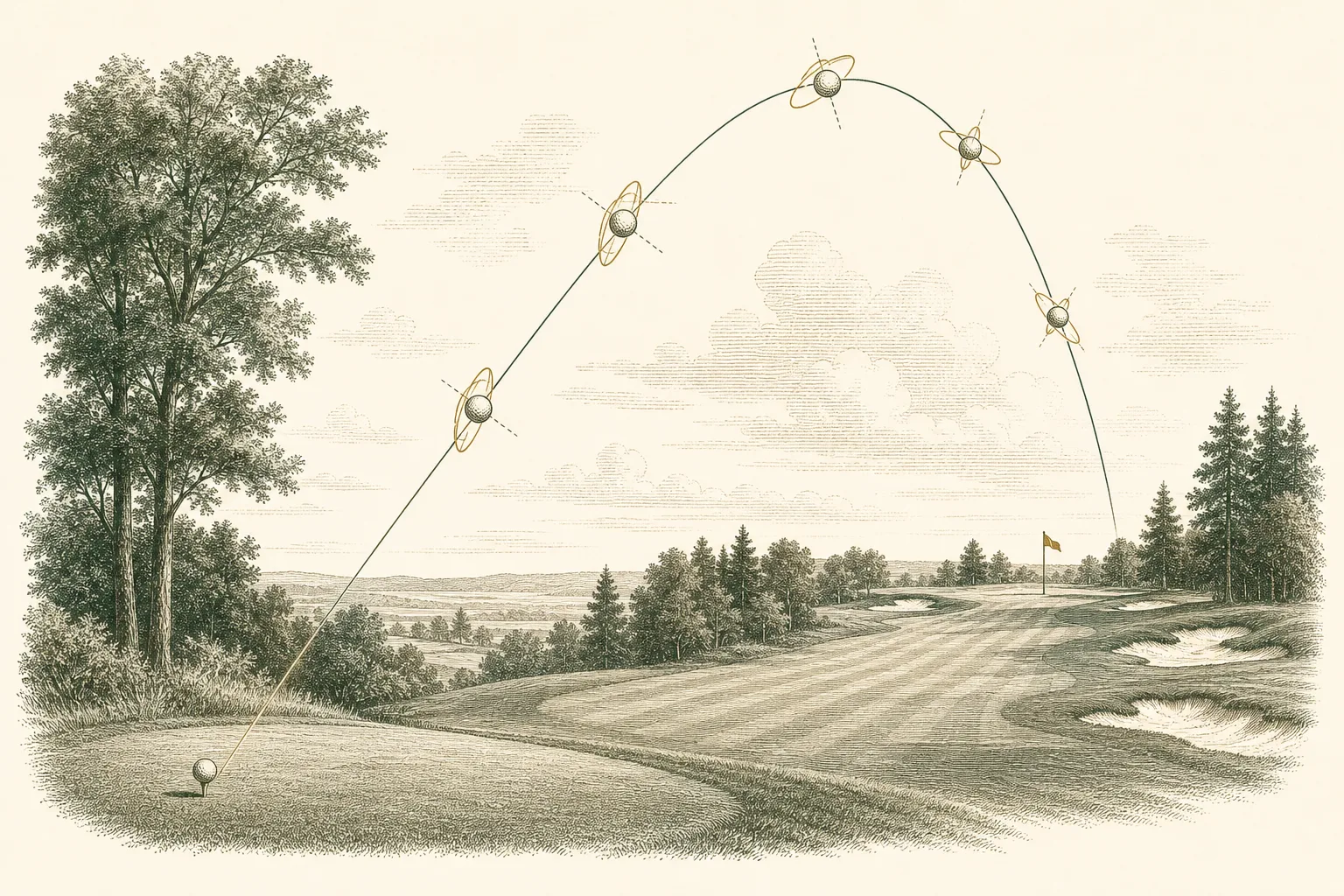
Ball speed tells you how much energy you put into the shot. Launch angle and spin rate tell you what the ball does with that energy — and that's where most golfers leave distance and control on the table. Two players with identical ball speed can carry the ball 20 yards apart, because one launches it on a flight that works and the other doesn't. Think of it as a recipe: ball speed is the size of the engine, launch is the angle of the ramp, and spin is the invisible hand that holds the ball in the air. Get the recipe right and the same swing suddenly flies farther, lands softer, and stops arguing with the wind.
Quick definitions before we go further. Launch angle is the angle the ball takes off relative to the ground, measured in degrees the instant it leaves the face. Spin rate is how fast the ball is rotating at that same instant, measured in revolutions per minute (rpm). Backspin creates lift — no spin and the ball falls out of the sky like a knuckleball; too much and it climbs, stalls, and drops short. Every launch monitor at Clubhouse reports both on every swing, so none of this is theoretical for you. It's on the screen right now.
The windows, club by club
There is no single "perfect" number — optimal launch and spin depend on your ball speed and angle of attack — but there are healthy windows, and knowing them turns your sim screen from trivia into a diagnosis.
Driver. For most amateurs, you want launch somewhere between 12 and 16 degrees with spin between roughly 2,000 and 2,800 rpm. The slower you swing, the more launch you need: a 90 mph swinger maximizes carry around 13–16 degrees of launch and 2,200–2,700 rpm, while a 110+ mph player can afford to launch lower, around 10–13 degrees, with spin closer to 2,000–2,400. PGA Tour players average about 2,545 rpm of driver spin; the average 14-handicap male amateur spins it around 3,275 rpm — and that extra 700 rpm is quietly stealing 10–15 yards of carry. PING's famous optimal launch chart makes the underlying logic explicit: slower ball speeds and upward attack angles want higher launch, faster speeds and downward hits want lower launch. High launch, low spin is the driver mantra for a reason.
Irons. A handy rule of thumb: your spin rate should be roughly the iron number times 1,000. A 7-iron around 7,000 rpm, a 6-iron around 6,000 (Tour average for a 6-iron is 6,204 rpm), a 9-iron pushing 9,000. Launch climbs as the clubs get shorter — mid-teens for long irons, low twenties for short irons. Irons aren't primarily about distance; they're about stopping the ball. A 7-iron spinning 4,500 rpm might go farther, but it lands like a runaway grocery cart.
Wedges. Full wedges live in the 8,000–10,500 rpm range with launch in the mid-twenties to thirties. Here, more spin is almost always better — this is the scoring zone, and spin is your brake pedal.
Where launch and spin actually come from
Both numbers are made at impact, in about half a millisecond, by three things.
First, dynamic loft — the loft the face actually presents at impact, which is rarely the number stamped on the club. Shaft lean, wrist angles, and where you catch the ball in your arc all change it. Dynamic loft is the biggest driver of launch angle.
Second, spin loft — the gap between dynamic loft and the direction the clubhead is traveling (attack angle). Bigger gap, more spin. This is why hitting down steeply on a driver adds spin: you've widened the gap. It's also why forward shaft lean with a wedge reduces spin even though it feels like you're "compressing" it.
Third, strike location. Off-center hits change spin dramatically through gear effect, especially with a driver. Hit it low on the face and spin jumps; hit it high on the face and spin drops and launch rises — which is why the classic fitter's trick for a spinny driver is simply "hit it a groove higher." Foot spray on the face in a bay session makes this visible in about three swings.
The two classic misses
Too much spin is the ballooning drive: it takes off fine, then climbs like it hit an escalator, hangs, and drops almost vertically 20 yards short of where it should. It's murder into the wind, because headwind multiplies the effect of spin. Causes: hitting down on the driver, striking it low on the face, too much loft for your delivery, or a shaft/head combo that adds dynamic loft. If your drives feel crushed but come up short, check spin before you blame your speed.
Too little spin is sneakier because it can look great indoors on a calm sim day. Below roughly 1,800 rpm with a driver, the ball can't generate enough lift, so it falls out of the sky early and — outdoors — becomes wildly inconsistent, because a ball with a barely-stable spin axis gets pushed around. With irons, low spin means shots that release 15 yards past their landing spot and won't hold a firm green. A "hot" low-spin 7-iron that goes 175 sounds like a bargain until you realize you can't stop it inside 30 feet.
The honest framing: spin is not good or bad. It's a budget. Drivers want the low end of the budget, wedges want the high end, and your job is to find out where your deliveries are spending it.
Same swing, different flight
Here's the part that surprises people: your launch and spin numbers are not just you. They're you plus the equipment, and swapping one variable can move the numbers as much as a swing change.
Heads. Loft is obvious, but center-of-gravity placement matters just as much. A driver with the CG low and back launches higher and spins more (forgiving); CG forward launches lower and spins less (demanding, but efficient for high-spin players). Two 10.5-degree drivers can produce 500+ rpm different spin with the identical swing.
Shafts. A shaft doesn't add speed by itself, but its weight, flex, and bend profile change how the head is delivered — how much the face closes, how much loft you present at impact. The wrong shaft can add dynamic loft you don't want or make your low-face misses more frequent. That's a launch-and-spin problem wearing a shaft costume.
Balls. The biggest single equipment lever most golfers ignore. In MyGolfSpy's robot testing, wedge spin at 35 yards ranged from about 2,000 rpm for a hard ionomer-cover distance ball to over 6,000 rpm for a urethane tour ball — the same strike, triple the spin. Broadly, urethane covers produce 8,000–10,000+ rpm on full wedges while ionomer balls sit thousands of rpm lower. If you play a rock-hard distance ball, no wedge lesson on earth will make your pitches check up.
This is exactly why fitting exists, and why guessing from a review video doesn't work: the review was someone else's delivery.
Dial it in at the bay
Here's a 30-minute Clubhouse session that will teach you more than a month of range balls. Hit ten drivers and write down your averages: ball speed, launch, spin. Compare launch and spin against the windows above for your speed. Spin above 3,000? Spray the face and check strike height, then try teeing it higher and hitting up on it — attack angle is free launch and free spin reduction. Then hit ten 7-irons and check the "iron number × 1,000" rule. If your numbers are way outside the windows and your strike is decent, that's not a swing flaw — that's a fitting conversation, and we can put different heads, shafts, and balls in your hands and watch the numbers move in real time.
Launch and spin are the recipe. You already own the engine. Now go see what your flight is actually made of.
Related reading: Ball Speed, Club Speed, and Smash Factor · Reading Your Shot Data Like a Fitter · Golf Balls: What You Should Actually Play · Shafts: Flex, Weight, and Your Swing Speed

Sleeper Classics: Great Clubs the Market Forgot
The used-club market has a memory problem. Prices track two things — marketing budgets and recency — and neither has much to do with how a club actually performs. A driver that led forgiveness testing in its day gets lapped by nine model cycles and lands in the $100 bin next to genuine junk. A forged iron a Champions Tour pro carried in his own bag sells for less than a single new wedge because the brand never bought enough American ad pages. That inefficiency is your opening.