
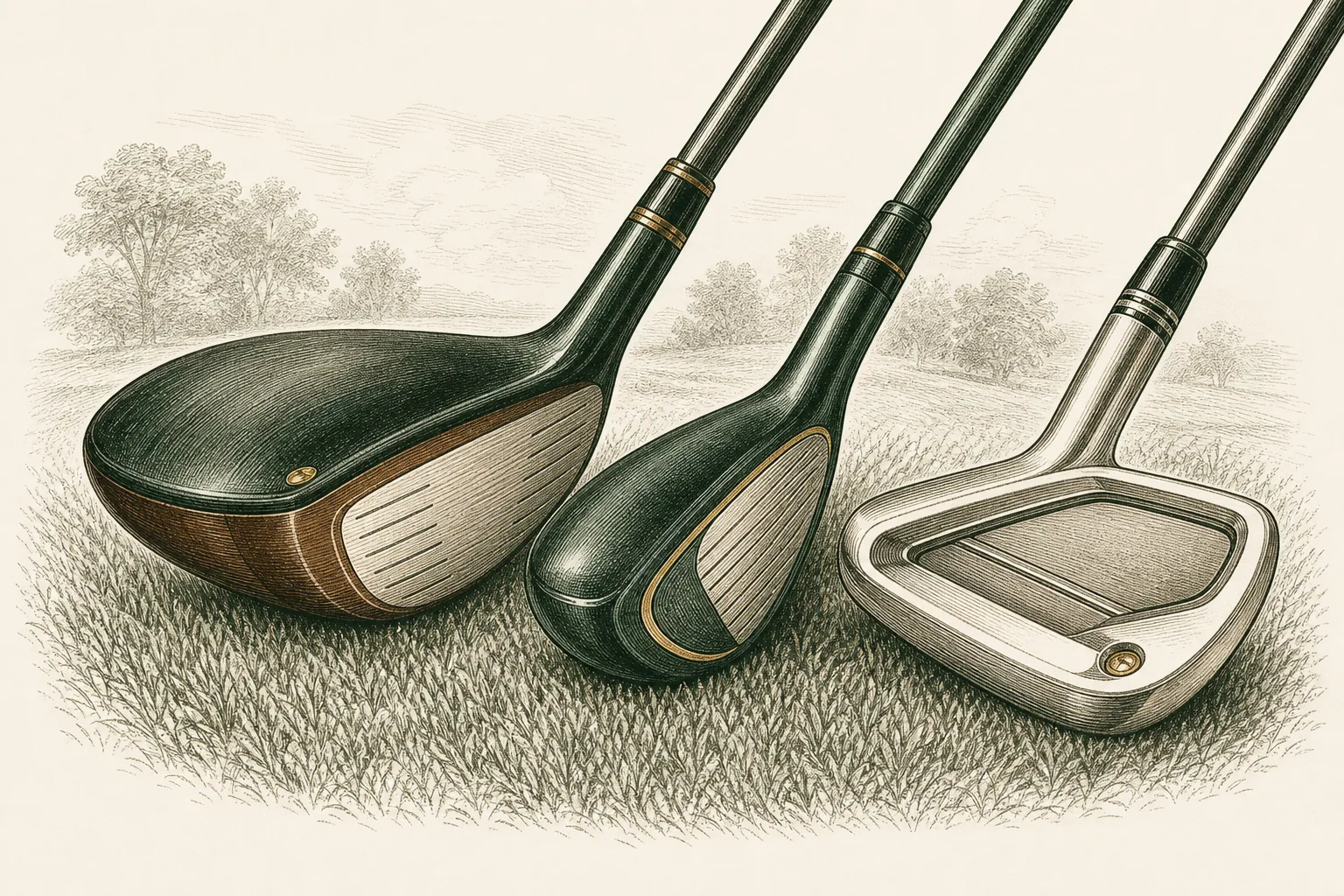
Somewhere between your longest iron and your driver lives the most awkward stretch of the bag: the 180–230 yard zone. Almost nobody hits those shots well, almost everybody faces them constantly, and the club industry has produced three entirely different answers to the problem — the fairway wood, the hybrid, and the driving iron. They can carry the same loft, the same number stamped on the sole, even fly a similar distance on your best swing. And yet they are wildly different tools. Here's what each one actually is, how they behave when they meet the turf, and how to figure out which belongs in your bag.
What each club actually is
Fairway woods are the biggest of the three: a large, shallow, hollow head — usually 15 to 22 degrees of loft for a 3-wood through 7-wood — on the longest shaft you'll swing besides your driver. All that size lets designers push the center of gravity low and deep, far behind the face. That's the whole trick: a deep CG launches a low-lofted club high in the air, so a 15-degree 3-wood flies like it has far more loft than it does.
Hybrids (also called rescues, which tells you everything about their job description) are wood-iron crossbreeds: a smaller hollow head than a fairway wood, on a shorter shaft closer to iron length, usually 17 to 27 degrees. The CG sits lower and further back than an iron's but not as deep as a wood's. They replace long irons in most bags — a 3-hybrid for a 3-iron, a 4-hybrid for a 4-iron.
Driving irons (the marketing term is "utility irons") look like a slightly swollen long iron: an iron shape with a hollow or foam-filled body and a thicker sole packing extra mass low. Of the three, the CG sits closest to the face — which means the lowest launch, the most penetrating flight, and the least built-in help.
Same loft, three launch profiles. A fitter at GOLF.com frames the choice around one number most golfers never think about: descent angle — how steeply the ball falls out of the sky. Too steep and you leave distance on the table; too shallow and the ball lands hot and won't hold a green. Which club gives you a playable descent angle depends almost entirely on how fast you swing.
Turf interaction: where the differences get real
Off a tee, all three work. Off the ground, they part ways fast — and this is the part launch monitors don't fully show you until you watch the strike itself.
A fairway wood wants to be swept. Its broad, shallow sole is built to skim the grass, not dig into it. Off a tight fairway lie that's lovely. Out of rough, that wide sole becomes a plow: grass grabs the big head, the face twists shut, and the ball comes out low and left. Fairway woods are the longest of the three from short grass and the most miserable from long grass.
A hybrid is the turf-interaction champion. The rounded, compact sole acts like the hull of a boat — it rides through rough instead of snagging in it — and the shorter shaft lets you hit slightly down on the ball like an iron. This is why hybrids earned the "rescue" name: bad lie, sidehill lie, wet turf, first cut — the hybrid handles all of it with the least drama. If you only remember one thing from this article: hybrids are the most forgiving of imperfect lies, not just imperfect swings.
A driving iron interacts with turf exactly like an iron, because it is one: you strike down, take a shallow divot, compress the ball. That gives skilled players precise control of the low point — and gives everyone else the same thin-and-fat misses their 3-iron produced. From rough it's the worst of the three; that thin topline slices under grass fine but the small face gives mishits nowhere to go.
Who should carry which
The data here is unusually clear. Shot Scope's 2026 numbers, analyzed by Golf Monthly, compared greens hit from 175 yards with a hybrid versus a long iron across handicap levels: a 20-handicapper nearly doubles their green-in-regulation rate with the hybrid (14% vs. 8%). A 15-handicap goes from 14% to 18%. Only scratch golfers hit slightly more greens with the iron — and even then it's a coin flip.
So, honest guidance:
- Most golfers — beginners through mid-handicaps — should carry hybrids and fairway woods and no driving iron. Not because driving irons are bad, but because they demand ball speed you probably don't have yet. A driving iron with average swing speed produces a low, spinless bullet that falls out of the sky short and runs unpredictably. The club that "goes far" on one perfect strike out of ten is not a club; it's a lottery ticket.
- Slower swing speeds (driver under ~90 mph) should lean toward fairway woods — a 5-wood and 7-wood combo often out-performs any hybrid because the deeper CG is the only thing that gets the ball airborne with enough hang time to hold a green. High-lofted woods (7- and 9-woods) are quietly one of the best-kept secrets in golf; plenty of tour players carry them now.
- Faster players who hit it high (driver ~105+ mph) are the actual audience for driving irons. With real ball speed, the low-spin flight becomes a weapon: a flat, wind-proof trajectory off the tee on tight holes, with tighter dispersion than a wood. This is why you see them at windy links events and rarely in a 15-handicap's bag.
- Fight a hook? Driving irons and smaller hybrids tend to fade-bias. Fight a slice? Hybrids and woods with draw-biased weighting help. Hybrids fly a touch draw-happy for many players — worth knowing before you buy.
Common gapping setups
Loft numbers overlap confusingly across categories — most 5-woods, 3-hybrids, and 3-irons cluster around 18 degrees, while 7-woods, 4-hybrids, and 4-irons sit around 21–24, per GOLF.com's fitting guidance. So don't gap by loft; gap by carry distance. Some setups that work:
- The forgiveness build (most 15+ handicaps): driver, 5-wood, 7-wood, 5-hybrid, then irons starting at the 6. No long irons at all. Zero shame, more greens.
- The classic mid-handicap build: driver, 3-wood, 4-hybrid, irons from the 5. One club covers the whole rescue zone.
- The stronger player's build: driver, 3-wood, 2- or 3-driving-iron, irons from the 4. The utility iron is a tee club and wind club, not a par-5 attack club.
- The mix-and-match: driver, 3-wood, 7-wood, 4-hybrid. Two different launch profiles in the same yardage neighborhood, chosen by lie and wind on the day.
The mistake to avoid is stacking three clubs that all carry 210. Every club needs its own job.
Settle it on a launch monitor, not a hunch
This entire debate collapses into an hour of honest data. In a bay at Clubhouse, hit ten shots each with a fairway wood, hybrid, and driving iron of similar loft, then look at three numbers: carry (are they actually different, or are you carrying duplicates?), peak height and descent angle (would that shot hold a green, or is it a runner?), and dispersion (the ellipse, not the one heroic strike). Most players discover their driving iron carries 15 yards shorter than they believed and their 7-wood is the best long club they own. If the numbers confuse you, a fitting session or a lesson with Pat will translate — this is exactly the kind of decision a fitter lives for.
The long game gets easier when you stop asking "which club is best?" and start asking "which club is best for the shot I actually face, at the speed I actually swing?" Woods for height and distance, hybrids for rescue and consistency, driving irons for speed and wind. Pick your fighters accordingly.
Related reading: Gapping Your Bag on a Launch Monitor · Blades, Cavity Backs, and Everything Between · Drivers: Loft, Forgiveness, and the Myths · Launch and Spin: the Flight Recipe

Sleeper Classics: Great Clubs the Market Forgot
The used-club market has a memory problem. Prices track two things — marketing budgets and recency — and neither has much to do with how a club actually performs. A driver that led forgiveness testing in its day gets lapped by nine model cycles and lands in the $100 bin next to genuine junk. A forged iron a Champions Tour pro carried in his own bag sells for less than a single new wedge because the brand never bought enough American ad pages. That inefficiency is your opening.