
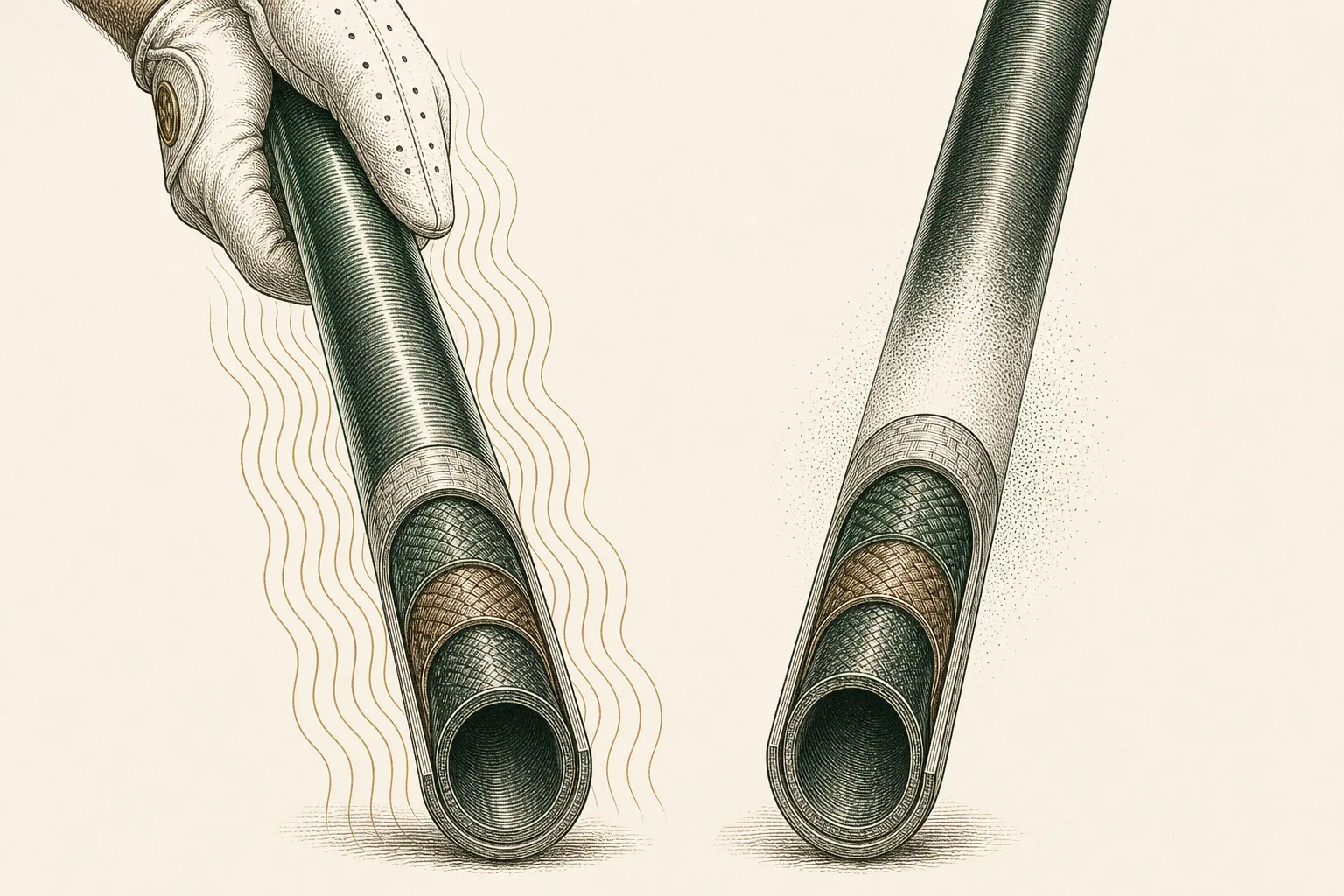
Weight and flex get all the attention. Torque is the third number on the spec sheet, most golfers have never thought about it for ten consecutive seconds, and it is the one with the cleanest published evidence behind it — because it is the spec that decides where your face is pointing when the ball leaves.
What torque is
Flex is how much a shaft bends. Torque is how much it twists around its own long axis. Clamp the butt end, apply a fixed twisting force near the tip, and measure how many degrees the shaft rotates. That number, in degrees, is the torque rating.
The direction of the scale trips people up, so fix it now: a higher number means it twists more. A 5.0-degree shaft is soft in torsion. A 2.8-degree shaft resists twisting hard.
The published numbers, and what they quietly tell you
Fujikura prints torque for every model, which makes the pattern easy to see. In the Ventus family: Ventus White 4 lists 5.0 degrees, Ventus Red 5 in R2 lists 3.8, and Ventus Red 9 in X lists 2.8. In the Speeder NX family: NX Violet 40 in R lists 5.7, NX Violet 50 in R lists 4.5, NX Gold 60 in SR lists 3.5.
Read down those columns and the truth appears. Torque tracks weight and flex almost perfectly. Light and soft twists a lot; heavy and stiff twists a little. Which means that most of the time you are not choosing torque at all — you are choosing weight and flex, and torque arrives in the box with them.
Where it becomes a real, separate decision is at the margins: two shafts at the same weight and flex where one maker has spent money on torsional stiffness and another has not.
And a warning: the number does not travel
Torque is measured the same way in principle everywhere and differently in detail everywhere. The clamp size varies, the distance from the tip at which the force is applied varies, and the amount of force varies between manufacturers. Two shafts listed at 3.4 degrees by two different houses have not necessarily been asked the same question.
Steel is a footnote here. Its torque values are small and much less variable than graphite's, which is why most steel shafts do not bother publishing one at all.
What torque actually does — the strongest evidence we have
This is where the topic stops being folklore. In 2018, Sasho MacKenzie and Heidi Macdonald and Troy Hillier of St. Francis Xavier University, working with Erik Henrikson of PING, published a study in the Journal of Sports Sciences built exactly for this question. Two driver shafts with disparate levels of torque but otherwise very similar properties, forty right-handed golfers across a range of abilities, fourteen swings with each shaft per golfer, grip and clubhead motion captured optically, ball flight on Doppler radar.
At impact, the high-torque shaft produced increased delivered loft (P = .028) and a more open face (P < .001) than the low-torque shaft. The ball finished further right (P = .002). At the individual level, the change in face angle attributable purely to shaft deformation was significantly greater with the high-torque shaft for 25 of the 40 participants.
The authors are careful, and so should we be: shaft twist was not measured directly. It was deduced from the data that the high-torque shaft was twisted more open at impact. But the outcome measurements are direct, and they are unambiguous.
So: torque is not a feel preference dressed up as a spec. Lower torque means a squarer face and a ball that finishes further left, on average, for most golfers, all else equal.
Which way that cuts for you
If your bad shot is a push or a weak cut, torque is a legitimate lever — a stiffer-in-torsion shaft at the same weight and flex should hand you back some of that open face. If you shut the face and fight a hook, the inference runs the other way, though note that the study measured the effect in one direction rather than testing hookers specifically.
Two honest caveats. Fifteen of the forty golfers did not show a significant individual effect, so this is a real average with real exceptions — you are one person, not an average. And the size of the effect is a fraction of a degree of face angle, not a swing fault cured. Torque tidies a tendency. It does not rebuild a golfer.
Stable is not the same as loud
Here is the thing the spec sheet cannot tell you. Torque describes twist resistance. It does not describe damping — how much of the impact vibration the shaft passes into your hands.
The general association is that higher-torque shafts feel smoother and softer, while low-torque shafts feel stiffer and, in Plugged In Golf's phrase, "harsher and more punishing" on a mishit. But that association is not a law, and nobody publishes a damping number. You can find a stable shaft that is muted and a stable shaft that rings like a tuning fork, and the spec sheet will list them both at 3.2 degrees.
This is why stable and loud are two words, not one. Stability is a measured property with published evidence. Loudness is feel, it is real, and you can only find it by hitting the thing.
The made-for trap lives right here
When a golf company puts a famous shaft name in a stock club at a stock price, torque is the first thing to go. John Oldenburg, formerly of Aldila and now at LA Golf, told GOLF.com plainly: "The most expensive thing to control on a golf club is torque." Made-for versions commonly carry a degree or two more of it than the aftermarket shaft whose paint they are wearing.
Put that beside the PING study and the consequence is concrete. The spec that got quietly cheapened is the same spec that measurably opened the face and moved the ball right. Same name on the shaft, different face angle at impact.
One rule you cannot buy your way around
The Equipment Rules require that a shaft "twist the same amount in both directions." Torque is legally symmetric. No shaft is allowed to resist twisting more one way than the other, so nothing on the market is a directional aid. All you are ever buying is more or less of the same twist.
Run it in a bay
Torque is hard to isolate because it comes bundled with weight and flex — so do not try to isolate it. Do the useful test instead: take one head, put the made-for stock shaft and the aftermarket version of the same model in it, and hit fifteen alternating shots with each on the launch monitor.
Look at face angle and at the left-right spread of the finishing positions, not at the carry number. If the two shafts really do differ by a degree or more of torque, that is exactly where it will show up — and now you know what you are looking at.
From the glossary
Related reading: The Clubhouse Guide to Golf Shafts · Weight Before Flex: The Shaft Spec That Decides the Rest · Shaft Flex Explained: Why the Letter on the Label Lies · Bend Profile and the EI Curve: Under the Kick Point

The Most Forgiving Drivers of the 2010s, Ranked by the Data
From roughly 2014 to 2019, every major manufacturer spent its entire driver budget chasing one number: MOI — how much the head resists twisting when you miss the middle. Carbon crowns, tungsten back weights, faces engineered to fight your specific mishit. Those flagships were the most forgiving drivers ever built to that point, and forgiveness does not expire. Your heel strike in 2026 is the same heel strike it was in 2018, and a head that held ball speed on it then holds ball speed on it now.