
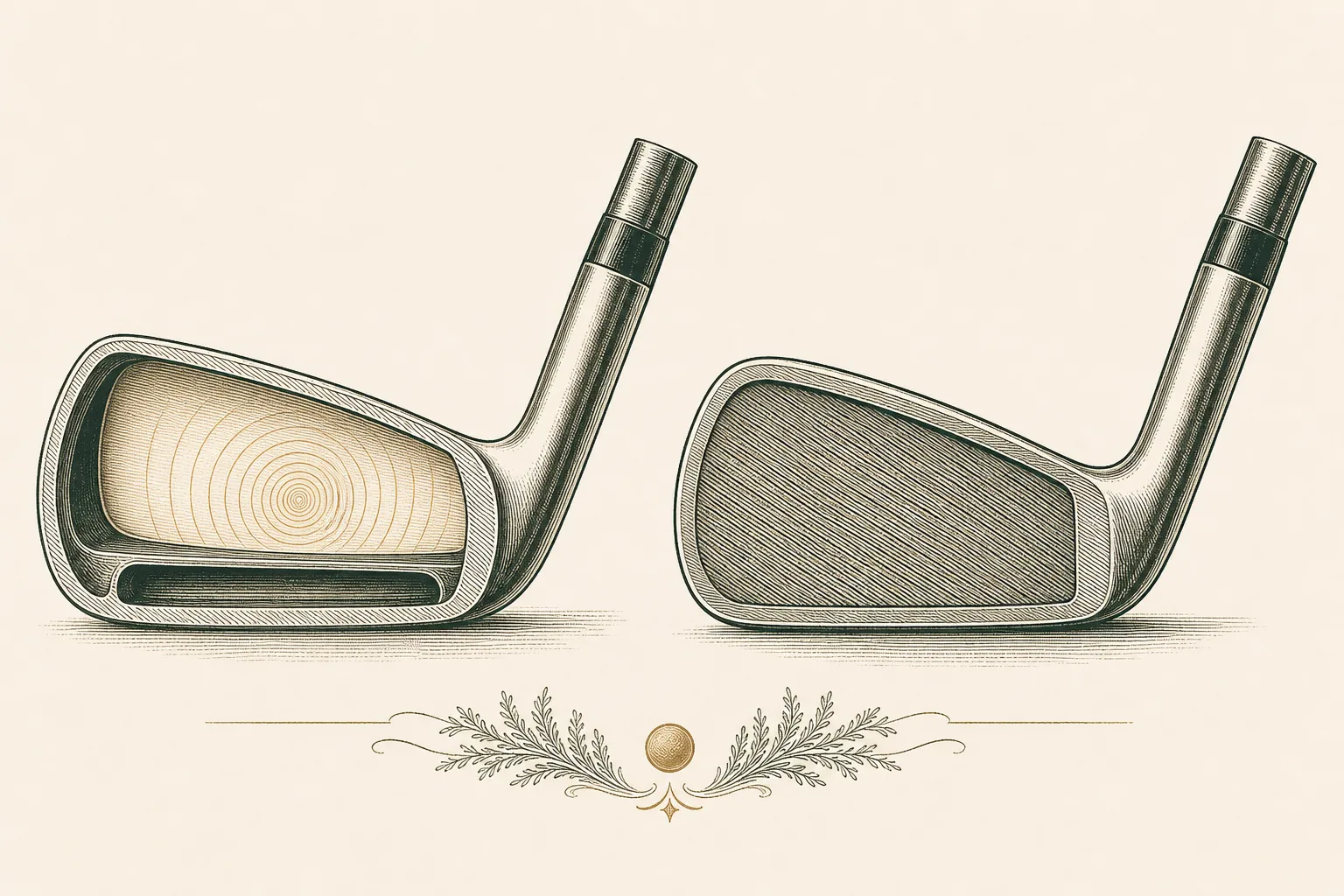
Stand behind the bays on a busy night and you can chart the room by sound alone. From one bay, a high metallic crack — almost a ring. From the next, a dense, quiet thud, like a door closing in an expensive car. Two golfers, two clubs, two completely different philosophies of what impact should tell you.
Most golfers think one of those sounds means "good feel" and the other means cheap. Both beliefs are wrong, and the truth is more useful.
Where the sounds come from
The ring — that springy, high-frequency crack — comes from a thin, fast, relatively unsupported cast face vibrating at impact. Thin faces, cup-face construction, and hollow-body heads all produce it. It's the sound of a face engineered like a trampoline.
The thud comes from forged carbon steel — a denser, softer material struck as one solid piece. Instead of transmitting vibration as sound, the mass of the head dissipates it. Add foam or microsphere filling behind a face and it's damped further still.
So the sound isn't a quality grade. It's a construction readout — you can hear the engineering.
Muted does not mean numb
Here's where careful golfers still get it wrong. A forged club is not giving you less information than the lively cast one. It's giving you a different kind.
Forged feedback is tactile — strike location arrives in your hands, as texture and firmness. A center strike on a forged blade feels like nothing at all, in the best way; a toe strike is unmistakable and mildly unpleasant, and you know within a groove where it hit. Cast and hollow feedback is acoustic — you hear that you hit it, and the head is deliberately built to make most of the face sound the same.
That's the real choice: not feel versus no feel, but which sense you want to be informed through — and how much information you want at all. A blade tells you where you struck it. A hot cast face tells you that you struck it. Early in your golf life the second one is a kindness. Later, when you're trying to fix a strike pattern, it's a blindfold.
What chasing the ring costs
The ringing face is genuinely faster — that's real ball speed, and for a newer player it's a gift. The bill:
- Distance control. A hot, thin face has more ball-speed variance across its surface, and can throw the occasional flier. For someone attacking pins, a club that's sometimes one extra club long is a liability, not a feature.
- Stopping power. Hot faces nearly always ship with strong lofts: lower spin, shallower descent, the ball landing hot and running instead of biting. The loft trade is the same story from another angle.
- Precision of information. The ring is binary. The thud has gradations.
- Durability. Thin faces wear, and occasionally crack, in a way one-piece forgings don't.
Not all cavity backs feel the same
One more thing you can't read on a spec sheet: "cavity back" is not one feel. Some cast cavity clubs are deliberately engineered to feel forged — vibration-damping inserts, filled cavities, internal structures tuned to kill the ring. Two cast wedges sitting next to each other in a used bin can feel completely different: one hollow and ringing, one solid and muted, because one has a damping layer and one doesn't. No listing will tell you. Ten swings will.
In the bay
Run the feel experiment properly — blind, the way your hands deserve:
- Pick three or four irons of the same loft from the rack: a true forging, a classic cast cavity, something hollow-bodied, something damped.
- Hit them before reading anything about them, and rank them by feel alone.
- Now look at the launch monitor: ball-speed spread, spin, descent angle. See whether the club your hands loved is the club your numbers love.
- When they disagree — and they often do — that disagreement is the most useful thing you'll learn all session. It tells you which side of the help-vs-information axis you're actually living on.
The Legends Rack exists so you can run exactly this test across five decades of construction. Book a bay, bring your ears.
From the glossary
Related reading: Every Club Is a Trade-Off · Blades, Cavity Backs, and Everything Between · The Used-Blade Buyer’s Guide · Launch and Spin: the Flight Recipe

The Most Forgiving Drivers of the 2010s, Ranked by the Data
From roughly 2014 to 2019, every major manufacturer spent its entire driver budget chasing one number: MOI — how much the head resists twisting when you miss the middle. Carbon crowns, tungsten back weights, faces engineered to fight your specific mishit. Those flagships were the most forgiving drivers ever built to that point, and forgiveness does not expire. Your heel strike in 2026 is the same heel strike it was in 2018, and a head that held ball speed on it then holds ball speed on it now.