
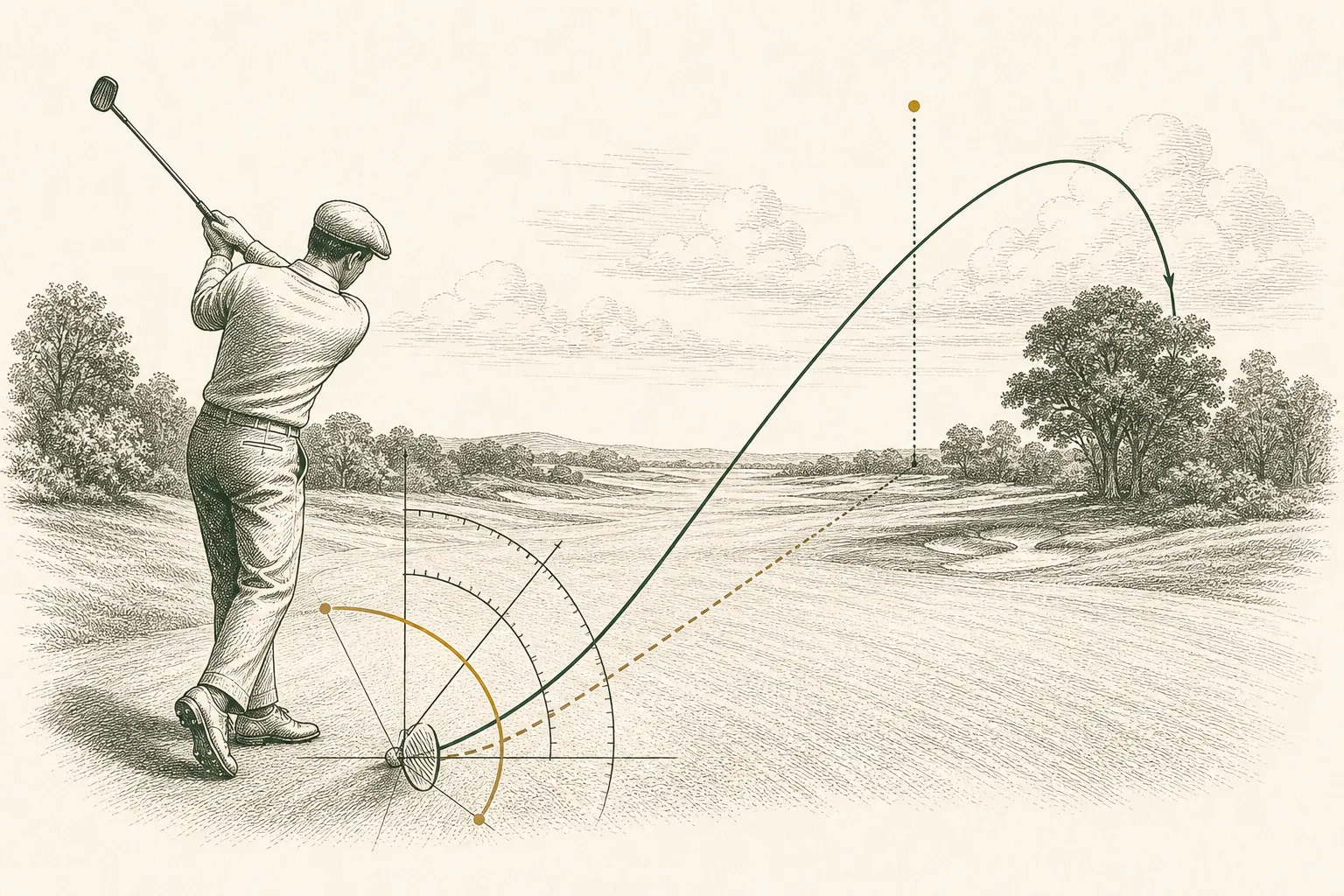
Ask a good fitter what they want to know first and it won't be your handicap, your swing speed, or what's in your bag. It's what's your miss? The miss is the most honest fitting input you own. Your best shots flatter you, your averages blur the story — but the miss repeats. It shows up under pressure, on the first cold swing of the day, on the hole where it costs the most. It's your swing's signature, and it's written in numbers a launch monitor reads straight off the ball.
This essay is a bridge between two ideas. Every club is a trade-off mapped the four axes every club sits on: help vs. information, speed vs. control, assistance vs. stability, damping vs. transmission. And reading your shot data like a fitter taught you to read patterns instead of shots. Put them together and you get the useful thing: your recurring miss tells you which side of each axis you belong on. Not a chart keyed to your handicap. Your actual golf.
One register note before we walk through them: a miss is information, not shame. Every golfer in the building has one, including the ones who play off scratch. The only mistake is refusing to read it.
Face-to-path, in one paragraph
One pair of numbers explains almost every curve you hit. The ball starts mostly where the face points at impact, then curves away from the path the club was traveling on — and the gap between the two, the face-to-path, is the curve-maker. Face open to the path, the ball curves right. Face closed to the path, it curves left. Bigger gap, harder curve. Our bays report both on every swing, which means your miss stops being a mystery and becomes a measurement. The full decoder — dispersion, attack angle, spin axis, honest shot-filtering — lives in the fitter's-eyes essay; here we only need this one pair. Now walk your miss through it.
The slice: the right miss
Face open to the path, ball curving away right. This is the most common recurring miss in golf, and it's the one the equipment industry actually built a tool for: draw bias — heel-shifted mass, offset, sometimes a face that sits a touch closed. If this is your miss, draw bias is not a gimmick. It's engineering aimed at exactly your face-to-path signature, and you are the only player it helps. The mechanism, and the crucial difference between draw bias and real forgiveness, is the whole subject of MOI vs. draw bias.
Worth one extra check: a shaft too stiff for the force you produce also resists squaring, so a persistent low fade-to-slice can be part shaft. On the axes, the slicer can afford the help end of help vs. information — take the correction, enjoy the golf, and revisit when the face-to-path gap shrinks.
The hook: the left miss
Face closed to the path. This is the player every "forgiving" recommendation chart betrays, because the chart asked your handicap instead of your miss. High MOI is still pure upside for you — your off-center strikes still deserve insurance. But draw bias is poison: a head engineered to close faster, handed to a face already closing too fast. The full argument is in MOI vs. draw bias; the short version is that you need high stability and neutral weighting, and those clubs exist in every lineup even though the chart doesn't lead with them.
Two build specs quietly feed a left miss too. A club built too long sits toe-up at address, and a toe-up lie points the face left before you've moved. A shaft too soft is still whipping through impact, arriving closed. If you fight the hook, you belong on the stability end of assistance vs. stability — honest length, neutral head, a shaft that holds still and lets you dictate.
The balloon: the high, spinny miss
The ball climbs, hangs, stalls, and drops short — and any headwind turns it into a punishment. Ballooning is a launch-and-spin overdose, and it usually stacks from more than one source: a shaft too soft for your force (launch assistance you didn't need), a deep-CG high-launch head doing the same job again, or a delivery adding spin on top. Check face-to-path first, because a ballooning ball that also curves hard is losing height to a tilted spin axis, and the curve is the cheaper fix. If the flight is straight but stalling, you belong on the stability end of the shaft axis and the control end of speed vs. control: a stabler, often heavier shaft, a lower-spinning head. What launch and spin numbers should look like for your speed is covered in launch and spin.
The dead low flight
The opposite signature: the ball never climbs, falls out of the air early, and the strike feels like swinging a board. That is the classic too-stiff shaft — a spring that never loads, arriving at the ball having done none of its work. The fix is a softer spring matched to the force you actually produce, and it is not a demotion; your shaft flex is not a skill level exists because so many golfers refuse this exact fix out of pride and pay for it in carry. You belong on the assistance end of the shaft axis. Let the club do its job.
The fat and thin miss
This one is different in kind, and pretending otherwise is how fittings go wrong. Fat and thin contact is a strike problem — where the club met the ground and the ball — not a curve problem, and no head or shaft on any rack corrects it. A wider sole can soften the penalty of a slightly heavy strike, but that's damage control, not a fix. This is the lesson-vs-equipment line that the fitter's-eyes essay draws in full: wandering strike says lesson, repeatable-but-offset pattern says equipment. The honest sequence is lesson first — and the nice thing about this building is that the lesson and the fitting data live in the same bays.
The map
| Your miss | What it usually is | Axis it puts you on | First bay test |
|---|---|---|---|
| Slice / right | Face open to path | Help end — draw bias earns its keep | Neutral vs. draw-biased head, same shaft |
| Hook / left | Face closed to path | Stability end — high MOI, neutral weighting | Check length and flex; never draw bias |
| Balloon | Launch + spin overdose | Control end — stabler shaft, lower-spin head | Same head, stiffer or heavier shaft |
| Dead low | Shaft never loads | Assistance end — softer spring | Same head, softer flex |
| Fat / thin | Strike, not curve | No axis yet — lesson first | Ten swings, watch strike location |
The bay protocol
- Baseline your own clubs. Eight to ten honest swings, and keep the mediocre ones — your real game is built out of mediocre strikes.
- Read the miss, not the worst shot. Face-to-path plus the scatter plot. You're looking for the signature that repeats, with a consistent sign.
- Then test the other side of your axis. One change at a time — swap the head or the shaft, never both — and let the monitor say whether the trade paid.
That's the whole discipline. The miss tells you which experiment to run; the bay runs it in twenty minutes with numbers attached. Book a bay, bring the clubs you already own, and let your most honest input pick your next one.
Related reading: Every Club Is a Trade-Off · Forgiveness Isn't What You Think It Is: MOI vs. Draw Bias · Reading Your Shot Data Like a Fitter · Your Shaft Flex Is Not a Skill Level

The Most Forgiving Drivers of the 2010s, Ranked by the Data
From roughly 2014 to 2019, every major manufacturer spent its entire driver budget chasing one number: MOI — how much the head resists twisting when you miss the middle. Carbon crowns, tungsten back weights, faces engineered to fight your specific mishit. Those flagships were the most forgiving drivers ever built to that point, and forgiveness does not expire. Your heel strike in 2026 is the same heel strike it was in 2018, and a head that held ball speed on it then holds ball speed on it now.