
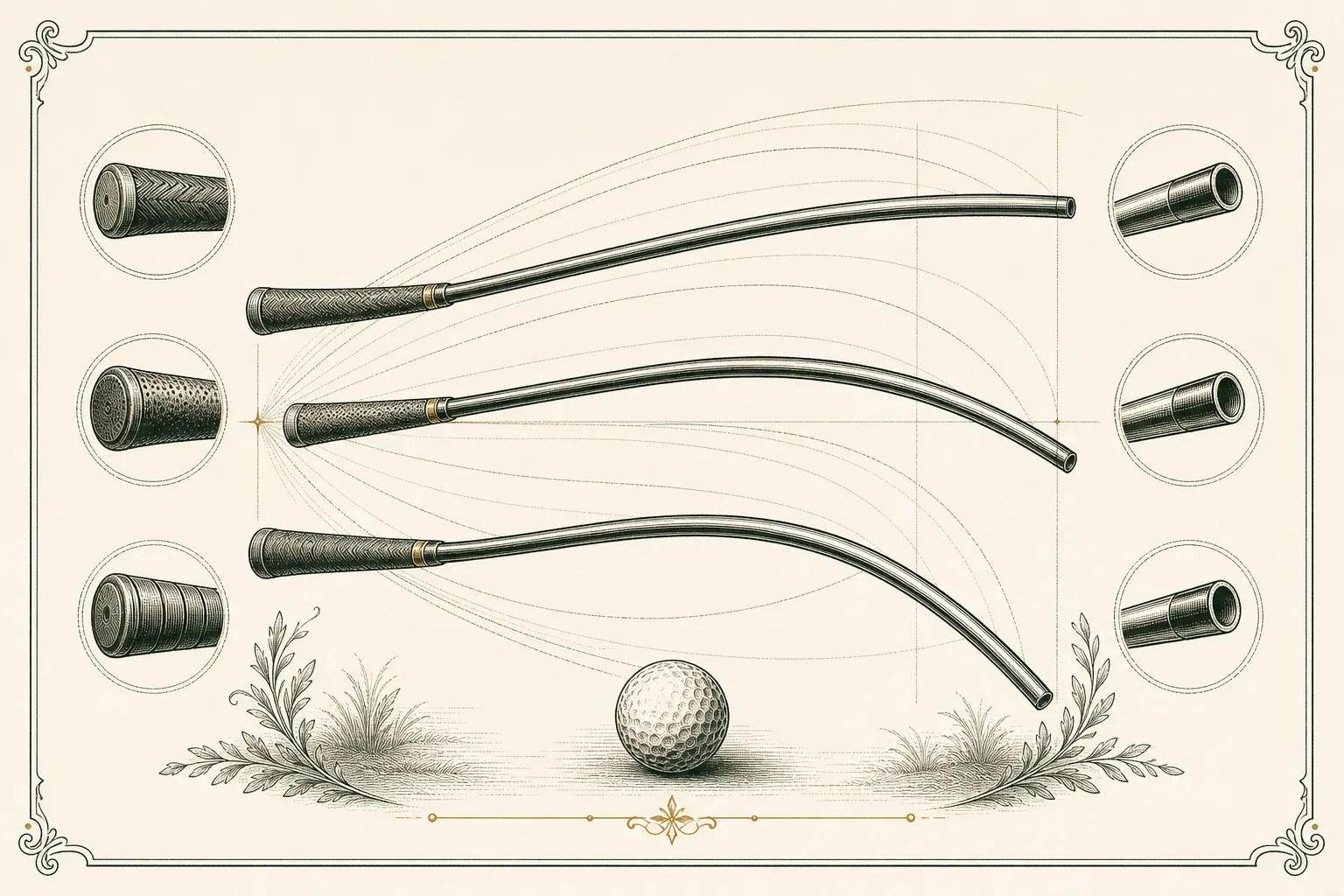
Walk into a good fitting bay and watch the order of operations. The fitter does not ask what flex you play. They hand you two shafts of the same family in different weights and watch you swing. Weight is the first decision, flex is the second, and the reason is not tradition — it is that weight is the one shaft spec that reliably changes what you do, and everybody can feel it.
Most golfers have this exactly backwards. They know their letter, they have never once been told their gram number, and the gram number is the one that matters.
The field you are choosing inside
Shaft weight spans roughly 45 grams at the ultralight graphite end to about 137 grams at the heaviest steel. That is the whole world, and no golfer plays anywhere near both ends of it.
For a driver, the useful bands run about like this, from Dallas Golf's fitting guide: under 80 mph of clubhead speed, 45–55 g; 80–90 mph, 55–65 g; 90–100 mph, 65–70 g; over 100 mph, 65–80 g. Read those as a starting neighbourhood, not a verdict — the whole point of the next section is that the bands overlap for a reason.
Irons are heavier, and the old rule that "steel starts at 120 grams" has quietly stopped being true. True Temper's own published table for AMT Black, a mainstream steel iron shaft, lists 94 g at the 3-iron in regular flex. Nippon markets its Zelos 6 as the lightest steel shaft in the world. Meanwhile graphite iron shafts now run all the way up to 125 g and higher precisely so that a player leaving steel does not have to give up the weight they are used to.
The evidence that weight goes first
Plugged In Golf ran the cleanest version of this test that exists in public. Seven golfers, from around 70 mph to over 110 mph. Five Nippon Regio MB driver shafts: 55, 65 and 75 grams all in stiff, plus 65 grams in regular, stiff and X. Seven drives each, on Trackman.
Across swing speed, ball speed, carry and total distance, weight proved slightly more important than flex. And the subjective result was not close at all: six of the seven testers said the weight difference was significantly more noticeable than the flex difference, and the seventh called them equal. Nobody found flex more obvious.
Two more findings from that data deserve to kill some myths. Heavier and stiffer did not reliably mean lower — three of the seven players launched the heaviest shaft the highest. And there was no consistent relationship between swing speed and which shaft a player did best with. Your speed narrows the search. It does not name the answer.
Weight is also the spec that moves swingweight
Here is the mechanical reason weight has to be settled first: change it and you have changed the whole club, not just the shaft.
The clubmaking arithmetic is roughly nine grams of shaft weight per swingweight point. For comparison, two grams of head weight is a point, five grams of grip weight is a point the other way, and half an inch of length is worth about three points. So swapping a 65 g driver shaft for an 80 g one drags the swingweight down by close to two points before anyone touches a hosel screw — and the fix is head weight, which changes the feel again.
This is why "I'll just try a heavier shaft" is never just a shaft change, and why a properly built comparison is worth more than a hundred forum posts.
Weight flow: why good iron sets are not one weight
Look at True Temper's published AMT Black spec table and you will see something that looks like a mistake. Regular flex: 94 g at the 3-iron, 94 at the 4, 97 at the 5, 100 at the 6, 103 at the 7, 106 at the 8, 109 at the 9, and 115 at the wedge. Stiff flex runs the same staircase one gram up.
That is Ascending Mass Technology, and the idea is simple. Your long irons want to be light, because you need speed and height there. Your scoring clubs want to be heavy, because you need control and you are swinging them at three-quarter effort anyway. Building the set at one weight forces a compromise at both ends. Building it as a staircase — about three grams per club — keeps the swingweight consistent while letting each end of the set do its own job.
If you have ever hit your 8-iron beautifully and your 4-iron like a fence post, weight flow is one of the first things worth looking at.
Changing weight changes flex, whether you meant to or not
The awkward truth that makes "weight first" more than a slogan: the two specs are not independent. Russ Ryden measured three KBS iron shafts all stamped S — the 120 g Tour, the 120 g C-Taper and the 110 g C-Taper Lite. The two 120-gram shafts profiled similarly. The 110-gram Lite was much softer along its whole length, despite wearing the same letter.
So when you drop ten grams to chase speed, you have usually softened the shaft too, whether the label admits it or not. Set the weight, then re-check the flex against the weight you landed on. Doing it the other way around means re-doing it.
Run it in a bay
This is one of the few fitting questions you can answer honestly in an hour. Take one driver head, two shafts of the same model in weights about 10 grams apart, and hit fifteen to twenty balls with each, alternating rather than doing all of one and then all of the other. Then read three things off the launch monitor, in this order:
- Strike. Where on the face are you finding? Weight that is wrong for you shows up as scattered contact before it shows up anywhere else.
- Dispersion. The tighter cluster wins, even if it is a couple of yards shorter.
- Ball speed. Only now. And if the lighter shaft is not actually producing more of it, that is your answer — lighter is a promise, not a guarantee.
The same protocol works for irons with a seven-iron and a target line. Bring your own clubs so the comparison starts from something you already know.
Aftermarket shafts sit in a premium tier and stock shafts in an entry tier, but the weight decision costs nothing to explore — most fitting carts hold three weights of the same model precisely because this is the first fork in the road. Get it right and the rest of the fitting gets easier. Get it wrong and no flex, torque or bend profile on earth will rescue the club.
From the glossary
Related reading: The Clubhouse Guide to Golf Shafts · Shaft Flex Explained: Why the Letter on the Label Lies · Torque: What Makes a Shaft Stable, and What Makes One Loud · Bend Profile and the EI Curve: Under the Kick Point

Sleeper Classics: Great Clubs the Market Forgot
The used-club market has a memory problem. Prices track two things — marketing budgets and recency — and neither has much to do with how a club actually performs. A driver that led forgiveness testing in its day gets lapped by nine model cycles and lands in the $100 bin next to genuine junk. A forged iron a Champions Tour pro carried in his own bag sells for less than a single new wedge because the brand never bought enough American ad pages. That inefficiency is your opening.