
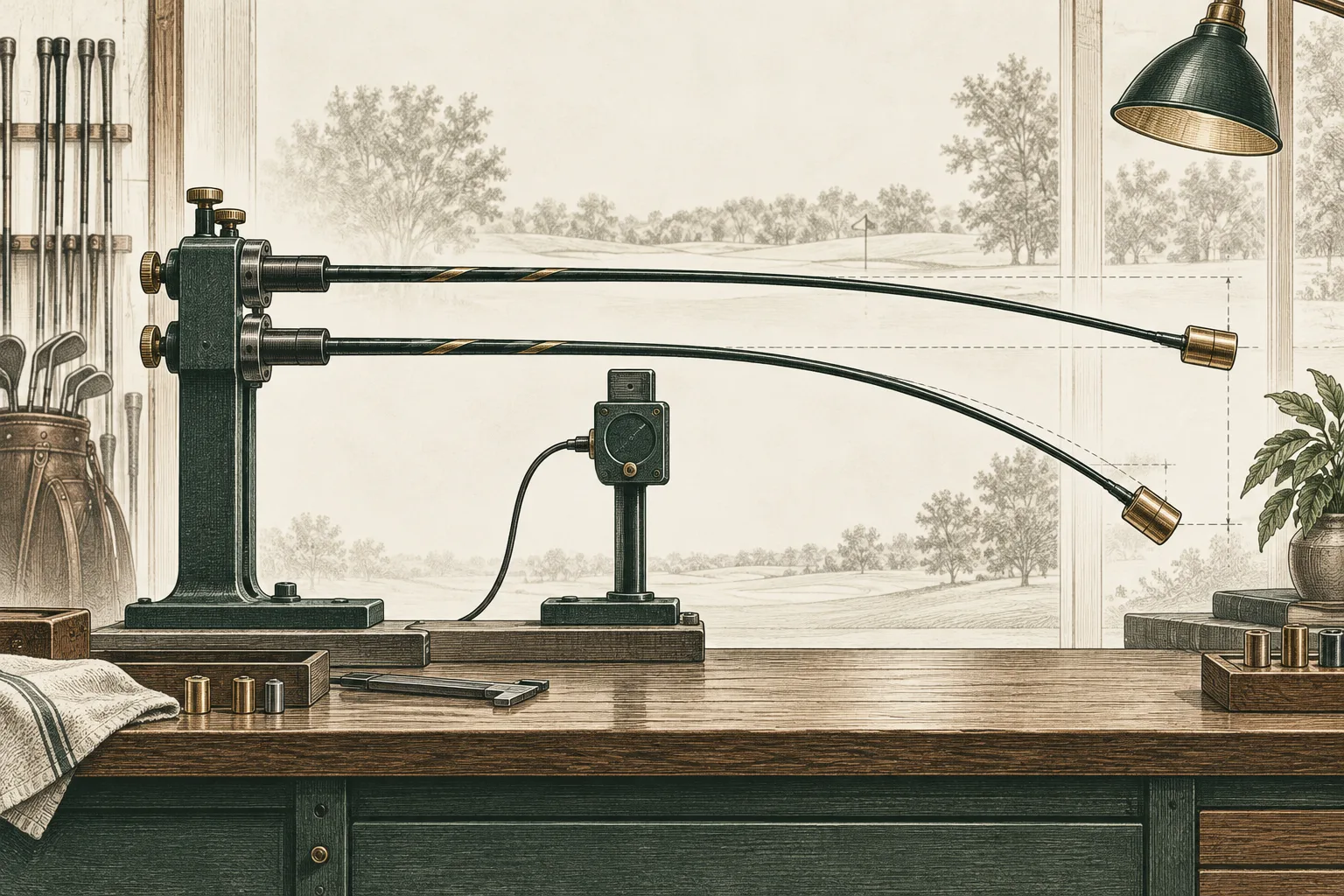
There is one letter printed on your shaft and it is doing more work in your head than it deserves. R, S, X — most golfers treat it like a size, as though an S were an S everywhere the way a 10.5 is a 10.5 everywhere. It is not. It is closer to a clothing size: nominally comparable, actually decided by whoever printed the label.
Kris McCormack, who fits for a living at True Spec Golf, says it about as bluntly as it can be said: "one company's 'Stiff' could be another company's 'X' could be another company's 'red'."
Flex is real. The letter is not
Flex itself is a genuine physical property — how much a shaft bends under load, and how quickly it comes back. It is measurable, repeatable and worth fitting. The problem is purely the labelling.
There is no standard because nobody was ever asked to write one. The R&A and USGA Equipment Rules devote about a page to the shaft: it must be straight, it must deflect the same regardless of how it is rotated, and it must twist the same amount in both directions. Nothing in the Rules mentions stiffness, weight or torque. Every letter on every shaft in the world is therefore a marketing decision made inside one company's own lineup, and it was never designed to mean anything outside it.
The number underneath the letter
The honest version of flex is frequency, in cycles per minute. Clamp the grip end, pull the tip, let go, and count how fast the shaft oscillates. Stiffer shafts oscillate faster. Golf shafts generally read somewhere between about 200 at the flexible end and 300-plus at the stiff end, and the rule of thumb among builders is roughly ten cycles per minute between one flex designation and the next.
That rule of thumb is what makes the following fact so damning. Tim Briand of True Spec: "A Modus 120X is like a 303 frequency, but Modus 130X is like 336 frequency, even though they're both X-flexes." Two shafts, same maker, same family, same letter — and thirty-three cycles apart, which by the builders' own arithmetic is more than three flex steps of daylight.
If a single family cannot keep its own X honest, the letter cannot possibly travel between brands.
Even frequency is not the whole story
Frequency is one number for a whole shaft, and a shaft is not one thing along its length. Russ Ryden, who built the EI measuring instrument several shaft companies use, found three shafts that all read an identical 354 CPM and were nonetheless "quite different when viewed with EI analysis" — because they were stiff and soft in different places.
He found the same thing inside a single brand's letters. Three KBS iron shafts all stamped S: the 120 g Tour and the 120 g C-Taper profiled similarly, while the 110 g C-Taper Lite was much softer along its entire length. His conclusion is the one to keep: the letter describes stiffness within one model at one weight. It does not survive a change of model, and it does not always survive a change of weight inside the same model.
So what is the chart for?
You have seen the swing-speed chart. The version True Spec Golf gave GOLF.com runs: X-stiff above 105 mph of driver speed, stiff at 97–104, regular at 84–96, senior at 72–83, ladies below 72.
That chart is a useful place to start and a terrible place to finish. It puts you in the right postcode. It cannot pick the house — partly because your driver speed and your iron speed do not extrapolate cleanly from one another, and mostly because tempo does at least as much of the deciding as speed. A player at 88 mph with a violent transition can genuinely need what a smooth 100 mph player would find unplayable.
The test that should unsettle you
Plugged In Golf ran six golfers — handicaps from 10 down to scratch, so not beginners — through regular, stiff and x-stiff shafts in identical 6-iron heads, seven shots each, on Trackman at Club Champion.
The regular flex won the averages. It produced the most distance: about two yards more than x-stiff and five more than stiff. It generated slightly higher clubhead speed, ball speed and smash factor. It produced the fewest mishits, counted as shots under 1.2 smash. And it was the most accurate flex in the group, which is precisely the opposite of what the folklore promises.
Now the part that matters more than the averages: every single player had one flex that clearly beat the others for them — and it was not the same flex for everybody. One tester picked up 16 yards simply by being in the right one.
Read those two results together and you get the whole lesson. Playing stiffer than you need is a common, quiet, expensive mistake driven by ego and by a chart. But the fix is not "everyone should play regular." The fix is that flex is individual and the only way to know is to hit them.
What to do instead of trusting the label
Ask for the frequency. Any decent fitter or builder has a frequency meter. Your CPM number travels between brands in a way your letter never will.
Compare inside a family first. Ventus Blue 6 S against Ventus Blue 6 X is a real comparison. Ventus 6 S against a Diamana S is a coin toss dressed as a comparison.
Set weight first, then re-check flex. Because dropping ten grams usually softens the shaft too, whether the label admits it or not.
Distrust any recommendation made without seeing you swing. Speed narrows the search. Transition finishes it.
Run it in a bay
Take one head. Put two flexes of the same shaft model in it. Hit fifteen alternating shots with each on the launch monitor and look, in order, at strike location, then dispersion, then ball speed. If the softer one is grouping tighter and going the same distance, that is not a failure of manhood — that is the Plugged In result reproducing itself in your own hands, and it is worth several strokes.
The letter on the shaft is a shelf tag. Your number is the thing that is actually true about you, and it takes about twenty minutes to find out what it is.
From the glossary
Related reading: The Clubhouse Guide to Golf Shafts · Weight Before Flex: The Shaft Spec That Decides the Rest · Bend Profile and the EI Curve: Under the Kick Point · Torque: What Makes a Shaft Stable, and What Makes One Loud

Sleeper Classics: Great Clubs the Market Forgot
The used-club market has a memory problem. Prices track two things — marketing budgets and recency — and neither has much to do with how a club actually performs. A driver that led forgiveness testing in its day gets lapped by nine model cycles and lands in the $100 bin next to genuine junk. A forged iron a Champions Tour pro carried in his own bag sells for less than a single new wedge because the brand never bought enough American ad pages. That inefficiency is your opening.