
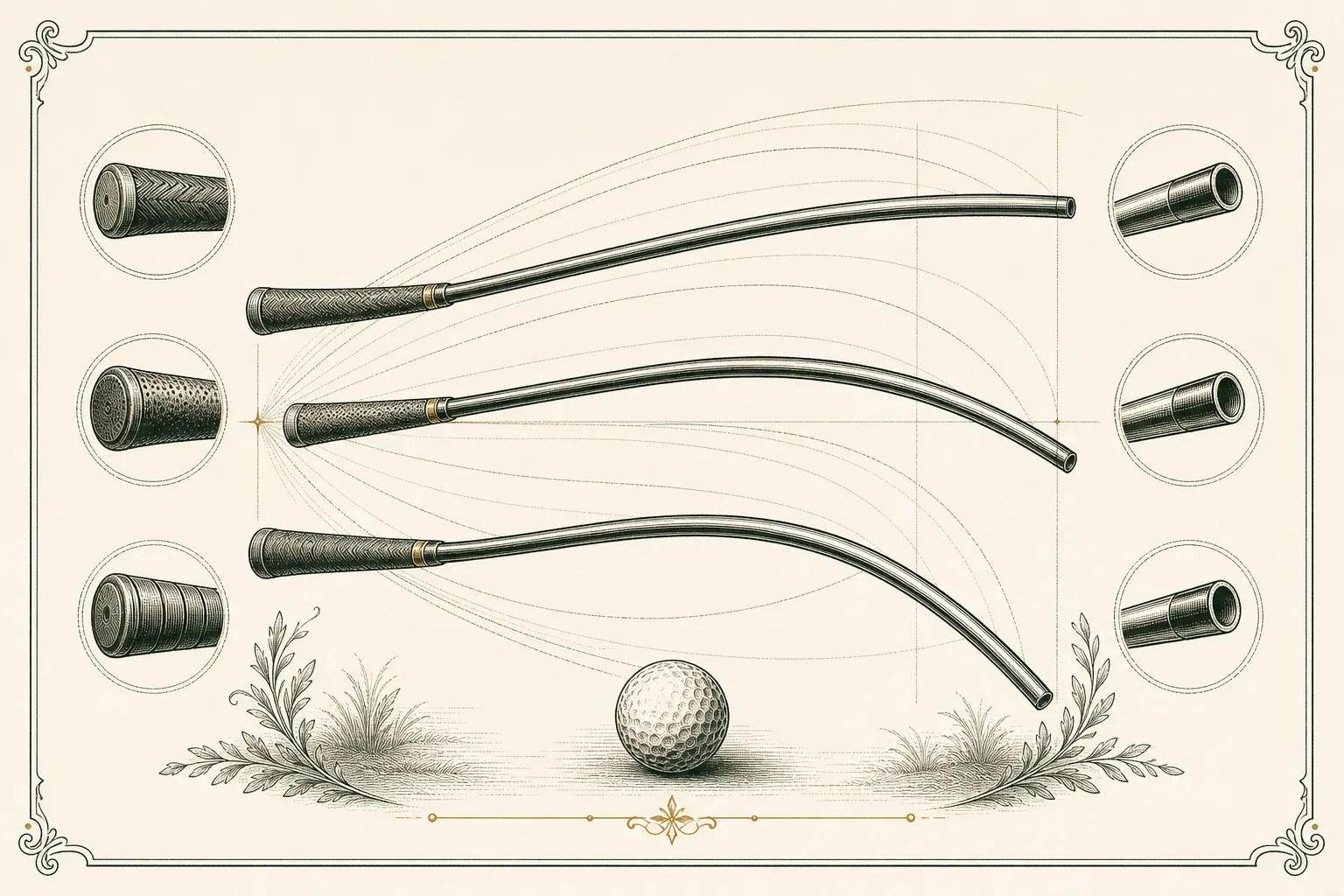
Golfers will spend three hundred dollars on a driver head, agonize over adjustable weights and crown graphics, and then play whatever shaft happened to be in it. That's backwards. The shaft is the transmission of the golf club — it's the only thing connecting your hands to the head, and it decides how much of your effort actually arrives at the ball, and in what condition. Two identical driver heads with different shafts can behave like two completely different clubs.
Here's the good news: shafts aren't actually that mysterious. There are five variables that matter — flex, weight, material, kick point, and torque — and once you understand what each one does, you can walk past ninety percent of the marketing noise.
Flex, and the chart everyone asks for
Flex is how much the shaft bends during your swing. Swing a shaft that's too soft for your speed and it bends too much, releases too early, and the clubface arrives at the ball doing its own thing — usually high, spinny, and left or right of where you aimed. Swing one that's too stiff and it never loads at all: the ball flies low, feels like hitting a rebar, and you lose distance you paid good money for.
Flex is matched to clubhead speed, and driver speed is the standard yardstick. Here's the chart, based on fitting data from True Spec Golf (via Golf.com):
| Driver swing speed | Flex |
|---|---|
| Under 72 mph | Ladies (L) |
| 72–83 mph | Senior (A) |
| 84–96 mph | Regular (R) |
| 97–104 mph | Stiff (S) |
| 105+ mph | Extra Stiff (X) |
Two things about this chart. First, notice how wide "Regular" is — 84 to 96 mph covers the majority of recreational golfers, which is exactly why regular flex is the default in off-the-rack clubs. Second, and this matters: these labels describe speed, not people. "Senior" flex has nothing to do with age, and "Ladies" flex has nothing to do with gender. Plenty of strong 68-year-olds swing stiff shafts, and plenty of 30-year-old men are honest 80-mph swingers who'd hit it better with a senior flex. The letter on the shaft doesn't care about your ego, and neither does the ball.
If you don't know your driver speed, don't guess. Every bay at Clubhouse has a launch monitor that measures clubhead speed on every single swing — ten minutes with your driver and you'll have a real number instead of a flattering estimate. Most golfers who guess, guess high.
Why the sticker lies
Here's the dirty secret of the shaft industry: flex is not standardized. Loft is measured in degrees. Length is measured in inches. Weight is measured in grams. But there is no industry standard for what "stiff" means — every manufacturer measures stiffness their own way, and none of them publish the method. One company's stiff can play like another company's regular. It happens constantly, even between two shafts from the same company.
Stock shafts in big-box drivers are often the worst offenders. They tend to be built light and soft for their labeled flex, because a softer shaft helps the average demo-day swinger launch it high and buy the club. So the "stiff" shaft that came in your driver may be doing something very different than the "stiff" aftermarket shaft your buddy plays.
The chart above is a starting point, not a verdict. The other reason it can't be a verdict: tempo. Two golfers at 90 mph can need different shafts. A smooth, syrupy swinger loads the shaft gently and can play softer and lighter than the chart says. A golfer with a quick, aggressive transition — snap it to the top, rip it down — loads the shaft violently and usually needs more stiffness and more weight than their speed alone suggests. Numbers get you to the neighborhood; how you deliver that speed picks the house.
Weight: the variable nobody talks about
Ask ten golfers about their shaft and nine will tell you the flex. Almost none will know the weight — and weight is arguably the more important spec. Many fitters will tell you it does more for your consistency than flex does.
Shafts run from about 45 grams in ultra-light graphite up to the high 130s in heavy steel. That's a threefold difference in the thing you're swinging, and it changes everything about how the club moves:
- Too light, and fast or aggressive swingers get "handsy" — the club feels like nothing, tempo speeds up, the face gets hard to control, and the miss is often a hook. You can overpower a shaft that isn't there.
- Too heavy, and slower swingers run out of gas — speed drops, the strike wanders, and by the back nine the driver feels like a sledgehammer.
- Right, and the club has enough presence that you can feel where the head is during the swing without having to muscle it. Tempo settles. Strike location tightens up.
If your driver swing feels quick and scattered, before you blame your takeaway, check what your shaft weighs. A move from a 50-gram noodle to a 65-gram shaft has fixed more "swing flaws" than a lot of lessons.
Steel vs. graphite
This one's simpler than it used to be. Steel is heavier (roughly 95–130 grams), barely twists, and transmits a ton of feedback to your hands — which is why it has traditionally lived in irons and wedges, where control matters more than raw speed. Graphite is lighter (roughly 40–85 grams), helps you swing faster, and filters vibration — which is why every driver and fairway wood shaft on earth is graphite, and why it's the right iron-shaft call for anyone with slower speed, aging joints, or a need for more height and carry.
The old stigma — graphite irons are for seniors — is dead. Modern graphite iron shafts are stable enough that plenty of strong players use them. Pick by weight and need, not by material pride.
Kick point and torque, in two minutes
These are the fine-tuning knobs, and you mostly need the headline version:
Kick point (or bend point) is where along its length the shaft bends most. A low kick point bends near the head and kicks the ball up — higher launch, great for slower speeds that struggle to flight the ball. A high kick point bends near the grip and produces a lower, more penetrating flight — for fast swingers fighting spin and balloon. Most stock shafts are mid-kick on purpose, because it suits the most people.
Torque is how many degrees the shaft twists under load. Steel barely twists (1–2 degrees). Graphite runs from around 2 degrees in tour-caliber shafts to 5+ in lightweight, slower-speed designs. Lower torque means a tighter, more stable face at impact but a firmer, "boardy" feel; higher torque feels smooth and lively but lets the face wander more at high speeds. Slower swings don't generate the load to punish high torque — so don't pay tour-shaft money to fix a problem you don't have.
What to actually do
Don't buy a shaft off a chart, including this one. Do this instead:
- Get your real number. Hit ten drivers in a bay and read your average clubhead speed off the launch monitor — not your best swing, your average.
- Find the chart's answer, then test one flex on either side. Because the sticker lies, the label is a hypothesis, not an answer. Watch dispersion and spin, not just your longest ball.
- Pay attention to weight. If the club feels whippy and the misses are quick hooks, go heavier. If you're losing speed and the ball won't get up, go lighter.
- If you're buying a driver or building irons, get fit. A fitting hands you the exact shaft — weight, flex, profile — that your delivery wants, and shafts are the one place where fitting reliably beats guessing.
The shaft won't add talent. But the wrong one actively subtracts it — and unlike your swing, this is a fix you can buy.
From the glossary
Related reading: Drivers: Loft, Forgiveness, and the Myths · Ball Speed, Club Speed, and Smash Factor · Reading Your Shot Data Like a Fitter · Grips, Lie Angle, and Why Fitting Matters

The Most Forgiving Drivers of the 2010s, Ranked by the Data
From roughly 2014 to 2019, every major manufacturer spent its entire driver budget chasing one number: MOI — how much the head resists twisting when you miss the middle. Carbon crowns, tungsten back weights, faces engineered to fight your specific mishit. Those flagships were the most forgiving drivers ever built to that point, and forgiveness does not expire. Your heel strike in 2026 is the same heel strike it was in 2018, and a head that held ball speed on it then holds ball speed on it now.