
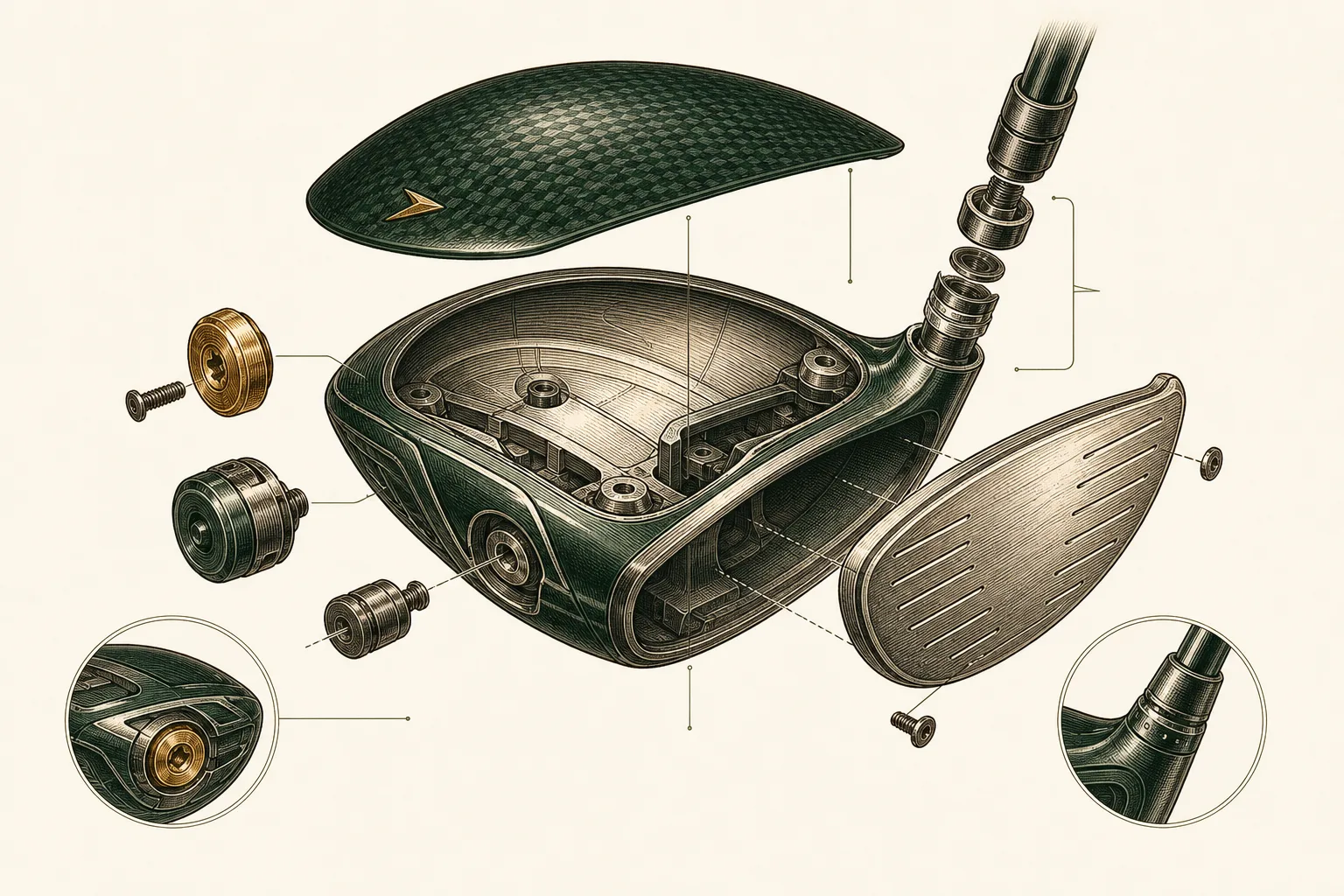
The driver is the most marketed, most mythologized, most impulse-purchased club in golf. It's also the club where the gap between what golfers believe and what launch monitor data actually shows is widest. So let's do what a good fitter would do: strip out the marketing, explain what actually matters in a driver head, and be honest about when a new one will help you — and when it won't.
Why every driver head looks like a bread loaf now
Modern drivers are 460 cubic centimeters because that's the maximum head size the USGA allows. Manufacturers ran to that ceiling years ago and stayed there, and the reason is a single concept: MOI, or moment of inertia.
MOI is a measurement of how much a clubhead resists twisting when you hit the ball somewhere other than the center of the face — which, for most of us, is most of the time. Strike it toward the toe and the head wants to rotate open; a high-MOI head rotates less, so the face stays closer to where you aimed it and the ball keeps more of its speed. The USGA caps heel-to-toe MOI at 5,900 g·cm², and today's most forgiving drivers sit right up against that number.
Here's the practical translation: a big, stretched-out driver head with weight pushed low and back isn't a gimmick. It's the engineering reason your mishits fly 240 instead of 210 and end up in the right rough instead of two fairways over. "Forgiveness" is not a marketing word — it's a measurable property, and for the vast majority of golfers it's worth more than any other spec on the club.
The trade-off is real, though. Weight pushed back for forgiveness tends to add spin and launch. Weight pushed forward reduces spin but shrinks the margin for error. Better players with fast swings and centered strikes sometimes want that low-spin head. If you're reading a beginner's library, you almost certainly don't — you want the forgiving one, full stop.
The loft myth: lower is not longer
If there is one number on a driver that golfers get wrong, it's loft. The myth goes like this: pros use 9 degrees or less, low loft means low spin means more roll, therefore a strong player uses a strong loft — and choosing 10.5 or 12 degrees is an admission of weakness.
The data says the opposite. Fitting studies consistently show most recreational golfers play less loft than their swing needs, and it costs them real distance. Carry distance comes from a combination of ball speed, launch angle, and spin — and the slower your ball speed, the higher you need to launch it to keep it in the air long enough to reach its potential. MyGolfSpy's fitting guidance puts it plainly: a golfer swinging under 85 mph should be launching the driver around 14–16 degrees, which usually means a 10.5-, 12-, even a 13-degree head. A tour pro launching at 10 degrees with 175 mph of ball speed is playing a completely different physics problem than you are.
There's a second, sneakier benefit: loft stabilizes the ball. More loft means more backspin, and backspin resists sideways curvature. That 9-degree driver isn't just launching too low for you — it's also making your slice worse, because there's less backspin holding the ball's flight together.
This is one of those questions a Clubhouse bay answers in about ten minutes. Hit ten drives on the launch monitor, look at your launch angle and ball speed, and compare against the optimal windows. If you're launching at 9 degrees with an 88 mph swing, no swing tip on earth will gain you as much as two more degrees of loft.
Adjustable hosels: useful, but know what the dial really does
Nearly every driver sold today has an adjustable hosel — a sleeve at the base of the shaft that lets you add or subtract a degree or two of loft with a wrench. Genuinely useful. But here's what the manual doesn't emphasize: the hosel doesn't just change loft. The sleeve works by tilting the shaft's angle relative to the head, so when you add loft, you also close the face; subtract loft and you open it. Depending on the manufacturer, one degree of loft change can move the face angle a degree and a half or more.
This is why "I turned my driver up and suddenly stopped slicing" is such a common story. It wasn't only the loft — the face got closer to square at the same time. Nothing wrong with that; it's two fixes in one turn of a wrench. Just understand it, because it also works against you: crank the loft down chasing distance and you've opened the face, and now your fade is a slice.
Adjustable weights are the other half of the system. Sliding or swapping weight toward the heel makes the head easier to rotate closed — draw bias. Toward the back: higher launch, more spin, more forgiveness. Toward the face: lower spin, less forgiveness.
Draw-bias drivers: not a badge of shame
Manufacturers sell dedicated draw-biased models (heel weighting, sometimes offset hosels, often a hair more upright), and a lot of golfers refuse them out of pride. That's silly. Somewhere around 80–90 percent of recreational golfers fight a slice. A driver that quietly moves your average start line and curvature 10–15 yards toward the fairway is worth more than 3 extra yards of theoretical carry from a "players" head you can't square up.
The honest caveat: draw bias treats the symptom, not the cause. If you're taking lessons — say, working with Pat on your path and face control — a heavily draw-biased head can mask your progress and even start hooking on you as your swing improves. A reasonable middle path is a neutral, forgiving head with adjustable weighting, set to draw now, and neutraled out later as your swing catches up.
When to buy a new driver — and when to save your money
Time for the most honest paragraph in this article. Golf Digest ran robot testing comparing new drivers to models a few years old and found what fitters have quietly known for a decade: on centered strikes, a well-fit driver from three or four years ago gives up almost nothing to this year's model. The 460cc limit, the ball-speed limit, and the MOI cap have all been maxed out for years. Year-over-year gains are real but tiny — think one yard, not ten.
So when should you buy?
Buy (or at least get fit) if: your driver is more than 6–8 years old; it was never fit to you in the first place; your loft is wrong for your ball speed; your shaft is the stock one that came in the display model; or your miss pattern screams for different bias or more forgiveness. In these cases the gains are real — often 10–20 yards — because you're fixing a fit problem, not buying newness.
Don't buy if: your current driver is recent, was fit to you, and you're just tempted by an ad. The new paint doesn't know your swing. Spend the money on lessons or bay time; the improvement per dollar isn't close.
And if you're unsure which camp you're in, that's exactly what a fitting is for. Bring your current driver into a bay at Clubhouse, hit it side-by-side against a few candidates on the launch monitor, and let the numbers vote. Ball speed, launch, spin, and dispersion don't care about marketing budgets — if the new head doesn't beat your gamer on the screen, you just saved six hundred dollars.
The driver rewards the same thing everything in golf rewards: honesty about where your game actually is. More loft than your ego wants, more forgiveness than the pros play, and a purchase decision made from data instead of a commercial. Do those three things and the biggest club in your bag becomes the easiest one to buy right.
From the glossary
Related reading: Launch and Spin: the Flight Recipe · Ball Speed, Club Speed, and Smash Factor · Shafts: Flex, Weight, and Your Swing Speed · Reading Your Shot Data Like a Fitter

The Most Forgiving Drivers of the 2010s, Ranked by the Data
From roughly 2014 to 2019, every major manufacturer spent its entire driver budget chasing one number: MOI — how much the head resists twisting when you miss the middle. Carbon crowns, tungsten back weights, faces engineered to fight your specific mishit. Those flagships were the most forgiving drivers ever built to that point, and forgiveness does not expire. Your heel strike in 2026 is the same heel strike it was in 2018, and a head that held ball speed on it then holds ball speed on it now.