
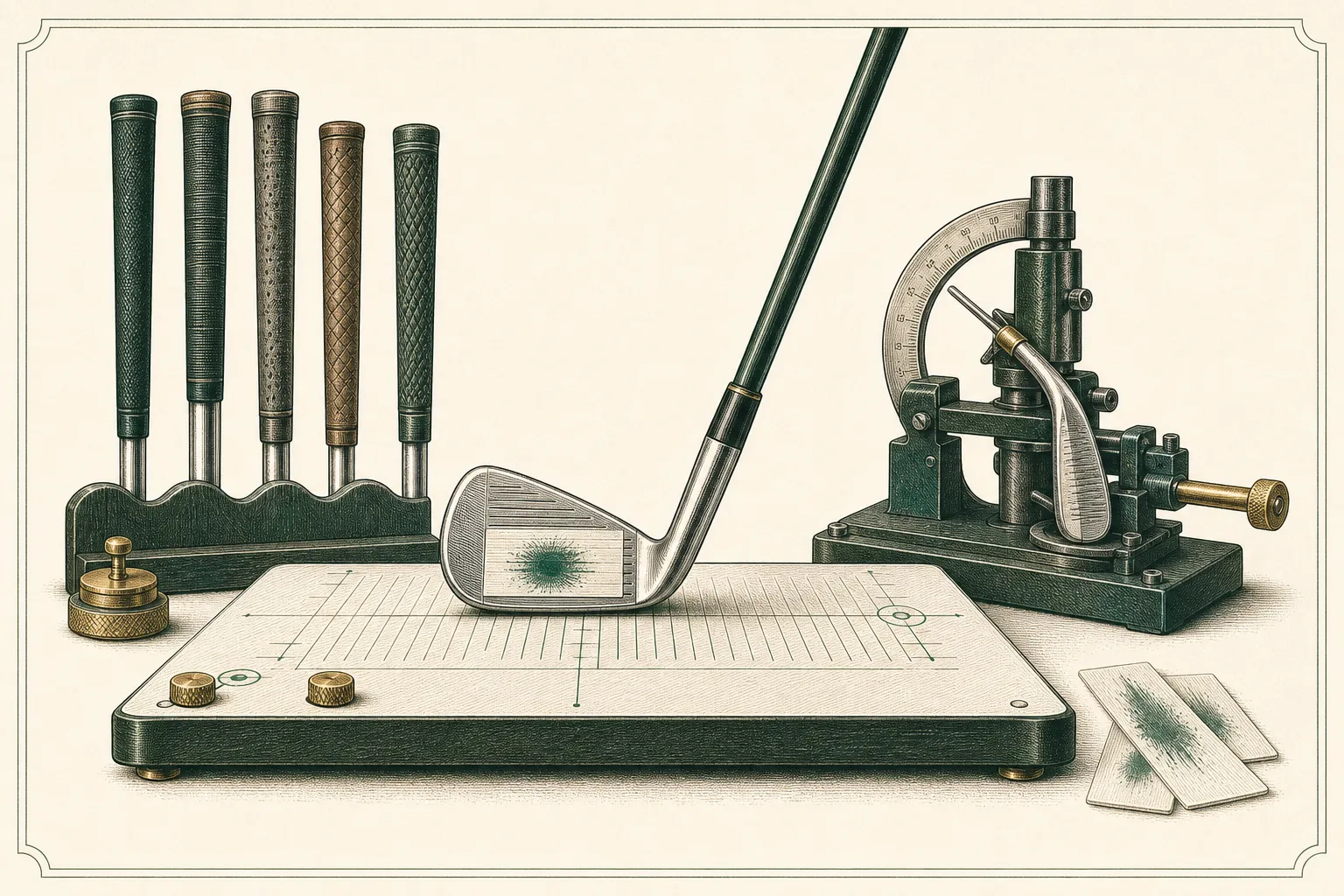
Here's a quiet truth about golf equipment: the two cheapest things to change on a club — the grip and the lie angle — are the two things most golfers have never once thought about. People will agonize for months over a $600 driver head and then swing it with a grip that's the wrong size, worn smooth as a doorknob, attached to irons that were bent for somebody else's posture. If you fix nothing else about your clubs this year, fix these.
Grip size is a steering wheel setting
Your hands are the only part of you that touches the club, and grip diameter changes what they're allowed to do. A grip that's too small for your hands invites extra hand and wrist rotation through impact — the face closes faster, and the miss trends toward hooks. A grip that's too big does the opposite: it restricts your release, the face hangs open a beat longer, and you leak pushes and fades to the right (for a right-hander). Neither of these is a swing flaw. It's hardware masquerading as one, and it's why Golf.com's equipment team treats grip diameter as a genuine fitting variable, not an afterthought.
There's a subtler effect, too. A grip that doesn't match your hands makes you squeeze. Squeezing tenses your forearms, tension kills wrist speed, and wrist speed is free distance. Some of the most satisfying fitting fixes are exactly this boring: right-sized grip, lighter hold, two or three more miles an hour of clubhead speed you didn't have to earn at the gym.
The standard starting points run off hand size — measure from the crease of your wrist to the tip of your middle finger. Under about 7 inches suggests undersize, 7 to 8¾ inches is standard territory, and bigger hands push toward midsize or jumbo. But that's a starting point, not a verdict. Finger length, arthritis, how many layers of tape go under the grip, whether you wear a glove — a good fitter accounts for all of it. Honest opinion: if you bought your clubs off the rack and have large or small hands, there's a decent chance you've been playing the wrong grip size your whole golf life.
Worn grips are quietly taxing every swing
Rubber grips age even if you never play. They oxidize, harden, and go glossy. Sunscreen, sweat, and range sessions accelerate it. And here's the sneaky part: your hands notice before your brain does. When a grip loses its tack, you instinctively hold on tighter to keep the club from twisting — and now you've got that same tension problem from the paragraph above, on every single swing, without changing anything about your grips' size.
The rule of thumb from Golf Monthly and most PGA professionals is to regrip every 12 to 18 months or roughly every 40 rounds — and range time counts, so if you're grinding on the mats a few times a week, that clock runs fast. MyGolfSpy's guide lists the tells: shiny patches where your thumbs sit, faded logos, cracks, or a grip that feels slick even right after you've cleaned it. A full regrip costs less than a dozen premium golf balls. It is, dollar for dollar, the best equipment purchase in golf.
Lie angle: the reason your "straight" swing goes sideways
Lie angle is the angle between the shaft and the ground when the club soles flat. It sounds like trivia. It is not. When the lie angle is wrong for you, the face doesn't point where you think it points at impact.
Too upright — toe up in the air at impact — and the face effectively aims left of your target. The heel digs, the face closes, and you pull it. Too flat — toe digging down — and the face aims right, producing low pushes. Estimates in the fitting world put a single degree of lie error at several yards offline, and Golf Monthly's breakdown notes a couple of degrees can move a well-struck shot 10–15 feet off line. That's the difference between a birdie putt and a bunker.
Here's the detail that surprises people: the effect gets worse as loft goes up. A two-degree lie error on your 4-iron is an annoyance; the same error on your 9-iron or wedges — the clubs you use to actually attack flags — sends the ball meaningfully further offline. If your scoring clubs miss left consistently while your long irons behave, don't book a lesson yet. Get your lies checked first.
Static vs. dynamic: why the ruler isn't enough
There are two ways to fit lie angle. Static fitting measures you standing still — height and wrist-to-floor distance — and reads a chart. It's fast, it's better than nothing, and it's how most online "custom" orders work. The problem, as Hireko's fitting guide explains, is that the shaft bends and your body moves during the swing, so the club's angle at address and its angle at impact are two different numbers. Two golfers with identical wrist-to-floor measurements can deliver the club completely differently.
Dynamic fitting measures what the club is actually doing at the moment of truth. The classic method is a lie board: a strip of tape on the sole, a few swings off a hard board, and the scuff mark tells the story — a mark toward the heel means too upright, toward the toe means too flat. Modern launch monitors add the ball's side: if your strike is centered and your path is neutral but the ball keeps starting left, lie angle is a prime suspect. Dynamic beats static every time, because you don't hit golf balls standing still.
What a good fitting session actually does
A real fitting isn't a sales pitch for new clubs. It's a diagnostic. A good fitter watches you hit your clubs, reads the launch monitor, checks strike location, and separates equipment problems from swing problems — because bending your irons two degrees flat is a lot cheaper than six months of fighting a pull that was never your fault. Sometimes the answer is new shafts. Often it's a $12 regrip and a trip to the loft-and-lie machine.
This is exactly what our Fitting Session at Clubhouse is built around. The bays give us the dynamic picture — face angle, path, start direction, strike — on every swing, so we're fitting the swing you actually make, not the one a chart assumes. And if the data says the problem is you and not the club, Pat's right here, and that conversation is a lot more useful than a new set of irons.
One honest caveat to leave you with: fitting is not magic. It won't turn a slice into a draw, and a perfectly fit club still needs a decent swing. What it does is remove the equipment's vote from every bad shot — so when the ball goes sideways, at least you know whose fault it was. That knowledge alone is worth the session.
Related reading: Shafts: Flex, Weight, and Your Swing Speed · Blades, Cavity Backs, and Everything Between · Reading Your Shot Data Like a Fitter · Used Clubs: How Old Is Too Old?

The Most Forgiving Drivers of the 2010s, Ranked by the Data
From roughly 2014 to 2019, every major manufacturer spent its entire driver budget chasing one number: MOI — how much the head resists twisting when you miss the middle. Carbon crowns, tungsten back weights, faces engineered to fight your specific mishit. Those flagships were the most forgiving drivers ever built to that point, and forgiveness does not expire. Your heel strike in 2026 is the same heel strike it was in 2018, and a head that held ball speed on it then holds ball speed on it now.