
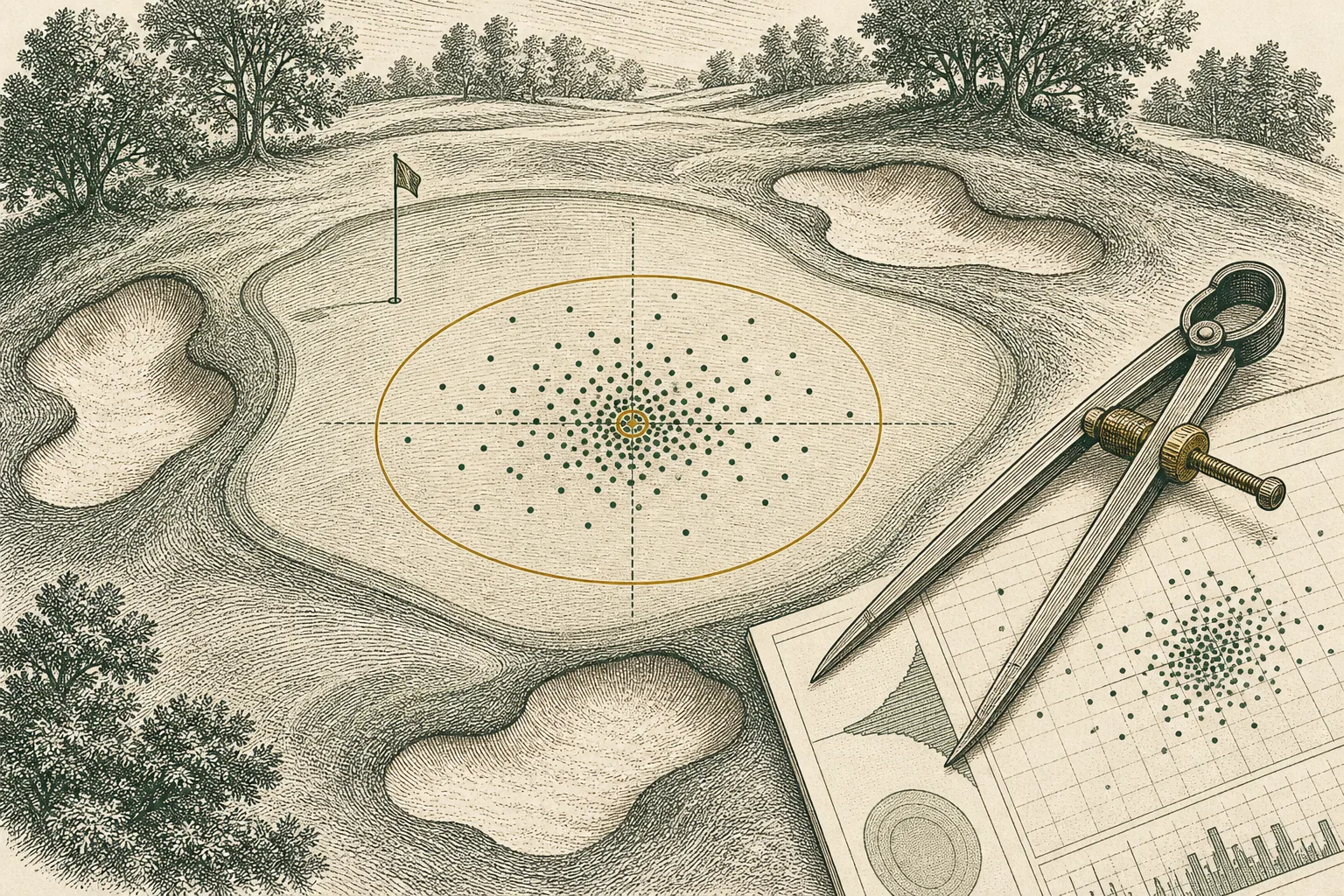
Watch a good club fitter work and you'll notice something: they barely react to any single shot. You flush one and feel great; they're staring at the screen. You chunk one and apologize; they wave it off. That's because a fitter isn't reading shots — they're reading patterns. The launch monitor in front of you at Clubhouse spits out a dozen numbers per swing, and most people fixate on the two vanity metrics (ball speed and carry) while ignoring the ones that actually explain their golf. Here's how to read the screen the way a fitter does.
Dispersion beats averages, every time
The single biggest mental shift: stop caring about your average and start caring about your spread.
Say your 7-iron "goes 155." A fitter wants to know: 155 with what shape around it? If your ten shots land between 148 and 161 inside a 15-yard-wide left-right window, that's a real, usable 155. If they land anywhere from 138 to 168 and 40 yards wide, you don't have a 155 club — you have a lottery ticket with a mean of 155. Both players will tell their buddies the same number. Only one of them can aim at a Sunday pin.
This matters double with driver. Amateur driver dispersion commonly runs 75 to 95 yards wide — and the population average is nearly useless, because the only pattern that matters for your club choices and course strategy is yours. A fitter fits to shrink and re-center your ellipse, not to add three yards to your best ball.
Practical move in a bay: hit ten shots with one club, then look at the shot plot — the top-down scatter — instead of the data table. Ignore the best one and the worst one. The shape of the remaining eight is your golf. The sim will happily celebrate your prettiest carry number; the scatter plot tells the truth.
Face and path: the two numbers that explain every shape you hit
If you learn to read only two swing metrics, make them face angle and club path. Modern launch monitor data settled an old argument: the ball starts mostly where the face points — roughly 75% of the initial direction with irons, and up to about 85% with driver — and then curves away from the path. Old-school teaching had it exactly backwards, which is why a generation of golfers "aimed left to fix the slice" and sliced worse.
So the decoder ring is:
- Face controls where the ball starts.
- Face minus path (fitters say "face-to-path") controls how much it curves, and which way.
- Face matching path = straight-ish. Face open to path = curves right. Face closed to path = curves left.
Your classic slicer shows path -6° (out-to-in) with face -1°: the ball starts a touch left of target, then curves hard right because the face is five degrees open to that path. The classic hooker is the mirror image. Once you can read those two columns, no ball flight is ever a mystery again — and you'll notice something freeing: a face-to-path of one or two degrees with a consistent sign isn't a flaw, it's a shot shape. Zeroed-out golf is for robots.
Attack angle: the quietest expensive number on the screen
Attack angle is how steeply the clubhead is traveling down (negative) or up (positive) at impact. Nobody brags about it at the bar, but it quietly sets your distance ceiling with driver.
TrackMan's tour data makes the point beautifully: PGA Tour pros average about -0.9° with driver while LPGA players average +2.8° — and hitting up like the LPGA does is far more efficient at turning clubhead speed into carry, because it lowers spin loft and raises launch. Tour pros can afford to hit slightly down at 120 mph of clubhead speed. At 85–95 mph, you can't. If your driver attack angle reads -4° session after session, you're leaving 15–25 yards on the table that no new driver head will give back to you.
With irons it flips: you want a negative number — ball first, then turf, which requires hitting down. If your 7-iron attack angle hovers around zero or positive, that's the scoopy, thin-prone contact pattern, and it usually travels with erratic spin numbers.
Spin axis: reading curve like an adult
Spin axis is the tilt of the ball's rotation. The ball doesn't carry separate "sidespin" — it has one axis that's either level (straight flight), tilted right (fade and slice spin), or tilted left (draw and hook spin). Spin axis is the effect; face-to-path plus strike location are the causes.
The strike part is what trips people up. On a driver, a toe strike gear-effects the spin axis left (draw spin) and a heel strike tilts it right (fade spin) — even off a perfectly neutral swing. So when your face-to-path numbers say "small fade" but the ball drew, don't spiral about your swing: you probably caught it off the toe. This is exactly why fitters spray the face before every session. If your bay's launch monitor reports impact location, watch it. If it doesn't, a $6 can of Dr. Scholl's foot spray is still the best fitting tool ever made.
Filtering mishits honestly (the part everyone cheats on)
Every session needs editing — the cold first swing, the one where you peeked at the screen mid-downswing. Deleting those is fine. Here's the honest rule: delete a shot for a reason you could name before you saw the numbers, never because the numbers embarrassed you.
A fitter's rough protocol: warm up with five to eight swings that don't count. Then hit eight to ten recorded shots. Throw out obvious non-swings — topped it, bailed out mid-swing. Keep everything else, especially the mediocre strikes, because your on-course game is built out of mediocre strikes. If you delete every heel strike "because that's not my real swing," you've just fitted your fantasy self, and your fantasy self isn't the one paying for the shafts.
One more honesty check: a sim bay tempts you into machine-gunning a ball every twenty seconds. Your real pattern comes from rested, routine-first swings. Slow down for the shots you're going to make decisions from.
When the data says "lesson" and when it says "equipment"
This is the question the whole screen exists to answer, and a good fitter splits it roughly like this.
The data says lesson when:
- Face-to-path is large and inconsistent — +6° on one swing, -3° on the next. No club fixes a face you can't repeat.
- Attack angle is positive with irons or steeply negative with driver. That's a pattern, and patterns are coachable.
- Strike location wanders all over the face. Dispersion caused by random strike is a contact problem, not a shaft problem.
The data says equipment when:
- Your pattern is consistent but offset — you repeat a strike and a face-to-path, and the ball still finishes on one side. Lie angle, shaft, and head choice can re-center a repeatable miss.
- Strike is centered but launch and spin are wrong for your speed — too much spin off flush driver strikes, or launch too low despite a decent attack angle. That's loft, shaft profile, and head design territory.
- The same swing produces wildly different results from two different clubs. That's the clubs disagreeing with each other, not with you.
The uncomfortable truth: for most golfers the answer is "lesson first, then fitting," because fitting a swing that's about to change is how you buy the wrong shaft twice. The nice thing about an indoor venue is that both answers live in the same building — walk ten honest swings' worth of data from a bay into a lesson with Pat or a fitting session, and you've already done half the diagnosis.
So next time you're in a bay, ignore your longest drive completely. Pull up the dispersion plot, read face, path, and attack angle on the middle eight shots, and ask one question: is this pattern consistent-but-offset, or inconsistent? That single answer tells you where your next dollar should go.
From the glossary
Related reading: Launch and Spin: the Flight Recipe · Ball Speed, Club Speed, and Smash Factor · Gapping Your Bag on a Launch Monitor · How to Practice With Intent

The Most Forgiving Drivers of the 2010s, Ranked by the Data
From roughly 2014 to 2019, every major manufacturer spent its entire driver budget chasing one number: MOI — how much the head resists twisting when you miss the middle. Carbon crowns, tungsten back weights, faces engineered to fight your specific mishit. Those flagships were the most forgiving drivers ever built to that point, and forgiveness does not expire. Your heel strike in 2026 is the same heel strike it was in 2018, and a head that held ball speed on it then holds ball speed on it now.