
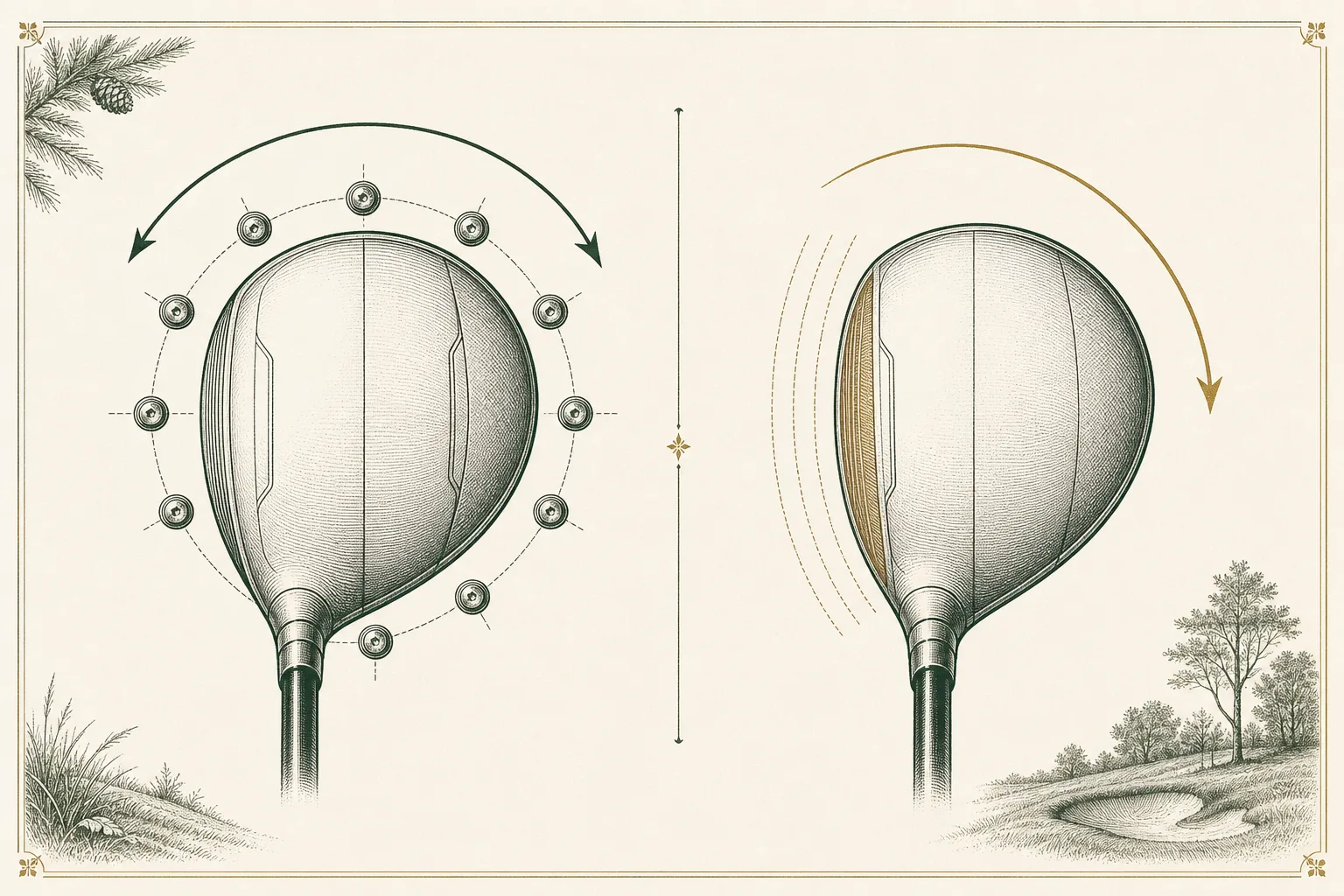
Walk into any big-box fitting and say "I want something forgiving," and watch what happens: you'll be handed a club that is both high-MOI and draw-biased, as if those were one property. They are not. They are two separate dials, they solve two different problems, and for a meaningful slice of golfers one of them is actively harmful.
Getting this distinction straight is worth more than any single equipment purchase you'll make this year.
What forgiveness actually is
Forgiveness is MOI — moment of inertia, the head's resistance to twisting around its own center of gravity when you strike it off-center. Designers create it by pushing mass out to the perimeter of the head: wide soles, deep cavities, heavy tungsten plugs in the corners. A head with high MOI resists rotating when the ball meets it out on the toe, so the face doesn't torque open as far and the strike doesn't bleed as much ball speed.
The result is simple and honest: your bad shots behave more like your good shots. Less distance lost on the mishit, less sideways spread. MOI is mishit insurance. It does absolutely nothing about where your good shots go.
What slice correction actually is
A slice is not a mishit problem — it's a face-to-path problem. The face is open relative to the swing path at impact, the ball leaves with tilt on its spin axis, and it curves away. MOI can't touch that, because MOI governs what happens after contact begins; the face angle at contact was set by your hands, your grip, your path, and the club's geometry.
What addresses a slice is draw bias, and it's a different toolbox entirely: mass shifted toward the heel so the toe releases faster, offset (the hosel set ahead of the leading edge, buying the face a few extra milliseconds to rotate closed), and sometimes a face angle that simply sits a degree closed at address. Offset is its own technology with its own history — it isn't perimeter weighting, it just usually ships in the same box.
MOI is mishit insurance. Draw bias is directional bias. Say it twice.
Why the industry fuses them
Because for the average new golfer, the same club sensibly turns both dials up. Most new players miss all over the face (MOI helps) and most fight a fade or slice (draw bias helps). So game-improvement clubs bundle them, the marketing collapses them into one word — "forgiving" — and golfers learn the two ideas as one.
The bundle comes apart the moment you meet a player who fights a left miss. For that golfer, high MOI is still pure upside: their toe strikes still lose less. But draw bias is poison — a club engineered to close faster, handed to someone whose face is already closing too fast, makes the hook worse. And here's the trap: nearly every "maximum forgiveness" recommendation chart in the industry will route that player into draw-biased heads anyway, because the chart only asked their handicap, not their miss.
If you fight a hook and you've been told you "need forgiveness," what you need is high MOI and neutral weighting. Those clubs exist in every lineup. The chart just doesn't lead with them.
What high MOI costs you
There's no free lunch, so pay the bill knowingly:
- Workability. A head built to resist twisting resists it when you want the face to turn over too. Shaping shots both directions with a max-MOI head is a fight.
- Feedback. The head barely reacting to a miss means the head barely tells you about the miss. High-MOI clubs are quiet liars in the nicest way.
- Footprint. Perimeter weighting demands a wide sole, a thicker topline, a bigger blade length, and usually more offset. Some players simply can't look at it — and address confidence is real.
- Turf and versatility. Wide soles that glide for sweepers can bounce and skip for steep, handsy players around greens.
In the bay
This one demos beautifully, because the two dials separate on a launch monitor in about ten swings:
- Hit a high-MOI, neutral-weighted head. Watch your off-center strikes hold their line and keep their ball speed — that's MOI working.
- Hit a similar head with draw bias. Watch the starting direction and curve of your good strikes move left — that's bias working, on shots that didn't need saving.
- Now check your own miss on the monitor: face-to-path tells you which dial you actually need.
Our Legends Rack keeps examples from every era of this argument, and the pillar essay — Every club is a trade-off — maps the rest of the framework. Book a bay and run the two-dial test before you spend anything.
From the glossary
Related reading: Every Club Is a Trade-Off · Blades, Cavity Backs, and Everything Between · Drivers: Loft, Forgiveness, and the Myths · The Most Forgiving Drivers of the 2010s, Ranked by the Data

The Most Forgiving Drivers of the 2010s, Ranked by the Data
From roughly 2014 to 2019, every major manufacturer spent its entire driver budget chasing one number: MOI — how much the head resists twisting when you miss the middle. Carbon crowns, tungsten back weights, faces engineered to fight your specific mishit. Those flagships were the most forgiving drivers ever built to that point, and forgiveness does not expire. Your heel strike in 2026 is the same heel strike it was in 2018, and a head that held ball speed on it then holds ball speed on it now.