
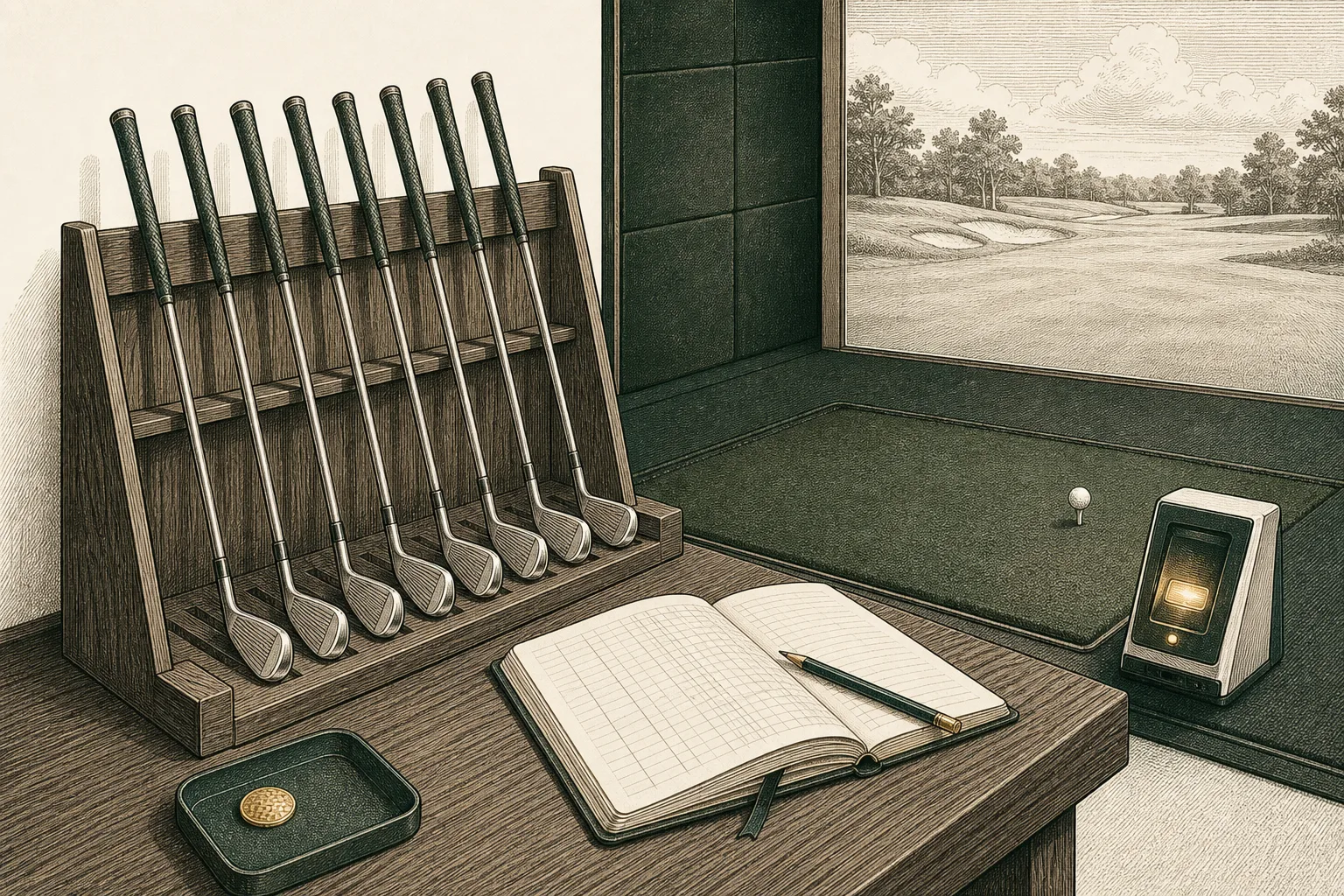
A club fitting is not a ceremony. Strip away the branding and it's a series of controlled experiments: hit this, then hit that, change one thing, watch what moves. Which means you can run one yourself — a bay with a launch monitor, the Legends racks full of heads and shafts to borrow, and one honest hour are the whole equipment list.
Every club is a trade-off gave you the map — what every design choice gives and takes. This is the field manual. Book a bay, bring your own clubs, and work the plan below.
Decide the question before you book
One session, one question. "Are my clubs right for me" is not a question — it's a mood, and it produces an hour of wandering. A real question sounds like: does a lighter shaft calm down my low heel miss? Or: do I actually need more help in my long irons?
Your miss usually writes the question for you — what your miss says translates a pattern into a hypothesis. No question yet? Fine: your first session's question is "what is my baseline?" and nothing else.
The shape of the hour
A suggested shape — not a stopwatch:
| Phase | Roughly | What happens |
|---|---|---|
| Warm-up | first 10 min | Swings that don't count, and aren't recorded as if they do |
| Baseline | next 10–15 min | Your own clubs, unhurried, full routine |
| Experiment block 1 | ~15 min | One variable changed against the baseline |
| Experiment block 2 | ~15 min | A second variable, or a rematch of block 1 |
| Verdict | last 5 min | Write down what you found while it's fresh |
Two experiment blocks is plenty. Five comparisons crammed into an hour is five half-answers and a sore back.
Warm up like it doesn't count — because it doesn't
Your first swings of the day are not your swing. They're stiffer, shorter, and slower, and any conclusion you sneak out of them is contaminated. Hit until your body shows up, and don't peek at the screen for verdicts — "this new head is ten yards shorter" means nothing while you're cold.
Baseline first: your clubs are the control group
Everything you learn today is relative to your current clubs, so they hit first. Take your gamer — the exact club whose job is under review — and hit a set of unhurried shots at a picked target, full pre-shot routine every time. Resist the sim-bay temptation to machine-gun a ball every fifteen seconds; the course only ever gives you one ball and plenty of time.
The baseline is the boring part of the session and the most important data of the day. Skip it and every number that follows is a comparison to nothing.
Change one thing at a time
The entire scientific method of club fitting: change the head, hold the shaft. Change the shaft, hold the head. Change both at once and you've learned that you prefer one club to another, with no idea why — which means you can't shop with it.
The racks make this practical: pull a different head in a familiar shaft family, or the same style of head wearing a very different shaft. And when you A/B, alternate in short blocks — a few swings with club A, a few with B, back to A — rather than a long run of each. A long run gives one club your fresh swings and the other your tired ones, and the comparison quietly becomes a fatigue test.
How many balls before the data means anything
The honest answer nobody puts on a poster: small samples lie, and your favorite shot lies the most. One flushed 7-iron with a borrowed club is an audition, not evidence. Your best and worst shots are the two least informative swings of the day — the middle of the cluster is your golf.
So hit enough shots with each club that a middle exists — more than a handful, enough to include a couple of ordinary strikes, not just the highlight — and then judge the clubs on their ordinary shots against each other. A club that only wins when you catch it perfectly hasn't won anything; you don't get to schedule your perfect strikes on the course.
And if the difference between two clubs is small, treat it as unproven. A small edge that shows up on Tuesday has to show up again next week before it's real. That's not a failed session — "too close to call, re-test" is a legitimate result, and it costs you nothing because the rack will still be there.
Blind your feel from the numbers
Before you look at a single number, write down which club you liked — the one you'd take to the first tee right now. Then look at the screen.
When feel and numbers agree, easy. When they disagree — and they will — that's the most valuable information of the session. The ring and the thud explains why a club can feel wonderful and perform worse, and why that's not a contradiction. And when you do turn to the screen, read it like a professional — dispersion and patterns, not best-ball carry. Reading your shot data like a fitter is the decoder.
Test where you score, not where you pose
Everyone experiments with the 7-iron, because the 7-iron makes everyone feel like a golfer. But scores are decided at the edges of the bag — the wedges you hit into every green and the long clubs you fear. Spend at least one block out at an edge; a head difference that barely shows in a short iron can be dramatic three clubs longer.
Stop before you're tired
Fatigue poisons fitting data, quietly and from behind. Tempo shortens, grip pressure creeps up, strikes wander — and suddenly every club looks worse, with whichever one is in your hands taking the blame. The classic trap is the late-session revelation: "this shaft was amazing at first, but I can't hit it anymore." The shaft didn't change; you did. As the flex essay explains, a shaft responds to the force you produce — and a tired swing produces a different force.
When your swings stop feeling like yours, the session is over, whatever the clock says. A second booked hour next week beats a heroic ninety minutes today, every time.
Write it down
A phone note is plenty. Five lines: date, question, clubs compared, which one you liked before the numbers, and a one-line verdict — even if the verdict is "unproven, rematch." A month from now, three of these notes beat any spec chart, because they're about you.
What to do with the answer
Three verdicts, all of them wins:
- Proven. A change clearly beat your baseline on ordinary strikes, twice. Now you can shop with precision — and patiently, because the used market is full of exactly-your-spec clubs owned by people who never ran this experiment.
- Unproven. Too close to call. Book the rematch — you've just learned your baseline is better than you feared.
- Buy nothing. The most underrated verdict in golf. Your clubs held off the challengers, and the upgrade you were about to pay for doesn't exist. You just got fitted into your own bag for the price of bay time.
The rack isn't going anywhere. Pick your one question, book a bay, and go get an answer that's actually yours.
From the glossary
Related reading: Every Club Is a Trade-Off · What Your Miss Says About Your Next Club · Reading Your Shot Data Like a Fitter · Your Shaft Flex Is Not a Skill Level

The Most Forgiving Drivers of the 2010s, Ranked by the Data
From roughly 2014 to 2019, every major manufacturer spent its entire driver budget chasing one number: MOI — how much the head resists twisting when you miss the middle. Carbon crowns, tungsten back weights, faces engineered to fight your specific mishit. Those flagships were the most forgiving drivers ever built to that point, and forgiveness does not expire. Your heel strike in 2026 is the same heel strike it was in 2018, and a head that held ball speed on it then holds ball speed on it now.