
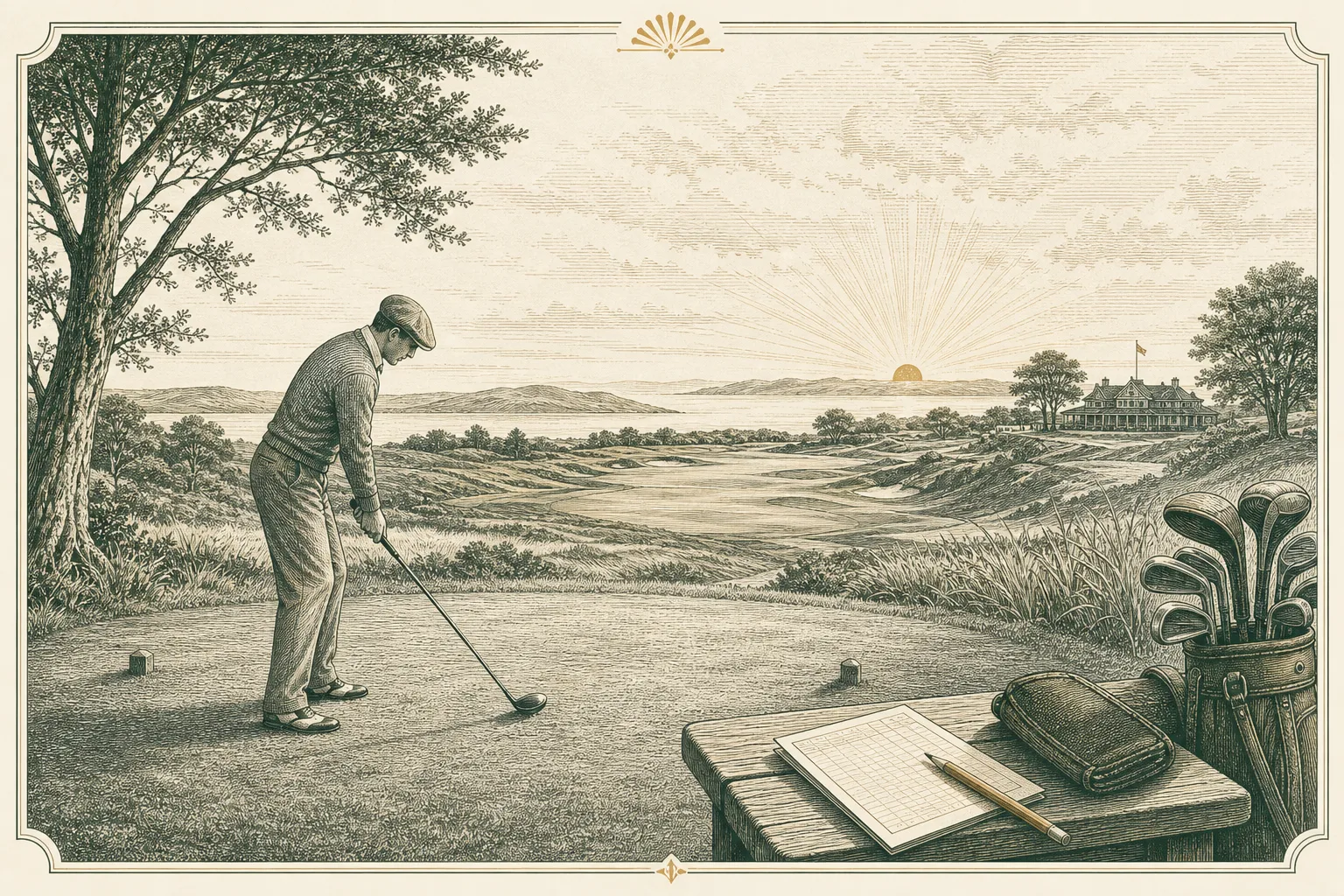
Strip away the lingo and the dress codes and golf is a beautifully simple game: get a ball from a starting point into a hole in the ground, using as few swings as possible, then walk to the next one and do it again. That's it. Rule 1 of the actual Rules of Golf says it in one sentence — golf is played in a round of 18 (or fewer) holes by striking a ball with a club. Everything else — par, birdies, handicaps, the guy in your group muttering about his "gapping" — is layered on top of that simple loop. Let's build it up from zero.
The course: 18 holes, each one a small puzzle
A standard golf course has 18 holes. Each "hole" isn't just the cup in the ground — it's the whole stretch of land from the starting area to that cup, usually somewhere between 100 and 600 yards long. Every hole has the same basic anatomy:
- The tee box (or teeing area): where you start. This is the one place in golf where you're allowed to prop the ball up on a little wooden peg — the tee — to make it easier to hit. Most holes have several sets of tee markers at different distances, so you choose how long the hole plays. There is zero shame in playing forward tees; it's the single fastest way to enjoy golf more.
- The fairway: the mowed-short strip of grass running from tee to green. This is where you want your ball, because short grass makes the next shot much easier.
- The rough: the longer grass on either side of the fairway. Playable, just harder.
- Hazards and bunkers: sand pits, ponds, creeks. They cost you strokes, either by being hard to escape or by forcing a penalty when your ball goes for a swim.
- The green: the ultra-short, super-smooth grass surrounding the hole itself, where you switch to your putter and roll the ball rather than fly it.
So the flow of a single hole is: tee shot, then one or more shots down the fairway, then a shot onto the green, then putts until the ball drops. Then you fish your ball out of the cup, jot down your score, and walk to the next tee.
Par: the number the hole expects from you
Every hole is assigned a par — the number of strokes an expert golfer is expected to need. Par is built on a simple formula: however many shots it should take to reach the green, plus two putts.
- Par 3: a short hole. One shot to the green, two putts.
- Par 4: a medium hole. Two shots to the green, two putts.
- Par 5: a long hole. Three shots to the green, two putts.
Add up the pars of all 18 holes and you get the course par, almost always 70 to 72. That's why you'll hear a professional's score described as "four under" — they took 4 fewer strokes than the course par.
Here's the part nobody tells beginners plainly enough: par is calibrated to expert play. A brand-new golfer shooting 110 or 120 is completely normal — that's roughly 6 strokes over par per hole, and everyone who has ever played started there. Golf's scoring vocabulary hangs off par too: one under par on a hole is a birdie, two under is an eagle, one over is a bogey, two over a double bogey. Your first real goal isn't par — it's bogey. A round of all bogeys is a 90, and a 90 makes you better than most people who play this game.
What "a round" actually is
A round is one complete trip through the course — usually 18 holes, though playing just the front nine or back nine is common and completely legitimate. On a real course, 18 holes takes about four hours walking or riding in a cart; nine holes takes about two. You typically play in a group of two to four people, taking turns: everyone hits their tee shot, then the player farthest from the hole plays next, and so on until everyone's ball is in the cup.
Each player counts every swing they take at the ball — those are your strokes — plus any penalty strokes (for a ball hit into a pond or lost, for example, you generally add one and replay from a designated spot). Whiffs count too, which feels cruel but keeps everyone honest. At the end of each hole you record your number on the scorecard, and at the end of the round you add them up. Lower is better. That single number is your score, and watching it drop over months is one of the most addictive progress bars in sports.
One practical note: you carry up to 14 clubs to handle all these different jobs — long clubs for distance off the tee, irons for approach shots, wedges for short shots near the green, a putter for the green itself. Which club does what is its own topic (we cover it in the clubs guide), but you don't need anywhere near 14 to start.
The formats: three ways to keep score
The Rules recognize two main forms of play, and casual golf adds a beloved third:
- Stroke play: the default. Count every stroke over 18 holes; lowest total wins. This is what you see on the PGA Tour most weeks. Its personality: relentless. One disaster hole sits on your card forever.
- Match play: you play head-to-head, hole by hole. Win a hole by scoring lower on it; whoever wins the most holes wins the match. Its personality: forgiving and feisty. Take a 9 on a hole? You only lost that one hole — you're "1 down," not buried. The Ryder Cup is match play, which is why it's such theater.
- Scramble: the team format of charity events and buddies' trips. Everyone hits, the team picks the best ball, everyone hits again from there. If you're new, a scramble is the best possible first taste of real golf — your bad shots simply vanish and your occasional great one counts.
If someone invites you to play, it's worth asking which format — it genuinely changes how you should think.
Why this all clicks faster in a sim bay
Here's the honest advantage of learning this indoors: a simulator collapses the intimidating parts. In a GSPro bay you play real, faithfully rendered courses — tee box, fairway, rough, bunkers, greens, the whole anatomy above — but nobody is waiting behind you, weather doesn't exist, and a lost ball costs you nothing. A full 18 takes an hour or so instead of four, and the launch monitor quietly shows you exactly how far each club goes, which on a real course you'd spend a full season guessing at. You can play stroke play against your own last round, match play against a friend in the next bay, or a two-person scramble on your first visit ever.
So that's the game: 18 small puzzles, count your strokes, lower is better, and par is the measuring stick — not the entry fee. Everything else you'll pick up one round at a time.
From the glossary
Related reading: Scoring and Handicaps, Explained · The 14 Clubs in Your Bag (and What Each Is For) · Etiquette and Pace: How Not to Feel Lost Out There · Your First Time in a Sim Bay

The Most Forgiving Drivers of the 2010s, Ranked by the Data
From roughly 2014 to 2019, every major manufacturer spent its entire driver budget chasing one number: MOI — how much the head resists twisting when you miss the middle. Carbon crowns, tungsten back weights, faces engineered to fight your specific mishit. Those flagships were the most forgiving drivers ever built to that point, and forgiveness does not expire. Your heel strike in 2026 is the same heel strike it was in 2018, and a head that held ball speed on it then holds ball speed on it now.