
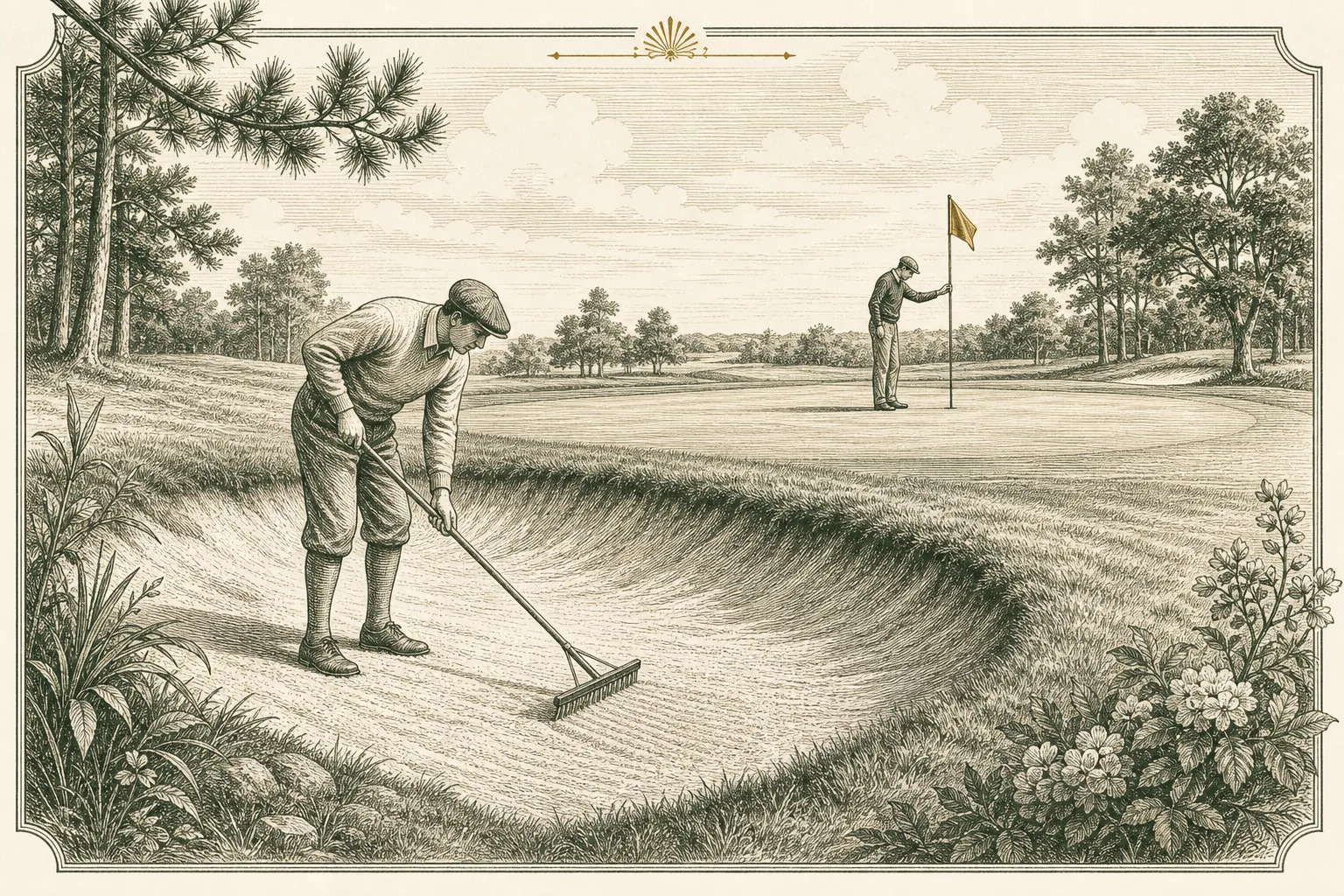
Here's the secret that nobody tells new golfers: the people you're worried about judging you are not judging your swing. Nobody cares if you top one off the first tee. What experienced golfers actually notice — the only things they notice — are whether you keep up, whether you're safe to be around, and whether you leave the course the way you found it. Get those three right and you can shoot 120 with a smile and be welcomed back anywhere. Get them wrong and you can shoot 75 and still be the person nobody wants to play with.
So let's separate the etiquette that actually matters from the stuffy folklore, because there's a lot of folklore.
Pace is 90% of etiquette
If you remember one thing from this article, make it this: your job is not to play fast, it's to keep up with the group in front of you. Those are different things. You can take three swings to their one and still keep pace, because most of a slow round isn't swinging — it's standing around.
The math backs this up. The USGA's own guidance says a stroke should take no more than 40 seconds once it's your turn, and both the USGA and R&A formally endorse "ready golf" — hitting when you're ready and it's safe, rather than strictly honoring who's "away." A four-hour round for a foursome is the widely used target, and the average round has crept past 4:30 mostly because of dead time, not bad golf.
Here's how to be a fast golfer without rushing a single swing:
- Think while you walk. Pick your club, read the wind, and plan the shot on the way to your ball, not after you arrive. When it's your turn, you hit.
- Play ready golf. If you're ready and the other person isn't, go (as long as it's safe). This is officially encouraged, not rude.
- Pick up when the hole has gone sideways. In casual golf, once you've hit your personal max — say, double par — pick up the ball, write down the max, and move on. This is exactly how most handicap scoring works anyway, so you're not even "cheating."
- Park smart. Leave your bag or cart on the side of the green closest to the next tee, so you walk off in the right direction.
- Do your bookkeeping on the next tee. Don't stand on the green writing down scores while the group behind waits in the fairway.
Safety and where to stand
This is the one area where etiquette isn't optional, because a golf ball leaves the face at over 150 mph and a swung club is a weapon. The Rules of Golf themselves (Rule 1.2) call out safety as a core standard of player conduct, not a nicety.
The rules of thumb:
- Never stand ahead of someone hitting. Ever. The safe zone is behind the player and off to the side, ideally facing them — roughly where they can see you.
- Give the swing a wide berth. Practice swings fling clubheads, turf, and the occasional rock. Two club-lengths of clearance minimum.
- Yell "Fore!" if your ball is heading toward anyone. Loudly, immediately, without embarrassment. A bruised ego beats a bruised skull.
- Don't hit until the group ahead is clearly out of range. When in doubt, wait. "I didn't think I could reach them" is the most famous last sentence in golf.
On the green, the fussier version of "where to stand" is about lines: try not to walk directly on the line between someone's ball and the hole, and don't stand directly behind their line while they putt. The first one is a real courtesy (spike marks and footprints matter on greens); the second one matters more to some people than others. If you just stand still and quiet while others putt, you're fine.
Leave the course better than you found it
Three habits, ten seconds each:
- Fix your ball mark on the green (and one more if you see it). A ball landing on a soft green leaves a crater; repaired promptly it heals in a day, ignored it takes weeks.
- Replace or fill your divots in the fairway, depending on what the course wants (some provide sand bottles; use them).
- Rake the bunker after you've been in it, and leave the rake where the course leaves them.
That's it. That's the whole "care of the course" chapter. It's also literally written into Rule 1.2 as expected conduct, so this isn't just tradition — it's the game's actual definition of playing it right.
The stuffy stuff you can ignore
Now for the myths that keep new golfers anxious for no reason:
- "You need to look like a golfer." You need to meet the course's dress code, which at most public courses means a collared or athletic shirt and no denim — and at plenty of places, less than that. Nobody is grading your outfit beyond that.
- "You must putt everything out and play by every rule." In a casual round, picking up, taking a breakfast-ball mulligan off the first tee, or bumping your ball out of an old divot are normal. Save strict rules for competition.
- "Silence at all times." Talk, laugh, have fun. The only rule is: be still and quiet during someone's actual swing or putt.
- "Honors on every tee." Strict order of play is for match play and tournaments. Ready golf is the modern default, endorsed by the governing bodies themselves.
- "Being a beginner is an imposition." It isn't. A beginner who keeps pace is a better playing partner than a scratch golfer who takes four practice swings and lines up putts from three angles.
Sim-bay etiquette (yes, it exists)
A simulator bay compresses all of the above into one room, and it has its own small code. If you're sharing a bay at Clubhouse — a league night, a group of four on a Saturday — here's the version that makes you a great bay-mate:
- One person in the hitting zone at a time. Everyone else stays behind the hitter, outside the swing arc. A clubhead moving 100 mph doesn't care that you're indoors. This is the "where to stand" rule with walls.
- Wait for the shot to register. Launch monitors need a beat to process. Stepping in while the previous shot is still tracing gets you a mis-read — or a ball off the shin.
- Keep a rhythm, not a queue. The sim equivalent of ready golf: be teed up and thinking about your shot while the person before you hits, so the bay never sits idle. Four players who rotate briskly can play a full GSPro 18 in a couple of hours; four players who each treat every shot like the 72nd at Augusta will run out the clock on the front nine.
- Respect the setup. If someone dialed in their tee height, alignment sticks, or monitor settings, put things back the way you found them when it's your turn.
- Mind the shared surface. Same green-care instinct, different turf: don't slam clubs into the hitting strip, and brush off the mat if you've been dragging range balls through it.
Honestly, a sim bay is the best etiquette classroom there is. The pace habits — plan while you wait, hit when you're ready, keep the rotation moving — transfer directly to the course, and you get to build them somewhere air-conditioned where nobody's waiting in the fairway behind you.
Your pocket cheat sheet
Keep up with the group ahead. Stand behind the person hitting. Yell "Fore!" when needed. Fix your marks, fill your divots, rake your sand. Be still during swings, human the rest of the time. Pick up when a hole blows up. And ignore anyone who makes golf etiquette sound like a licensing exam — the whole thing fits on a napkin, and every good golfer you meet learned it by doing exactly what you're doing now: showing up and paying attention.
Related reading: How a Round of Golf Actually Works · Your First Time in a Sim Bay · Scoring and Handicaps, Explained · How to Pick a Beginner-Friendly Course

The Most Forgiving Drivers of the 2010s, Ranked by the Data
From roughly 2014 to 2019, every major manufacturer spent its entire driver budget chasing one number: MOI — how much the head resists twisting when you miss the middle. Carbon crowns, tungsten back weights, faces engineered to fight your specific mishit. Those flagships were the most forgiving drivers ever built to that point, and forgiveness does not expire. Your heel strike in 2026 is the same heel strike it was in 2018, and a head that held ball speed on it then holds ball speed on it now.