
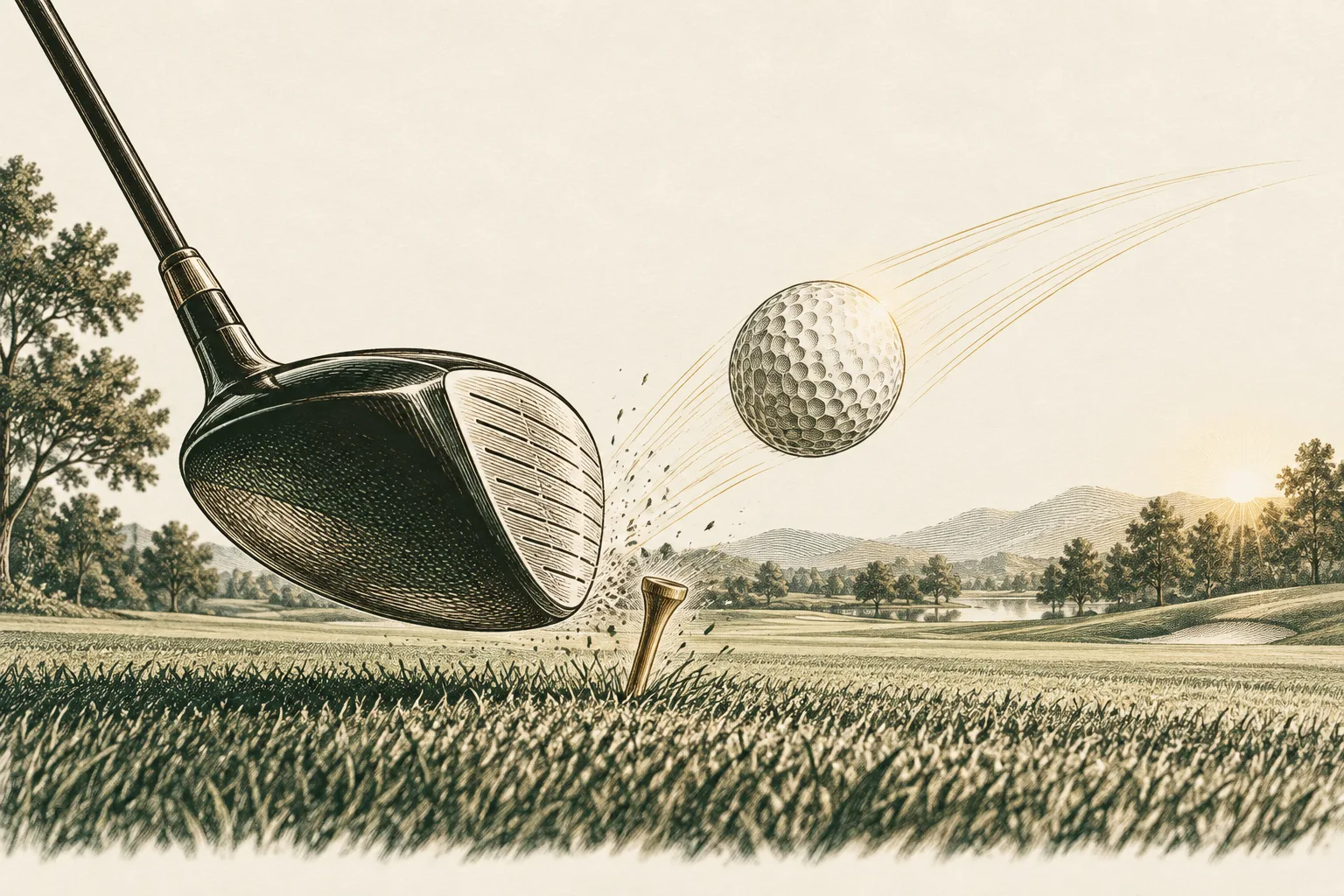
Open your Records tab and one number is always there: ball speed. Club speed can be missing. Smash factor can be missing. Even the club name can be missing. But the speed the ball left the face is measured on every single shot you hit in a bay, which makes it the honest backbone of your record wall — and it happens to be the number that decides how far the ball can possibly go.
If you want the definitions — what club speed, ball speed and smash factor are and how the three fit together — read Ball Speed, Club Speed, and Smash Factor first. This piece goes one level deeper on ball speed alone: what one mile an hour is worth, where your number sits, and where your next one is hiding.
What one more mile an hour buys
TrackMan's own phrasing is worth quoting exactly: "Gaining 1 mph of Ball Speed can increase your driver distance by up to 2 yards." Up to. That's a ceiling on a well-launched drive, not a receipt. But as a working rule, two yards per mile an hour with a driver is close enough to plan with, and it turns an abstract speed into something you can feel.
Do the arithmetic once. Five mph of ball speed is about ten yards — a full club. Ten mph is twenty, which is the difference between laying up and having a look at the green. So when you're chasing distance, ball speed is the line to watch, not the club-speed line above it.
One limit: two yards per mph is a driver number, riding on driver launch and spin. A mile an hour on a wedge doesn't buy two yards, because a wedge is deliberately spending its energy on height and spin instead. Use the rule where it was measured — at the top of the bag.
Where your number actually sits
There are two honest ways to place yourself on the rail.
The first is the tour. TrackMan's classic PGA Tour driver averages put a pro at 113 mph of club speed and 167 mph of ball speed — that's the brass mark on your plate, labeled with its source. TrackMan's current published tour figure is higher: 171 mph. Both are real; the tour simply got faster. So treat "tour average" as a band from about 167 to 171 rather than a line in the sand, and don't agonize over three miles an hour either side of it.
The second is the round numbers: 150, 160, 170, 180. They're arbitrary, and they're also the ones golfers actually feel. Crossing 150 is a real event. 160 is a strong amateur driver. 170 puts you past the classic tour average — not past the tour, past the average of the tour — a slightly ridiculous sentence to get to write about yourself. Your plate shows the next round number up and how far you are from it.
The plate also carries a few everyday speeds for scale: the fastest you're legally allowed to drive on a Florida interstate is 70 mph, and the average four-seam fastball in the majors sits around 94 mph. A golf ball at 161 mph isn't in the same conversation as either. Those are everyday landmarks, there to give the rail a human floor — not golf references, and they say nothing about your swing.
The one number the bay always sees
A photometric launch monitor watches the ball. Its cameras are aimed at the strike, and what they measure directly is the ball coming off the face — speed, launch angle, spin. That's why ball speed is captured on essentially every shot hit at Clubhouse and is never blank.
Club speed is a different problem. To read the club — how fast it was moving, where on the face you caught it, how it was delivered — the monitor has to see the club, and that means the small Foresight markers that go on the face. No markers, no club speed. And no club speed means no smash factor either, since smash is just ball speed divided by club speed. In practice most shots come back without it: our session files are missing club speed on roughly 94% of shots, and shots recovered through the GSPro proxy carry no club data at all.
So when the plate says "Club speed needs a marker on the club; this swing had none," that isn't the app being coy. It's the plate refusing to print a number nothing measured. Markers are free at the front desk, go on once, and switch on club speed, smash factor and per-club strike quality for good.
Two ways to make it bigger — one of them is free
Swing faster, or strike it better. Swinging faster works, and it costs you: weeks of speed training, some money, and a nonzero injury risk if you go at it stupidly. Striking it better costs nothing and pays on the next swing.
Watch what that's worth. At 100 mph of club speed, a 1.40 strike gives you 140 mph of ball speed. The same 100 mph swing at 1.47 gives you 147 — seven miles an hour, about fourteen yards, for no extra effort. To find those same seven through speed alone you'd have to get your swing up to 105 and keep it there. One of those takes a season; the other takes a bucket of balls and honest feedback. Check the cheap lever before you pay for the expensive one.
When the cheap lever is already spent
Now the interesting case: say your best ball speed came off a swing with a 1.48 smash factor. The rules cap how springy a driver face may be, which is why roughly 1.50 is the practical ceiling — TrackMan's guidance is to hope for a smash near 1.50 with a driver. A 1.48 means you're essentially at it.
Good news, and a narrower road. You aren't leaving contact yards on the table — there are barely any left to leave. Your remaining ball speed has to come from the engine — actual club speed — or from launch and spin conditions that let the speed you have carry further: speed work, a driver genuinely fitted to you, a ball that suits your delivery. It also means you can stop grinding center-strike drills for distance. You already won that one.
The opposite reading is the happy one. A high ball speed sitting on a 1.40 smash is a big engine with a leaky transmission — the best news on your record wall, because those are the cheapest yards in golf and they're right there.
The short version
Ball speed is the engine, and it's the one record that can never be blank. A mile an hour is worth roughly two yards with a driver. The tour band is 167 to 171; 150, 160, 170 and 180 are the doors you walk through on the way. When you want more of it, ask the smash factor question first — the free lever is only free until you've pulled it.
From the glossary
Related reading: Ball Speed, Club Speed, and Smash Factor · Purest Strike: why 1.49 with a driver and 1.22 with a wedge are both perfect

The Most Forgiving Drivers of the 2010s, Ranked by the Data
From roughly 2014 to 2019, every major manufacturer spent its entire driver budget chasing one number: MOI — how much the head resists twisting when you miss the middle. Carbon crowns, tungsten back weights, faces engineered to fight your specific mishit. Those flagships were the most forgiving drivers ever built to that point, and forgiveness does not expire. Your heel strike in 2026 is the same heel strike it was in 2018, and a head that held ball speed on it then holds ball speed on it now.